

60
2 The Interaction of Electromagnetic Waves with Water
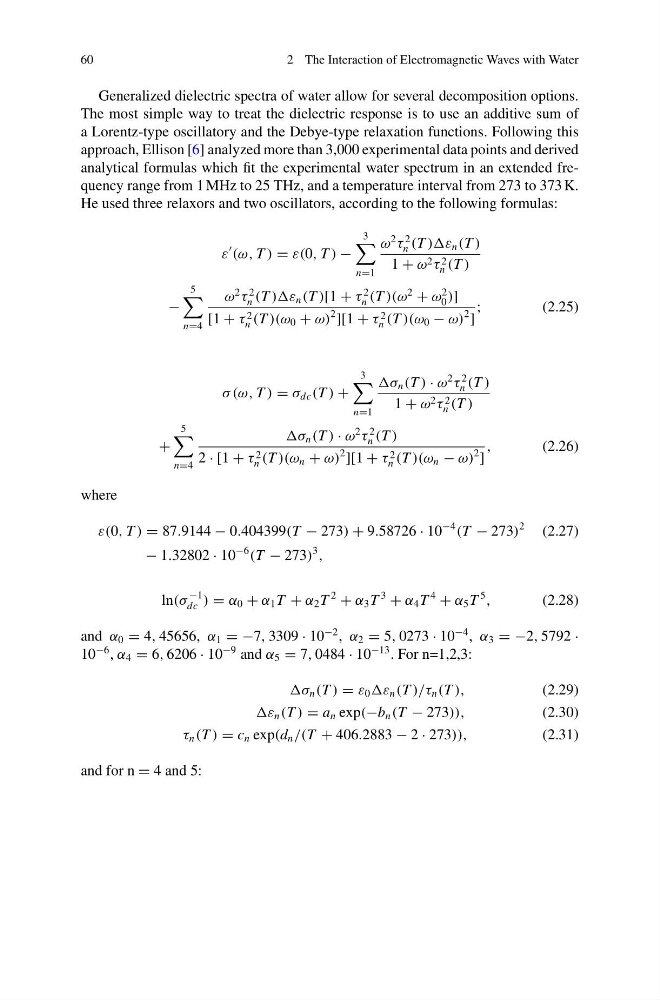
Generalized dielectric spectra of water allow for several decomposition options.
The most simple way to treat the dielectric response is to use an additive sum of
a Lorentz-type oscillatory and the Debye-type relaxation functions. Following this
approach, Ellison [6] analyzed more than 3,000 experimental data points and derived
analytical formulas which fit the experimental water spectrum in an extended frequency range from 1 MHz to 25 THz, and a temperature interval from 273 to 373 K.
He used three relaxors and two oscillators, according to the following formulas:
ε
(ω, T ) = ε(0, T ) −
3
n=1
ω
2
τ
2
n (T ))ε n (T )
1 + ω 2 τ 2
n (T )
−
5
n=4
ω
2
τ
2
n (T ))ε n (T )[1 + τ
2
n (T )(ω
2
+ ω
2
0 )]
[1 + τ 2
n (T )(ω 0 + ω)
2
][1 + τ 2
n (T )(ω 0 − ω)
2
]
;
(2.25)
σ (ω, T ) = σ dc (T ) +
3
n=1
σ n (T ) · ω
2
τ
2
n (T )
1 + ω 2 τ 2
n (T )
+
5
n=4
σ n (T ) · ω
2
τ
2
n (T )
2 · [1 + τ 2
n (T )(ω n + ω)
2
][1 + τ 2
n (T )(ω n − ω)
2
]
,
(2.26)
where
ε(0, T ) = 87.9144 − 0.404399(T − 273) + 9.58726 · 10
−4
(T − 273)
2
(2.27)
− 1.32802 · 10
−6
(T − 273)
3
,
ln(σ
−1
dc ) = α 0 + α 1 T + α 2 T
2
+ α 3 T
3
+ α 4 T
4
+ α 5 T
5
,
(2.28)
and α 0 = 4, 45656, α 1 = −7, 3309 · 10
−2 , α 2 = 5, 0273 · 10
−4 , α 3 = −2, 5792 ·
10
−6 , α 4 = 6, 6206 · 10
−9 and α 5 = 7, 0484 · 10
−13 . For n=1,2,3:
σ n (T ) = ε 0 ε n (T )/τ n (T ),
(2.29)
ε n (T ) = a n exp(−b n (T − 273)),
(2.30)
τ n (T ) = c n exp(d n /(T + 406.2883 − 2 · 273)),
(2.31)
and for n = 4 and 5:
2 The Interaction of Electromagnetic Waves with Water
Generalized dielectric spectra of water allow for several decomposition options.
The most simple way to treat the dielectric response is to use an additive sum of
a Lorentz-type oscillatory and the Debye-type relaxation functions. Following this
approach, Ellison [6] analyzed more than 3,000 experimental data points and derived
analytical formulas which fit the experimental water spectrum in an extended frequency range from 1 MHz to 25 THz, and a temperature interval from 273 to 373 K.
He used three relaxors and two oscillators, according to the following formulas:
ε
(ω, T ) = ε(0, T ) −
3
n=1
ω
2
τ
2
n (T ))ε n (T )
1 + ω 2 τ 2
n (T )
−
5
n=4
ω
2
τ
2
n (T ))ε n (T )[1 + τ
2
n (T )(ω
2
+ ω
2
0 )]
[1 + τ 2
n (T )(ω 0 + ω)
2
][1 + τ 2
n (T )(ω 0 − ω)
2
]
;
(2.25)
σ (ω, T ) = σ dc (T ) +
3
n=1
σ n (T ) · ω
2
τ
2
n (T )
1 + ω 2 τ 2
n (T )
+
5
n=4
σ n (T ) · ω
2
τ
2
n (T )
2 · [1 + τ 2
n (T )(ω n + ω)
2
][1 + τ 2
n (T )(ω n − ω)
2
]
,
(2.26)
where
ε(0, T ) = 87.9144 − 0.404399(T − 273) + 9.58726 · 10
−4
(T − 273)
2
(2.27)
− 1.32802 · 10
−6
(T − 273)
3
,
ln(σ
−1
dc ) = α 0 + α 1 T + α 2 T
2
+ α 3 T
3
+ α 4 T
4
+ α 5 T
5
,
(2.28)
and α 0 = 4, 45656, α 1 = −7, 3309 · 10
−2 , α 2 = 5, 0273 · 10
−4 , α 3 = −2, 5792 ·
10
−6 , α 4 = 6, 6206 · 10
−9 and α 5 = 7, 0484 · 10
−13 . For n=1,2,3:
σ n (T ) = ε 0 ε n (T )/τ n (T ),
(2.29)
ε n (T ) = a n exp(−b n (T − 273)),
(2.30)
τ n (T ) = c n exp(d n /(T + 406.2883 − 2 · 273)),
(2.31)
and for n = 4 and 5: