

54
2 The Interaction of Electromagnetic Waves with Water
Hence, the integral (or area under the curve of the frequency-dependent dynamic
conductivity σ (ω)) is proportional to the concentration of the charges per unit, and
one can find this concentration has a broadband spectrum (see Sect. 2.7 for further
details).
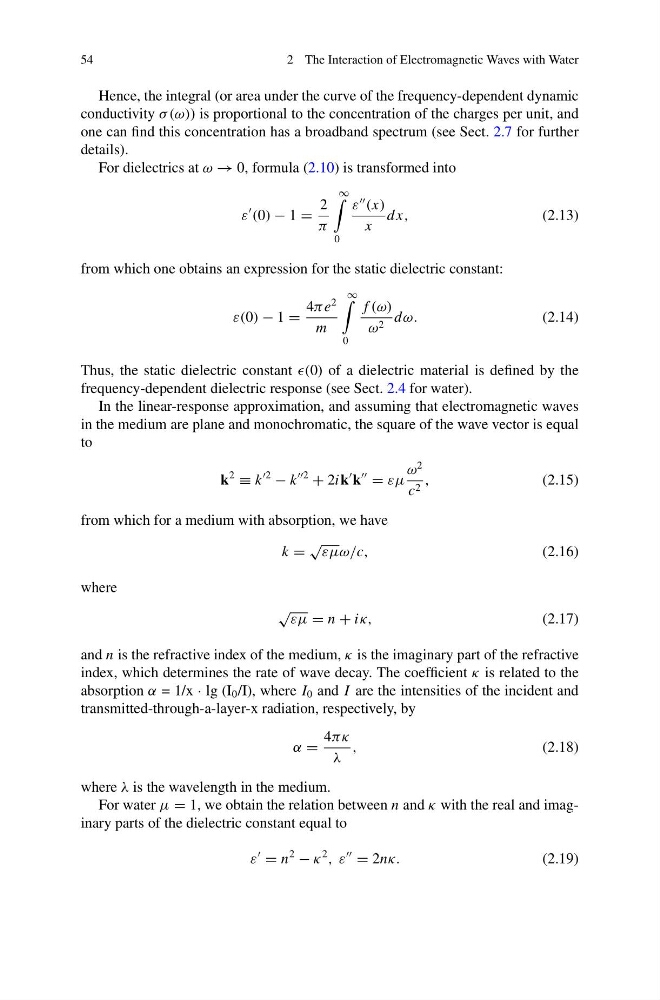
For dielectrics at ω → 0, formula (2.10) is transformed into
ε
(0) − 1 =
2
π
∞
0
ε
(x)
x
dx,
(2.13)
from which one obtains an expression for the static dielectric constant:
ε(0) − 1 =
4π e
2
m
∞
0
f (ω)
ω 2 dω.
(2.14)
Thus, the static dielectric constant (0) of a dielectric material is defined by the
frequency-dependent dielectric response (see Sect. 2.4 for water).
In the linear-response approximation, and assuming that electromagnetic waves
in the medium are plane and monochromatic, the square of the wave vector is equal
to
k
2
≡ k
2
− k
2
+ 2ik
k
= εμ
ω
2
c 2 ,
(2.15)
from which for a medium with absorption, we have
k =
√ εμω/c,
(2.16)
where
√
εμ = n + iκ,
(2.17)
and n is the refractive index of the medium, κ is the imaginary part of the refractive
index, which determines the rate of wave decay. The coefficient κ is related to the
absorption α = 1/x · lg (I 0 /I), where I 0 and I are the intensities of the incident and
transmitted-through-a-layer-x radiation, respectively, by
α =
4πκ
λ
,
(2.18)
where λ is the wavelength in the medium.
For water μ = 1, we obtain the relation between n and κ with the real and imaginary parts of the dielectric constant equal to
ε
= n
2
− κ
2
, ε
= 2nκ.
(2.19)
2 The Interaction of Electromagnetic Waves with Water
Hence, the integral (or area under the curve of the frequency-dependent dynamic
conductivity σ (ω)) is proportional to the concentration of the charges per unit, and
one can find this concentration has a broadband spectrum (see Sect. 2.7 for further
details).
For dielectrics at ω → 0, formula (2.10) is transformed into
ε
(0) − 1 =
2
π
∞
0
ε
(x)
x
dx,
(2.13)
from which one obtains an expression for the static dielectric constant:
ε(0) − 1 =
4π e
2
m
∞
0
f (ω)
ω 2 dω.
(2.14)
Thus, the static dielectric constant (0) of a dielectric material is defined by the
frequency-dependent dielectric response (see Sect. 2.4 for water).
In the linear-response approximation, and assuming that electromagnetic waves
in the medium are plane and monochromatic, the square of the wave vector is equal
to
k
2
≡ k
2
− k
2
+ 2ik
k
= εμ
ω
2
c 2 ,
(2.15)
from which for a medium with absorption, we have
k =
√ εμω/c,
(2.16)
where
√
εμ = n + iκ,
(2.17)
and n is the refractive index of the medium, κ is the imaginary part of the refractive
index, which determines the rate of wave decay. The coefficient κ is related to the
absorption α = 1/x · lg (I 0 /I), where I 0 and I are the intensities of the incident and
transmitted-through-a-layer-x radiation, respectively, by
α =
4πκ
λ
,
(2.18)
where λ is the wavelength in the medium.
For water μ = 1, we obtain the relation between n and κ with the real and imaginary parts of the dielectric constant equal to
ε
= n
2
− κ
2
, ε
= 2nκ.
(2.19)