

1.4 Self-diffusion by Isotopic Tracers
29
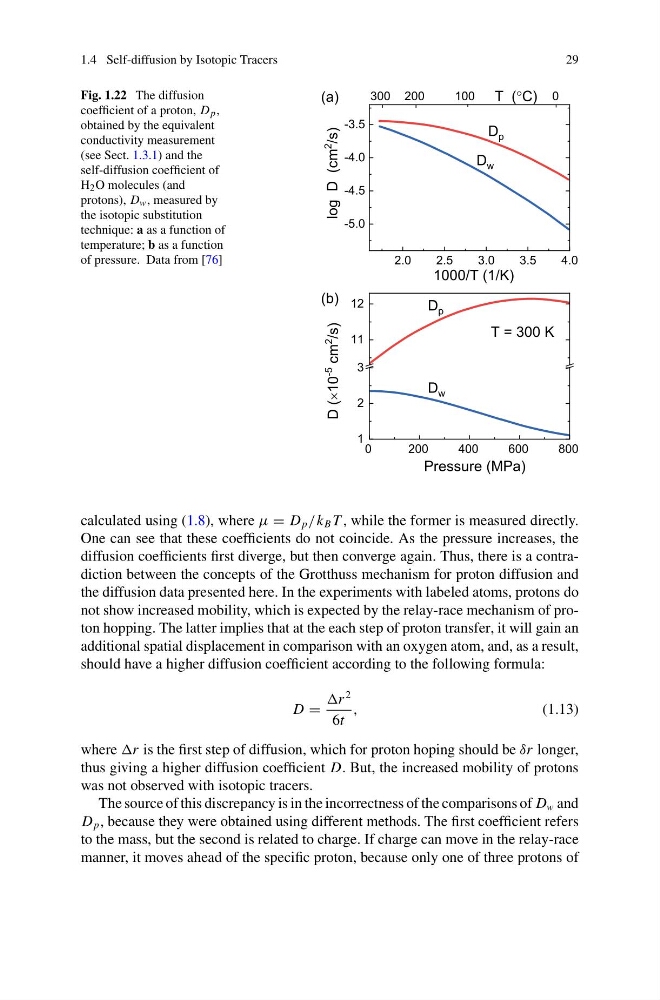
Fig. 1.22 The diffusion
coefficient of a proton, D p ,
obtained by the equivalent
conductivity measurement
(see Sect. 1.3.1) and the
self-diffusion coefficient of
H 2 O molecules (and
protons), D w , measured by
the isotopic substitution
technique: a as a function of
temperature; b as a function
of pressure. Data from [76]
calculated using (1.8), where μ = D p /k B T , while the former is measured directly.
One can see that these coefficients do not coincide. As the pressure increases, the
diffusion coefficients first diverge, but then converge again. Thus, there is a contradiction between the concepts of the Grotthuss mechanism for proton diffusion and
the diffusion data presented here. In the experiments with labeled atoms, protons do
not show increased mobility, which is expected by the relay-race mechanism of proton hopping. The latter implies that at the each step of proton transfer, it will gain an
additional spatial displacement in comparison with an oxygen atom, and, as a result,
should have a higher diffusion coefficient according to the following formula:
D =
2
6t
,
(1.13)
where is the first step of diffusion, which for proton hoping should be δr longer,
thus giving a higher diffusion coefficient D. But, the increased mobility of protons
was not observed with isotopic tracers.
The source of this discrepancy is in the incorrectness of the comparisons of D w and
D p , because they were obtained using different methods. The first coefficient refers
to the mass, but the second is related to charge. If charge can move in the relay-race
manner, it moves ahead of the specific proton, because only one of three protons of
29
Fig. 1.22 The diffusion
coefficient of a proton, D p ,
obtained by the equivalent
conductivity measurement
(see Sect. 1.3.1) and the
self-diffusion coefficient of
H 2 O molecules (and
protons), D w , measured by
the isotopic substitution
technique: a as a function of
temperature; b as a function
of pressure. Data from [76]
calculated using (1.8), where μ = D p /k B T , while the former is measured directly.
One can see that these coefficients do not coincide. As the pressure increases, the
diffusion coefficients first diverge, but then converge again. Thus, there is a contradiction between the concepts of the Grotthuss mechanism for proton diffusion and
the diffusion data presented here. In the experiments with labeled atoms, protons do
not show increased mobility, which is expected by the relay-race mechanism of proton hopping. The latter implies that at the each step of proton transfer, it will gain an
additional spatial displacement in comparison with an oxygen atom, and, as a result,
should have a higher diffusion coefficient according to the following formula:
D =
2
6t
,
(1.13)
where is the first step of diffusion, which for proton hoping should be δr longer,
thus giving a higher diffusion coefficient D. But, the increased mobility of protons
was not observed with isotopic tracers.
The source of this discrepancy is in the incorrectness of the comparisons of D w and
D p , because they were obtained using different methods. The first coefficient refers
to the mass, but the second is related to charge. If charge can move in the relay-race
manner, it moves ahead of the specific proton, because only one of three protons of