

26
1 A Historical Review of the Structures of Water and Ice
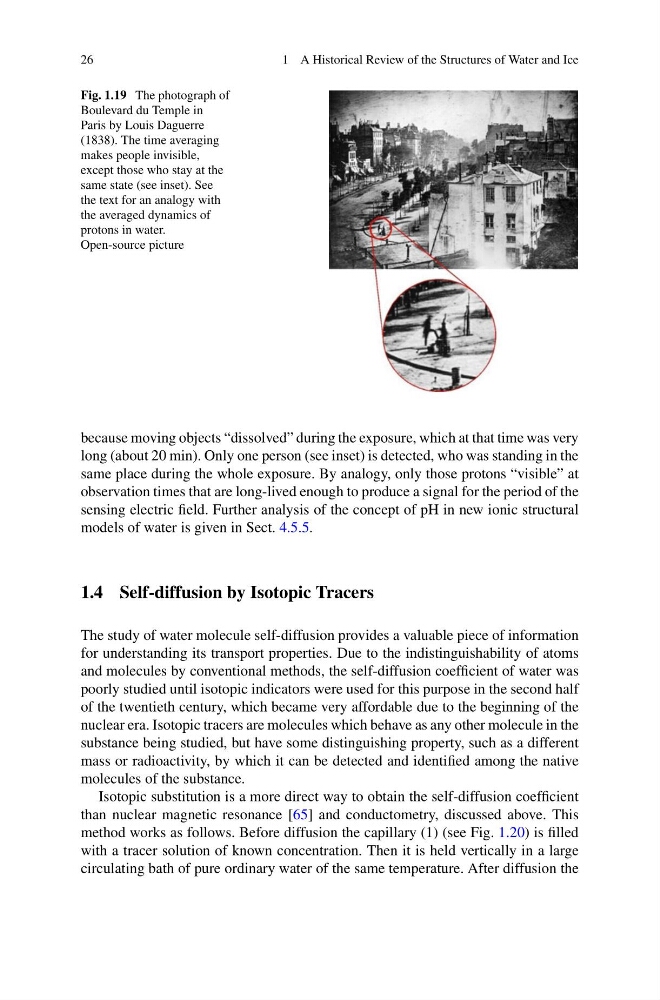
Fig. 1.19 The photograph of
Boulevard du Temple in
Paris by Louis Daguerre
(1838). The time averaging
makes people invisible,
except those who stay at the
same state (see inset). See
the text for an analogy with
the averaged dynamics of
protons in water.
Open-source picture
because moving objects “dissolved” during the exposure, which at that time was very
long (about 20 min). Only one person (see inset) is detected, who was standing in the
same place during the whole exposure. By analogy, only those protons “visible” at
observation times that are long-lived enough to produce a signal for the period of the
sensing electric field. Further analysis of the concept of pH in new ionic structural
models of water is given in Sect. 4.5.5.
1.4 Self-diffusion by Isotopic Tracers
The study of water molecule self-diffusion provides a valuable piece of information
for understanding its transport properties. Due to the indistinguishability of atoms
and molecules by conventional methods, the self-diffusion coefficient of water was
poorly studied until isotopic indicators were used for this purpose in the second half
of the twentieth century, which became very affordable due to the beginning of the
nuclear era. Isotopic tracers are molecules which behave as any other molecule in the
substance being studied, but have some distinguishing property, such as a different
mass or radioactivity, by which it can be detected and identified among the native
molecules of the substance.
Isotopic substitution is a more direct way to obtain the self-diffusion coefficient
than nuclear magnetic resonance [65] and conductometry, discussed above. This
method works as follows. Before diffusion the capillary (1) (see Fig. 1.20) is filled
with a tracer solution of known concentration. Then it is held vertically in a large
circulating bath of pure ordinary water of the same temperature. After diffusion the
1 A Historical Review of the Structures of Water and Ice
Fig. 1.19 The photograph of
Boulevard du Temple in
Paris by Louis Daguerre
(1838). The time averaging
makes people invisible,
except those who stay at the
same state (see inset). See
the text for an analogy with
the averaged dynamics of
protons in water.
Open-source picture
because moving objects “dissolved” during the exposure, which at that time was very
long (about 20 min). Only one person (see inset) is detected, who was standing in the
same place during the whole exposure. By analogy, only those protons “visible” at
observation times that are long-lived enough to produce a signal for the period of the
sensing electric field. Further analysis of the concept of pH in new ionic structural
models of water is given in Sect. 4.5.5.
1.4 Self-diffusion by Isotopic Tracers
The study of water molecule self-diffusion provides a valuable piece of information
for understanding its transport properties. Due to the indistinguishability of atoms
and molecules by conventional methods, the self-diffusion coefficient of water was
poorly studied until isotopic indicators were used for this purpose in the second half
of the twentieth century, which became very affordable due to the beginning of the
nuclear era. Isotopic tracers are molecules which behave as any other molecule in the
substance being studied, but have some distinguishing property, such as a different
mass or radioactivity, by which it can be detected and identified among the native
molecules of the substance.
Isotopic substitution is a more direct way to obtain the self-diffusion coefficient
than nuclear magnetic resonance [65] and conductometry, discussed above. This
method works as follows. Before diffusion the capillary (1) (see Fig. 1.20) is filled
with a tracer solution of known concentration. Then it is held vertically in a large
circulating bath of pure ordinary water of the same temperature. After diffusion the