

1.3 Direct Current Conductivity and pH of Water
19
assumed that H
+ (H 3 O
+ ) and OH
− ions do not interact with each other,
13 and calculated the concentration, which corresponds to the observed conductivity level, using
the following equation:
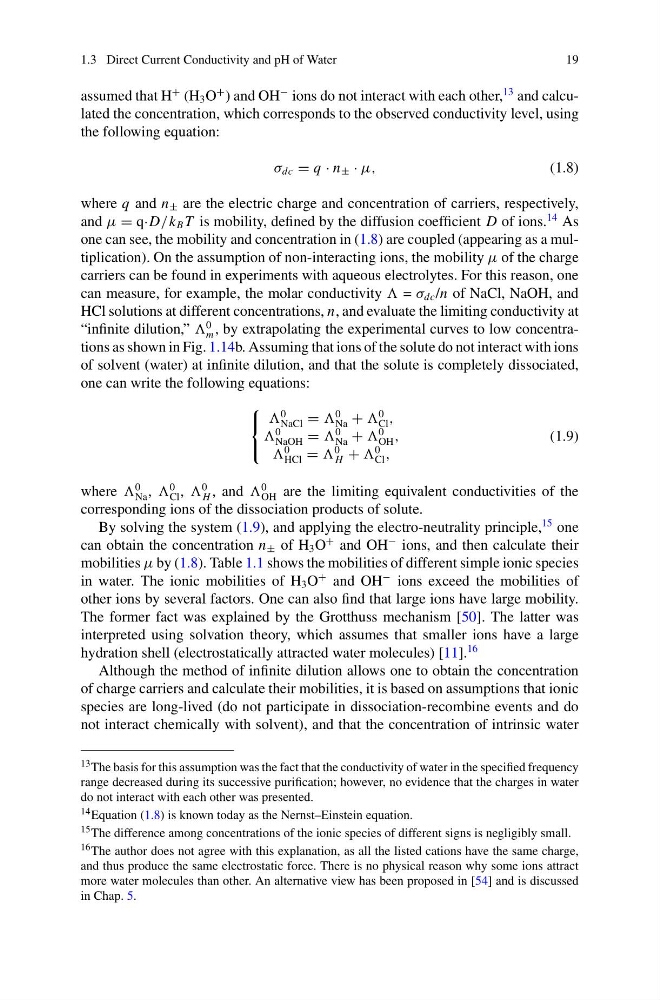
σ dc = q · n ± · μ,
(1.8)
where q and n ± are the electric charge and concentration of carriers, respectively,
and μ = q·D/k B T is mobility, defined by the diffusion coefficient D of ions.
14 As
one can see, the mobility and concentration in (1.8) are coupled (appearing as a multiplication). On the assumption of non-interacting ions, the mobility μ of the charge
carriers can be found in experiments with aqueous electrolytes. For this reason, one
can measure, for example, the molar conductivity = σ dc /n of NaCl, NaOH, and
HCl solutions at different concentrations, n, and evaluate the limiting conductivity at
“infinite dilution,”
0
m , by extrapolating the experimental curves to low concentrations as shown in Fig. 1.14b. Assuming that ions of the solute do not interact with ions
of solvent (water) at infinite dilution, and that the solute is completely dissociated,
one can write the following equations:
⎧
⎨
⎩
0
NaCl =
0
Na +
0
Cl ,
0
NaOH =
0
Na +
0
OH ,
0
HCl =
0
H +
0
Cl ,
(1.9)
where
0
Na ,
0
Cl ,
0
H , and
0
OH are the limiting equivalent conductivities of the
corresponding ions of the dissociation products of solute.
By solving the system (1.9), and applying the electro-neutrality principle,
15 one
can obtain the concentration n ± of H 3 O
+ and OH
− ions, and then calculate their
mobilities μ by (1.8). Table 1.1 shows the mobilities of different simple ionic species
in water. The ionic mobilities of H 3 O
+ and OH
− ions exceed the mobilities of
other ions by several factors. One can also find that large ions have large mobility.
The former fact was explained by the Grotthuss mechanism [50]. The latter was
interpreted using solvation theory, which assumes that smaller ions have a large
hydration shell (electrostatically attracted water molecules) [11].
16
Although the method of infinite dilution allows one to obtain the concentration
of charge carriers and calculate their mobilities, it is based on assumptions that ionic
species are long-lived (do not participate in dissociation-recombine events and do
not interact chemically with solvent), and that the concentration of intrinsic water
13 The basis for this assumption was the fact that the conductivity of water in the specified frequency
range decreased during its successive purification; however, no evidence that the charges in water
do not interact with each other was presented.
14 Equation (1.8) is known today as the Nernst–Einstein equation.
15 The difference among concentrations of the ionic species of different signs is negligibly small.
16 The author does not agree with this explanation, as all the listed cations have the same charge,
and thus produce the same electrostatic force. There is no physical reason why some ions attract
more water molecules than other. An alternative view has been proposed in [54] and is discussed
in Chap. 5.
19
assumed that H
+ (H 3 O
+ ) and OH
− ions do not interact with each other,
13 and calculated the concentration, which corresponds to the observed conductivity level, using
the following equation:
σ dc = q · n ± · μ,
(1.8)
where q and n ± are the electric charge and concentration of carriers, respectively,
and μ = q·D/k B T is mobility, defined by the diffusion coefficient D of ions.
14 As
one can see, the mobility and concentration in (1.8) are coupled (appearing as a multiplication). On the assumption of non-interacting ions, the mobility μ of the charge
carriers can be found in experiments with aqueous electrolytes. For this reason, one
can measure, for example, the molar conductivity = σ dc /n of NaCl, NaOH, and
HCl solutions at different concentrations, n, and evaluate the limiting conductivity at
“infinite dilution,”
0
m , by extrapolating the experimental curves to low concentrations as shown in Fig. 1.14b. Assuming that ions of the solute do not interact with ions
of solvent (water) at infinite dilution, and that the solute is completely dissociated,
one can write the following equations:
⎧
⎨
⎩
0
NaCl =
0
Na +
0
Cl ,
0
NaOH =
0
Na +
0
OH ,
0
HCl =
0
H +
0
Cl ,
(1.9)
where
0
Na ,
0
Cl ,
0
H , and
0
OH are the limiting equivalent conductivities of the
corresponding ions of the dissociation products of solute.
By solving the system (1.9), and applying the electro-neutrality principle,
15 one
can obtain the concentration n ± of H 3 O
+ and OH
− ions, and then calculate their
mobilities μ by (1.8). Table 1.1 shows the mobilities of different simple ionic species
in water. The ionic mobilities of H 3 O
+ and OH
− ions exceed the mobilities of
other ions by several factors. One can also find that large ions have large mobility.
The former fact was explained by the Grotthuss mechanism [50]. The latter was
interpreted using solvation theory, which assumes that smaller ions have a large
hydration shell (electrostatically attracted water molecules) [11].
16
Although the method of infinite dilution allows one to obtain the concentration
of charge carriers and calculate their mobilities, it is based on assumptions that ionic
species are long-lived (do not participate in dissociation-recombine events and do
not interact chemically with solvent), and that the concentration of intrinsic water
13 The basis for this assumption was the fact that the conductivity of water in the specified frequency
range decreased during its successive purification; however, no evidence that the charges in water
do not interact with each other was presented.
14 Equation (1.8) is known today as the Nernst–Einstein equation.
15 The difference among concentrations of the ionic species of different signs is negligibly small.
16 The author does not agree with this explanation, as all the listed cations have the same charge,
and thus produce the same electrostatic force. There is no physical reason why some ions attract
more water molecules than other. An alternative view has been proposed in [54] and is discussed
in Chap. 5.