

1.2 Bragg Scattering and Bernal–Fowler Water
13
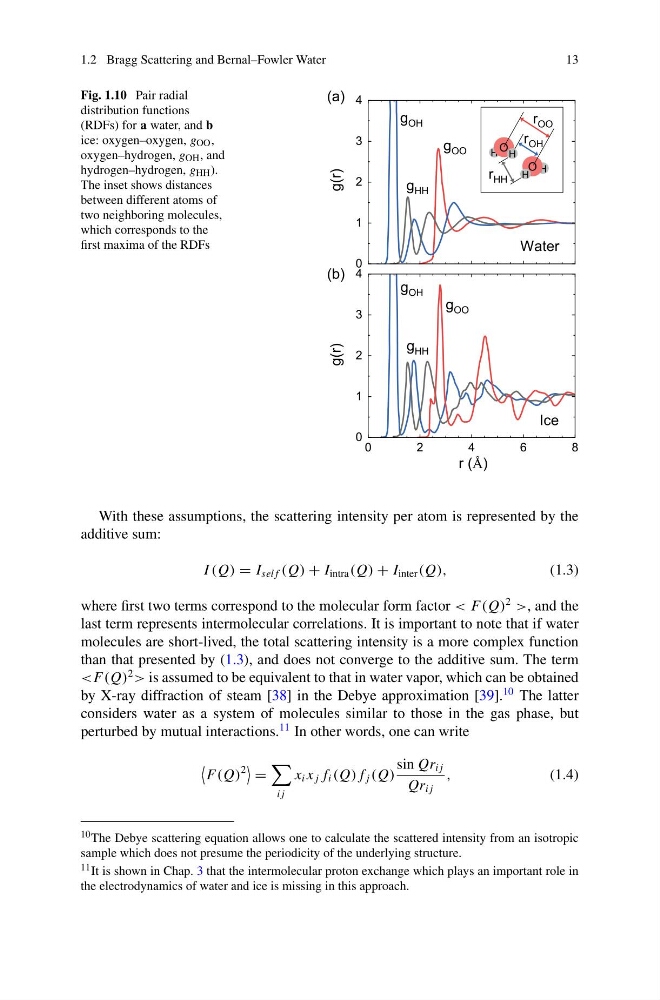
Fig. 1.10 Pair radial
distribution functions
(RDFs) for a water, and b
ice: oxygen–oxygen, g OO ,
oxygen–hydrogen, g OH , and
hydrogen–hydrogen, g HH ).
The inset shows distances
between different atoms of
two neighboring molecules,
which corresponds to the
first maxima of the RDFs
With these assumptions, the scattering intensity per atom is represented by the
additive sum:
I (Q) = I sel f (Q) + I intra (Q) + I inter (Q),
(1.3)
where first two terms correspond to the molecular form factor < F(Q)
2
>, and the
last term represents intermolecular correlations. It is important to note that if water
molecules are short-lived, the total scattering intensity is a more complex function
than that presented by (1.3), and does not converge to the additive sum. The term
> is assumed to be equivalent to that in water vapor, which can be obtained
by X-ray diffraction of steam [38] in the Debye approximation [39].
10 The latter
considers water as a system of molecules similar to those in the gas phase, but
perturbed by mutual interactions.
11 In other words, one can write
F(Q)
2
=
i j
x i x j f i (Q) f j (Q)
sin Qr i j
Qr i j
,
(1.4)
10 The Debye scattering equation allows one to calculate the scattered intensity from an isotropic
sample which does not presume the periodicity of the underlying structure.
11 It is shown in Chap. 3 that the intermolecular proton exchange which plays an important role in
the electrodynamics of water and ice is missing in this approach.
13
Fig. 1.10 Pair radial
distribution functions
(RDFs) for a water, and b
ice: oxygen–oxygen, g OO ,
oxygen–hydrogen, g OH , and
hydrogen–hydrogen, g HH ).
The inset shows distances
between different atoms of
two neighboring molecules,
which corresponds to the
first maxima of the RDFs
With these assumptions, the scattering intensity per atom is represented by the
additive sum:
I (Q) = I sel f (Q) + I intra (Q) + I inter (Q),
(1.3)
where first two terms correspond to the molecular form factor < F(Q)
2
>, and the
last term represents intermolecular correlations. It is important to note that if water
molecules are short-lived, the total scattering intensity is a more complex function
than that presented by (1.3), and does not converge to the additive sum. The term
> is assumed to be equivalent to that in water vapor, which can be obtained
by X-ray diffraction of steam [38] in the Debye approximation [39].
10 The latter
considers water as a system of molecules similar to those in the gas phase, but
perturbed by mutual interactions.
11 In other words, one can write
F(Q)
2
=
i j
x i x j f i (Q) f j (Q)
sin Qr i j
Qr i j
,
(1.4)
10 The Debye scattering equation allows one to calculate the scattered intensity from an isotropic
sample which does not presume the periodicity of the underlying structure.
11 It is shown in Chap. 3 that the intermolecular proton exchange which plays an important role in
the electrodynamics of water and ice is missing in this approach.