

10
1 A Historical Review of the Structures of Water and Ice
Basal
plane
a 1
a 3
a 2
a 1
a 3
a 2
c
c
(a)
(b)
7.8 Å
7.3 Å
2.8 Å
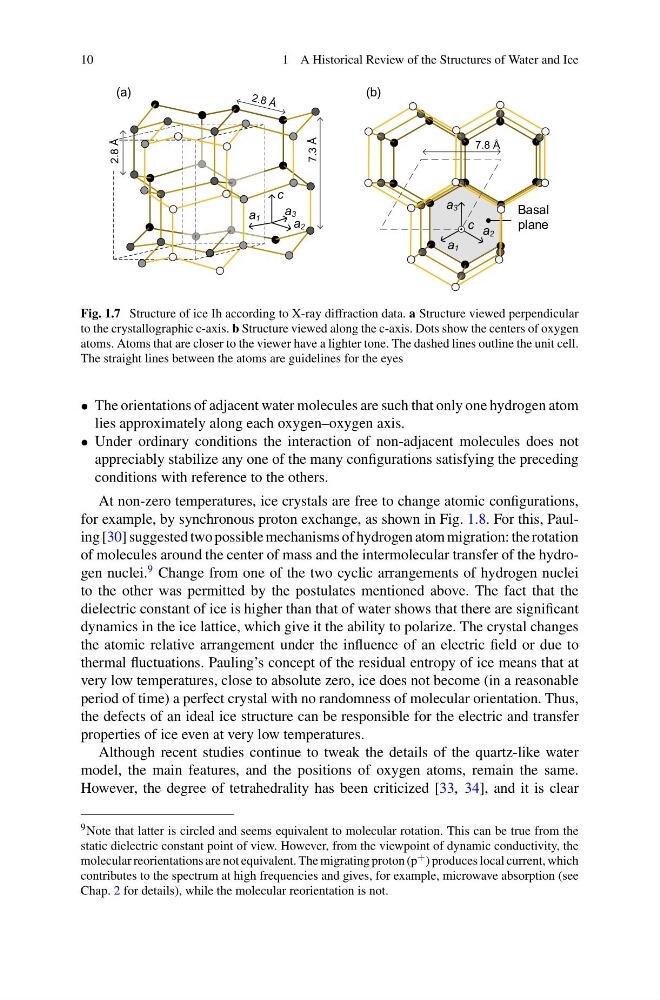
Fig. 1.7 Structure of ice Ih according to X-ray diffraction data. a Structure viewed perpendicular
to the crystallographic c-axis. b Structure viewed along the c-axis. Dots show the centers of oxygen
atoms. Atoms that are closer to the viewer have a lighter tone. The dashed lines outline the unit cell.
The straight lines between the atoms are guidelines for the eyes
• The orientations of adjacent water molecules are such that only one hydrogen atom
lies approximately along each oxygen–oxygen axis.
• Under ordinary conditions the interaction of non-adjacent molecules does not
appreciably stabilize any one of the many configurations satisfying the preceding
conditions with reference to the others.
At non-zero temperatures, ice crystals are free to change atomic configurations,
for example, by synchronous proton exchange, as shown in Fig. 1.8. For this, Pauling [30] suggested two possible mechanisms of hydrogen atom migration: the rotation
of molecules around the center of mass and the intermolecular transfer of the hydrogen nuclei.
9 Change from one of the two cyclic arrangements of hydrogen nuclei
to the other was permitted by the postulates mentioned above. The fact that the
dielectric constant of ice is higher than that of water shows that there are significant
dynamics in the ice lattice, which give it the ability to polarize. The crystal changes
the atomic relative arrangement under the influence of an electric field or due to
thermal fluctuations. Pauling’s concept of the residual entropy of ice means that at
very low temperatures, close to absolute zero, ice does not become (in a reasonable
period of time) a perfect crystal with no randomness of molecular orientation. Thus,
the defects of an ideal ice structure can be responsible for the electric and transfer
properties of ice even at very low temperatures.
Although recent studies continue to tweak the details of the quartz-like water
model, the main features, and the positions of oxygen atoms, remain the same.
However, the degree of tetrahedrality has been criticized [33, 34], and it is clear
9 Note that latter is circled and seems equivalent to molecular rotation. This can be true from the
static dielectric constant point of view. However, from the viewpoint of dynamic conductivity, the
molecular reorientations are not equivalent. The migrating proton (p + ) produces local current, which
contributes to the spectrum at high frequencies and gives, for example, microwave absorption (see
Chap. 2 for details), while the molecular reorientation is not.
1 A Historical Review of the Structures of Water and Ice
Basal
plane
a 1
a 3
a 2
a 1
a 3
a 2
c
c
(a)
(b)
7.8 Å
7.3 Å
2.8 Å
Fig. 1.7 Structure of ice Ih according to X-ray diffraction data. a Structure viewed perpendicular
to the crystallographic c-axis. b Structure viewed along the c-axis. Dots show the centers of oxygen
atoms. Atoms that are closer to the viewer have a lighter tone. The dashed lines outline the unit cell.
The straight lines between the atoms are guidelines for the eyes
• The orientations of adjacent water molecules are such that only one hydrogen atom
lies approximately along each oxygen–oxygen axis.
• Under ordinary conditions the interaction of non-adjacent molecules does not
appreciably stabilize any one of the many configurations satisfying the preceding
conditions with reference to the others.
At non-zero temperatures, ice crystals are free to change atomic configurations,
for example, by synchronous proton exchange, as shown in Fig. 1.8. For this, Pauling [30] suggested two possible mechanisms of hydrogen atom migration: the rotation
of molecules around the center of mass and the intermolecular transfer of the hydrogen nuclei.
9 Change from one of the two cyclic arrangements of hydrogen nuclei
to the other was permitted by the postulates mentioned above. The fact that the
dielectric constant of ice is higher than that of water shows that there are significant
dynamics in the ice lattice, which give it the ability to polarize. The crystal changes
the atomic relative arrangement under the influence of an electric field or due to
thermal fluctuations. Pauling’s concept of the residual entropy of ice means that at
very low temperatures, close to absolute zero, ice does not become (in a reasonable
period of time) a perfect crystal with no randomness of molecular orientation. Thus,
the defects of an ideal ice structure can be responsible for the electric and transfer
properties of ice even at very low temperatures.
Although recent studies continue to tweak the details of the quartz-like water
model, the main features, and the positions of oxygen atoms, remain the same.
However, the degree of tetrahedrality has been criticized [33, 34], and it is clear
9 Note that latter is circled and seems equivalent to molecular rotation. This can be true from the
static dielectric constant point of view. However, from the viewpoint of dynamic conductivity, the
molecular reorientations are not equivalent. The migrating proton (p + ) produces local current, which
contributes to the spectrum at high frequencies and gives, for example, microwave absorption (see
Chap. 2 for details), while the molecular reorientation is not.