

204
5 Electrodynamics of Aqueous Media
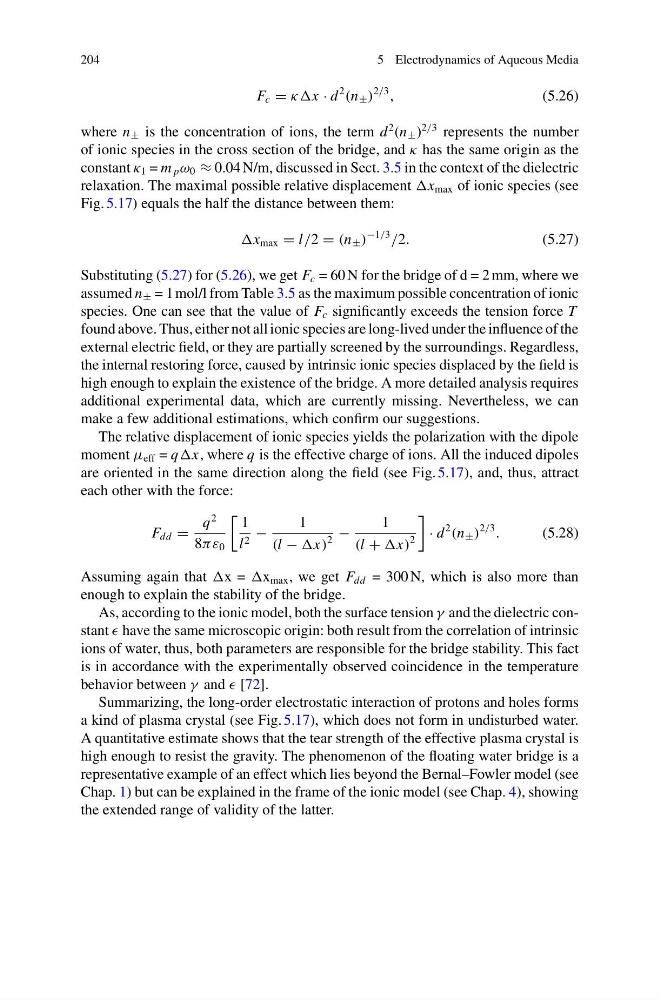
F c = κκx · d
2
(n ± )
2/3
,
(5.26)
where n ± is the concentration of ions, the term d
2 (n ± )
2/3 represents the number
of ionic species in the cross section of the bridge, and κ has the same origin as the
constant κ 1 = m p ω 0 ≈ 0.04 N/m, discussed in Sect. 3.5 in the context of the dielectric
relaxation. The maximal possible relative displacement x max of ionic species (see
Fig. 5.17) equals the half the distance between them:
x max = l/2 = (n ± )
−1/3
/2.
(5.27)
Substituting (5.27) for (5.26), we get F c = 60 N for the bridge of d = 2 mm, where we
assumed n ± = 1 mol/l from Table 3.5 as the maximum possible concentration of ionic
species. One can see that the value of F c significantly exceeds the tension force T
found above. Thus, either not all ionic species are long-lived under the influence of the
external electric field, or they are partially screened by the surroundings. Regardless,
the internal restoring force, caused by intrinsic ionic species displaced by the field is
high enough to explain the existence of the bridge. A more detailed analysis requires
additional experimental data, which are currently missing. Nevertheless, we can
make a few additional estimations, which confirm our suggestions.
The relative displacement of ionic species yields the polarization with the dipole
moment μ eff = qx, where q is the effective charge of ions. All the induced dipoles
are oriented in the same direction along the field (see Fig. 5.17), and, thus, attract
each other with the force:
F dd =
q
2
8πε 0
1
l 2 −
1
(l − x)
2
−
1
(l + x)
2
· d
2
(n ± )
2/3
.
(5.28)
Assuming again that x = x max , we get F dd = 300 N, which is also more than
enough to explain the stability of the bridge.
As, according to the ionic model, both the surface tension γ and the dielectric constant have the same microscopic origin: both result from the correlation of intrinsic
ions of water, thus, both parameters are responsible for the bridge stability. This fact
is in accordance with the experimentally observed coincidence in the temperature
behavior between γ and [72].
Summarizing, the long-order electrostatic interaction of protons and holes forms
a kind of plasma crystal (see Fig. 5.17), which does not form in undisturbed water.
A quantitative estimate shows that the tear strength of the effective plasma crystal is
high enough to resist the gravity. The phenomenon of the floating water bridge is a
representative example of an effect which lies beyond the Bernal–Fowler model (see
Chap. 1) but can be explained in the frame of the ionic model (see Chap. 4), showing
the extended range of validity of the latter.
5 Electrodynamics of Aqueous Media
F c = κκx · d
2
(n ± )
2/3
,
(5.26)
where n ± is the concentration of ions, the term d
2 (n ± )
2/3 represents the number
of ionic species in the cross section of the bridge, and κ has the same origin as the
constant κ 1 = m p ω 0 ≈ 0.04 N/m, discussed in Sect. 3.5 in the context of the dielectric
relaxation. The maximal possible relative displacement x max of ionic species (see
Fig. 5.17) equals the half the distance between them:
x max = l/2 = (n ± )
−1/3
/2.
(5.27)
Substituting (5.27) for (5.26), we get F c = 60 N for the bridge of d = 2 mm, where we
assumed n ± = 1 mol/l from Table 3.5 as the maximum possible concentration of ionic
species. One can see that the value of F c significantly exceeds the tension force T
found above. Thus, either not all ionic species are long-lived under the influence of the
external electric field, or they are partially screened by the surroundings. Regardless,
the internal restoring force, caused by intrinsic ionic species displaced by the field is
high enough to explain the existence of the bridge. A more detailed analysis requires
additional experimental data, which are currently missing. Nevertheless, we can
make a few additional estimations, which confirm our suggestions.
The relative displacement of ionic species yields the polarization with the dipole
moment μ eff = qx, where q is the effective charge of ions. All the induced dipoles
are oriented in the same direction along the field (see Fig. 5.17), and, thus, attract
each other with the force:
F dd =
q
2
8πε 0
1
l 2 −
1
(l − x)
2
−
1
(l + x)
2
· d
2
(n ± )
2/3
.
(5.28)
Assuming again that x = x max , we get F dd = 300 N, which is also more than
enough to explain the stability of the bridge.
As, according to the ionic model, both the surface tension γ and the dielectric constant have the same microscopic origin: both result from the correlation of intrinsic
ions of water, thus, both parameters are responsible for the bridge stability. This fact
is in accordance with the experimentally observed coincidence in the temperature
behavior between γ and [72].
Summarizing, the long-order electrostatic interaction of protons and holes forms
a kind of plasma crystal (see Fig. 5.17), which does not form in undisturbed water.
A quantitative estimate shows that the tear strength of the effective plasma crystal is
high enough to resist the gravity. The phenomenon of the floating water bridge is a
representative example of an effect which lies beyond the Bernal–Fowler model (see
Chap. 1) but can be explained in the frame of the ionic model (see Chap. 4), showing
the extended range of validity of the latter.