

178
5 Electrodynamics of Aqueous Media
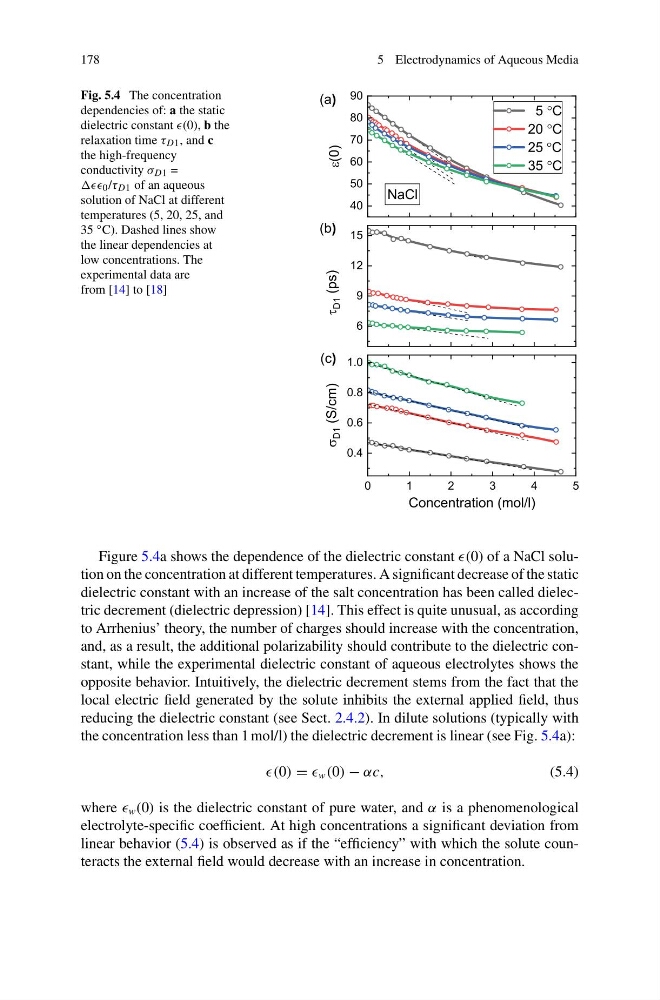
Fig. 5.4 The concentration
dependencies of: a the static
dielectric constant (0), b the
relaxation time τ D1 , and c
the high-frequency
conductivity σ D1 =
0 /τ D1 of an aqueous
solution of NaCl at different
temperatures (5, 20, 25, and
35 ◦ C). Dashed lines show
the linear dependencies at
low concentrations. The
experimental data are
from [14] to [18]
Figure 5.4a shows the dependence of the dielectric constant (0) of a NaCl solution on the concentration at different temperatures. A significant decrease of the static
dielectric constant with an increase of the salt concentration has been called dielectric decrement (dielectric depression) [14]. This effect is quite unusual, as according
to Arrhenius’ theory, the number of charges should increase with the concentration,
and, as a result, the additional polarizability should contribute to the dielectric constant, while the experimental dielectric constant of aqueous electrolytes shows the
opposite behavior. Intuitively, the dielectric decrement stems from the fact that the
local electric field generated by the solute inhibits the external applied field, thus
reducing the dielectric constant (see Sect. 2.4.2). In dilute solutions (typically with
the concentration less than 1 mol/l) the dielectric decrement is linear (see Fig. 5.4a):
= w (0) − αc,
(5.4)
where w (0) is the dielectric constant of pure water, and α is a phenomenological
electrolyte-specific coefficient. At high concentrations a significant deviation from
linear behavior (5.4) is observed as if the “efficiency” with which the solute counteracts the external field would decrease with an increase in concentration.
5 Electrodynamics of Aqueous Media
Fig. 5.4 The concentration
dependencies of: a the static
dielectric constant (0), b the
relaxation time τ D1 , and c
the high-frequency
conductivity σ D1 =
0 /τ D1 of an aqueous
solution of NaCl at different
temperatures (5, 20, 25, and
35 ◦ C). Dashed lines show
the linear dependencies at
low concentrations. The
experimental data are
from [14] to [18]
Figure 5.4a shows the dependence of the dielectric constant (0) of a NaCl solution on the concentration at different temperatures. A significant decrease of the static
dielectric constant with an increase of the salt concentration has been called dielectric decrement (dielectric depression) [14]. This effect is quite unusual, as according
to Arrhenius’ theory, the number of charges should increase with the concentration,
and, as a result, the additional polarizability should contribute to the dielectric constant, while the experimental dielectric constant of aqueous electrolytes shows the
opposite behavior. Intuitively, the dielectric decrement stems from the fact that the
local electric field generated by the solute inhibits the external applied field, thus
reducing the dielectric constant (see Sect. 2.4.2). In dilute solutions (typically with
the concentration less than 1 mol/l) the dielectric decrement is linear (see Fig. 5.4a):
= w (0) − αc,
(5.4)
where w (0) is the dielectric constant of pure water, and α is a phenomenological
electrolyte-specific coefficient. At high concentrations a significant deviation from
linear behavior (5.4) is observed as if the “efficiency” with which the solute counteracts the external field would decrease with an increase in concentration.