

4.5 The Microscopic Origin of the Electrodynamic Properties of Water and Ice
165
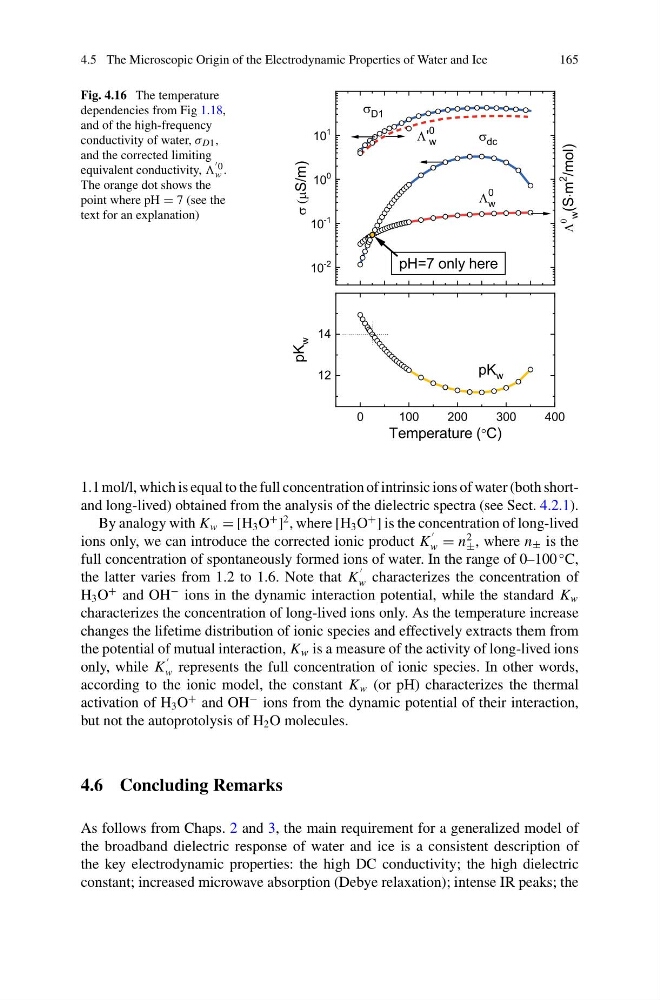
Fig. 4.16 The temperature
dependencies from Fig 1.18,
and of the high-frequency
conductivity of water, σ D1 ,
and the corrected limiting
equivalent conductivity,
0
w .
The orange dot shows the
point where pH = 7 (see the
text for an explanation)
1.1 mol/l, which is equal to the full concentration of intrinsic ions of water (both shortand long-lived) obtained from the analysis of the dielectric spectra (see Sect. 4.2.1).
By analogy with K w = [H 3 O
+ ]
2 , where [H 3 O
+ ] is the concentration of long-lived
ions only, we can introduce the corrected ionic product K
w = n
2
± , where n ± is the
full concentration of spontaneously formed ions of water. In the range of 0–100
◦ C,
the latter varies from 1.2 to 1.6. Note that K
w characterizes the concentration of
H 3 O
+ and OH
− ions in the dynamic interaction potential, while the standard K w
characterizes the concentration of long-lived ions only. As the temperature increase
changes the lifetime distribution of ionic species and effectively extracts them from
the potential of mutual interaction, K w is a measure of the activity of long-lived ions
only, while K
w represents the full concentration of ionic species. In other words,
according to the ionic model, the constant K w (or pH) characterizes the thermal
activation of H 3 O
+ and OH
− ions from the dynamic potential of their interaction,
but not the autoprotolysis of H 2 O molecules.
4.6 Concluding Remarks
As follows from Chaps. 2 and 3, the main requirement for a generalized model of
the broadband dielectric response of water and ice is a consistent description of
the key electrodynamic properties: the high DC conductivity; the high dielectric
constant; increased microwave absorption (Debye relaxation); intense IR peaks; the
165
Fig. 4.16 The temperature
dependencies from Fig 1.18,
and of the high-frequency
conductivity of water, σ D1 ,
and the corrected limiting
equivalent conductivity,
0
w .
The orange dot shows the
point where pH = 7 (see the
text for an explanation)
1.1 mol/l, which is equal to the full concentration of intrinsic ions of water (both shortand long-lived) obtained from the analysis of the dielectric spectra (see Sect. 4.2.1).
By analogy with K w = [H 3 O
+ ]
2 , where [H 3 O
+ ] is the concentration of long-lived
ions only, we can introduce the corrected ionic product K
w = n
2
± , where n ± is the
full concentration of spontaneously formed ions of water. In the range of 0–100
◦ C,
the latter varies from 1.2 to 1.6. Note that K
w characterizes the concentration of
H 3 O
+ and OH
− ions in the dynamic interaction potential, while the standard K w
characterizes the concentration of long-lived ions only. As the temperature increase
changes the lifetime distribution of ionic species and effectively extracts them from
the potential of mutual interaction, K w is a measure of the activity of long-lived ions
only, while K
w represents the full concentration of ionic species. In other words,
according to the ionic model, the constant K w (or pH) characterizes the thermal
activation of H 3 O
+ and OH
− ions from the dynamic potential of their interaction,
but not the autoprotolysis of H 2 O molecules.
4.6 Concluding Remarks
As follows from Chaps. 2 and 3, the main requirement for a generalized model of
the broadband dielectric response of water and ice is a consistent description of
the key electrodynamic properties: the high DC conductivity; the high dielectric
constant; increased microwave absorption (Debye relaxation); intense IR peaks; the