

164
4 The Dielectric Properties and Dynamic Structure of Water and Ice
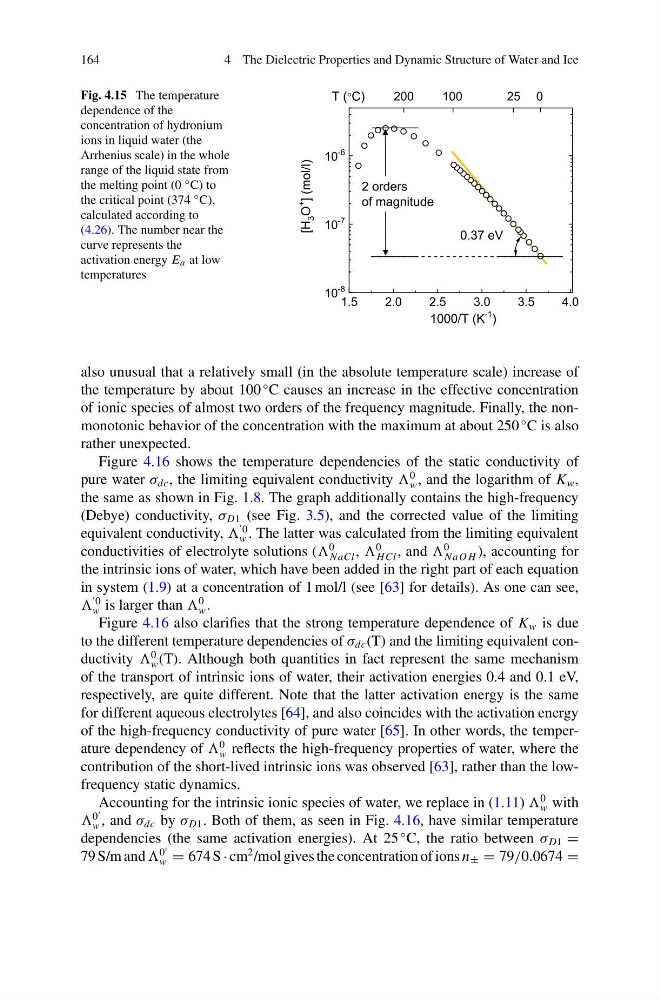
Fig. 4.15 The temperature
dependence of the
concentration of hydronium
ions in liquid water (the
Arrhenius scale) in the whole
range of the liquid state from
the melting point (0 ◦ C) to
the critical point (374 ◦ C),
calculated according to
(4.26). The number near the
curve represents the
activation energy E a at low
temperatures
also unusual that a relatively small (in the absolute temperature scale) increase of
the temperature by about 100
◦ C causes an increase in the effective concentration
of ionic species of almost two orders of the frequency magnitude. Finally, the nonmonotonic behavior of the concentration with the maximum at about 250
◦ C is also
rather unexpected.
Figure 4.16 shows the temperature dependencies of the static conductivity of
pure water σ dc , the limiting equivalent conductivity
0
w , and the logarithm of K w ,
the same as shown in Fig. 1.8. The graph additionally contains the high-frequency
(Debye) conductivity, σ D1 (see Fig. 3.5), and the corrected value of the limiting
equivalent conductivity,
0
w . The latter was calculated from the limiting equivalent
conductivities of electrolyte solutions (
0
NaCl ,
0
HCl , and
0
NaO H ), accounting for
the intrinsic ions of water, which have been added in the right part of each equation
in system (1.9) at a concentration of 1 mol/l (see [63] for details). As one can see,
0
w is larger than
0
w .
Figure 4.16 also clarifies that the strong temperature dependence of K w is due
to the different temperature dependencies of σ dc (T) and the limiting equivalent conductivity
0
w (T). Although both quantities in fact represent the same mechanism
of the transport of intrinsic ions of water, their activation energies 0.4 and 0.1 eV,
respectively, are quite different. Note that the latter activation energy is the same
for different aqueous electrolytes [64], and also coincides with the activation energy
of the high-frequency conductivity of pure water [65]. In other words, the temperature dependency of
0
w reflects the high-frequency properties of water, where the
contribution of the short-lived intrinsic ions was observed [63], rather than the lowfrequency static dynamics.
Accounting for the intrinsic ionic species of water, we replace in (1.11)
0
w with
0
w , and σ dc by σ D1 . Both of them, as seen in Fig. 4.16, have similar temperature
dependencies (the same activation energies). At 25
◦ C, the ratio between σ D1 =
79 S/m and
0
w = 674 S · cm
2 /mol gives the concentration of ions n ± = 79/0.0674 =
4 The Dielectric Properties and Dynamic Structure of Water and Ice
Fig. 4.15 The temperature
dependence of the
concentration of hydronium
ions in liquid water (the
Arrhenius scale) in the whole
range of the liquid state from
the melting point (0 ◦ C) to
the critical point (374 ◦ C),
calculated according to
(4.26). The number near the
curve represents the
activation energy E a at low
temperatures
also unusual that a relatively small (in the absolute temperature scale) increase of
the temperature by about 100
◦ C causes an increase in the effective concentration
of ionic species of almost two orders of the frequency magnitude. Finally, the nonmonotonic behavior of the concentration with the maximum at about 250
◦ C is also
rather unexpected.
Figure 4.16 shows the temperature dependencies of the static conductivity of
pure water σ dc , the limiting equivalent conductivity
0
w , and the logarithm of K w ,
the same as shown in Fig. 1.8. The graph additionally contains the high-frequency
(Debye) conductivity, σ D1 (see Fig. 3.5), and the corrected value of the limiting
equivalent conductivity,
0
w . The latter was calculated from the limiting equivalent
conductivities of electrolyte solutions (
0
NaCl ,
0
HCl , and
0
NaO H ), accounting for
the intrinsic ions of water, which have been added in the right part of each equation
in system (1.9) at a concentration of 1 mol/l (see [63] for details). As one can see,
0
w is larger than
0
w .
Figure 4.16 also clarifies that the strong temperature dependence of K w is due
to the different temperature dependencies of σ dc (T) and the limiting equivalent conductivity
0
w (T). Although both quantities in fact represent the same mechanism
of the transport of intrinsic ions of water, their activation energies 0.4 and 0.1 eV,
respectively, are quite different. Note that the latter activation energy is the same
for different aqueous electrolytes [64], and also coincides with the activation energy
of the high-frequency conductivity of pure water [65]. In other words, the temperature dependency of
0
w reflects the high-frequency properties of water, where the
contribution of the short-lived intrinsic ions was observed [63], rather than the lowfrequency static dynamics.
Accounting for the intrinsic ionic species of water, we replace in (1.11)
0
w with
0
w , and σ dc by σ D1 . Both of them, as seen in Fig. 4.16, have similar temperature
dependencies (the same activation energies). At 25
◦ C, the ratio between σ D1 =
79 S/m and
0
w = 674 S · cm
2 /mol gives the concentration of ions n ± = 79/0.0674 =