

158
4 The Dielectric Properties and Dynamic Structure of Water and Ice
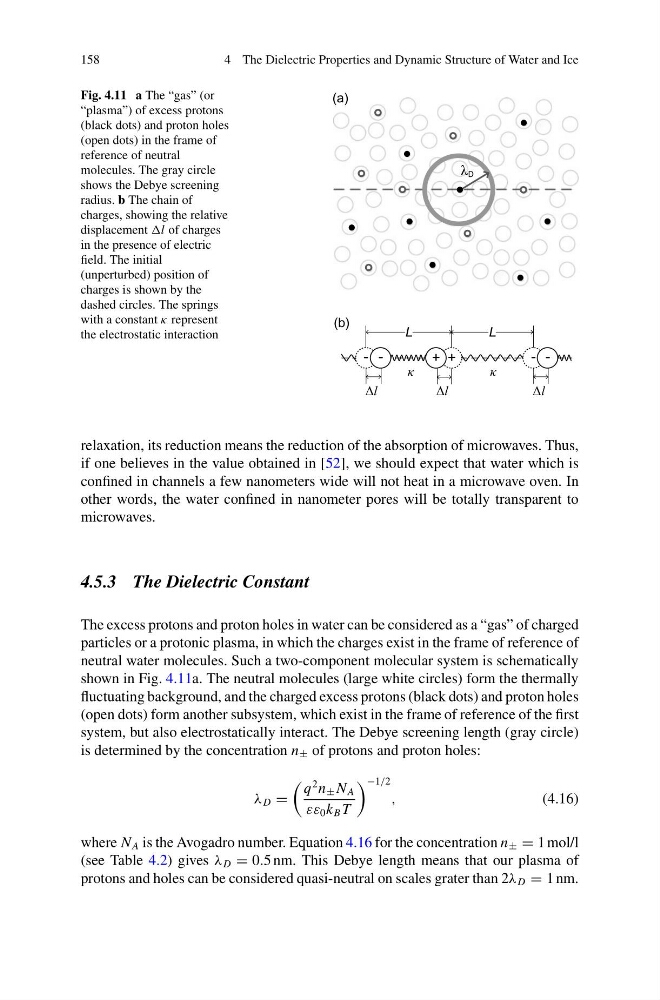
Fig. 4.11 a The “gas” (or
“plasma”) of excess protons
(black dots) and proton holes
(open dots) in the frame of
reference of neutral
molecules. The gray circle
shows the Debye screening
radius. b The chain of
charges, showing the relative
displacement of charges
in the presence of electric
field. The initial
(unperturbed) position of
charges is shown by the
dashed circles. The springs
with a constant κ represent
the electrostatic interaction
λ D
L
L
κ
κ
Δl
Δl
Δl
-
+
+
-
-
-
(a)
(b)
relaxation, its reduction means the reduction of the absorption of microwaves. Thus,
if one believes in the value obtained in [52], we should expect that water which is
confined in channels a few nanometers wide will not heat in a microwave oven. In
other words, the water confined in nanometer pores will be totally transparent to
microwaves.
4.5.3 The Dielectric Constant
The excess protons and proton holes in water can be considered as a “gas” of charged
particles or a protonic plasma, in which the charges exist in the frame of reference of
neutral water molecules. Such a two-component molecular system is schematically
shown in Fig. 4.11a. The neutral molecules (large white circles) form the thermally
fluctuating background, and the charged excess protons (black dots) and proton holes
(open dots) form another subsystem, which exist in the frame of reference of the first
system, but also electrostatically interact. The Debye screening length (gray circle)
is determined by the concentration n ± of protons and proton holes:
λ D =
q
2 n ± N A
εε 0 k B T
−1/2
,
(4.16)
where N A is the Avogadro number. Equation 4.16 for the concentration n ± = 1 mol/l
(see Table 4.2) gives λ D = 0.5 nm. This Debye length means that our plasma of
protons and holes can be considered quasi-neutral on scales grater than 2λ D = 1 nm.
4 The Dielectric Properties and Dynamic Structure of Water and Ice
Fig. 4.11 a The “gas” (or
“plasma”) of excess protons
(black dots) and proton holes
(open dots) in the frame of
reference of neutral
molecules. The gray circle
shows the Debye screening
radius. b The chain of
charges, showing the relative
displacement of charges
in the presence of electric
field. The initial
(unperturbed) position of
charges is shown by the
dashed circles. The springs
with a constant κ represent
the electrostatic interaction
λ D
L
L
κ
κ
Δl
Δl
Δl
-
+
+
-
-
-
(a)
(b)
relaxation, its reduction means the reduction of the absorption of microwaves. Thus,
if one believes in the value obtained in [52], we should expect that water which is
confined in channels a few nanometers wide will not heat in a microwave oven. In
other words, the water confined in nanometer pores will be totally transparent to
microwaves.
4.5.3 The Dielectric Constant
The excess protons and proton holes in water can be considered as a “gas” of charged
particles or a protonic plasma, in which the charges exist in the frame of reference of
neutral water molecules. Such a two-component molecular system is schematically
shown in Fig. 4.11a. The neutral molecules (large white circles) form the thermally
fluctuating background, and the charged excess protons (black dots) and proton holes
(open dots) form another subsystem, which exist in the frame of reference of the first
system, but also electrostatically interact. The Debye screening length (gray circle)
is determined by the concentration n ± of protons and proton holes:
λ D =
q
2 n ± N A
εε 0 k B T
−1/2
,
(4.16)
where N A is the Avogadro number. Equation 4.16 for the concentration n ± = 1 mol/l
(see Table 4.2) gives λ D = 0.5 nm. This Debye length means that our plasma of
protons and holes can be considered quasi-neutral on scales grater than 2λ D = 1 nm.