

4.5 The Microscopic Origin of the Electrodynamic Properties of Water and Ice
157
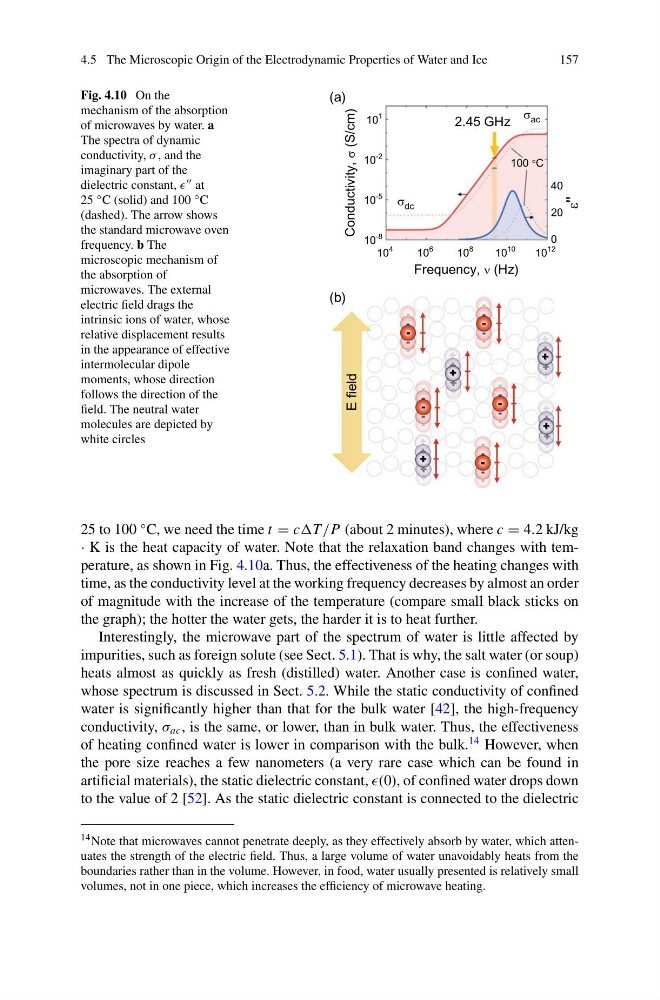
Fig. 4.10 On the
mechanism of the absorption
of microwaves by water. a
The spectra of dynamic
conductivity, σ , and the
imaginary part of the
dielectric constant, at
25 ◦ C (solid) and 100 ◦ C
(dashed). The arrow shows
the standard microwave oven
frequency. b The
microscopic mechanism of
the absorption of
microwaves. The external
electric field drags the
intrinsic ions of water, whose
relative displacement results
in the appearance of effective
intermolecular dipole
moments, whose direction
follows the direction of the
field. The neutral water
molecules are depicted by
white circles
10
4
10
6
10
8
10
10
10
12
10
-8
10
-5
10
-2
10
1
Frequency, (Hz)
Conductivity, (S/cm)
ac
dc
2.45 GHz
0
20
40
100 C
-
-
-
-
-
+
+
+
+
E field
(a)
(b)
25 to 100
◦ C, we need the time t = c /P (about 2 minutes), where c = 4.2 kJ/kg
· K is the heat capacity of water. Note that the relaxation band changes with temperature, as shown in Fig. 4.10a. Thus, the effectiveness of the heating changes with
time, as the conductivity level at the working frequency decreases by almost an order
of magnitude with the increase of the temperature (compare small black sticks on
the graph); the hotter the water gets, the harder it is to heat further.
Interestingly, the microwave part of the spectrum of water is little affected by
impurities, such as foreign solute (see Sect. 5.1). That is why, the salt water (or soup)
heats almost as quickly as fresh (distilled) water. Another case is confined water,
whose spectrum is discussed in Sect. 5.2. While the static conductivity of confined
water is significantly higher than that for the bulk water [42], the high-frequency
conductivity, σ ac , is the same, or lower, than in bulk water. Thus, the effectiveness
of heating confined water is lower in comparison with the bulk.
14 However, when
the pore size reaches a few nanometers (a very rare case which can be found in
artificial materials), the static dielectric constant, (0), of confined water drops down
to the value of 2 [52]. As the static dielectric constant is connected to the dielectric
14 Note that microwaves cannot penetrate deeply, as they effectively absorb by water, which attenuates the strength of the electric field. Thus, a large volume of water unavoidably heats from the
boundaries rather than in the volume. However, in food, water usually presented is relatively small
volumes, not in one piece, which increases the efficiency of microwave heating.
157
Fig. 4.10 On the
mechanism of the absorption
of microwaves by water. a
The spectra of dynamic
conductivity, σ , and the
imaginary part of the
dielectric constant, at
25 ◦ C (solid) and 100 ◦ C
(dashed). The arrow shows
the standard microwave oven
frequency. b The
microscopic mechanism of
the absorption of
microwaves. The external
electric field drags the
intrinsic ions of water, whose
relative displacement results
in the appearance of effective
intermolecular dipole
moments, whose direction
follows the direction of the
field. The neutral water
molecules are depicted by
white circles
10
4
10
6
10
8
10
10
10
12
10
-8
10
-5
10
-2
10
1
Frequency, (Hz)
Conductivity, (S/cm)
ac
dc
2.45 GHz
0
20
40
100 C
-
-
-
-
-
+
+
+
+
E field
(a)
(b)
25 to 100
◦ C, we need the time t = c /P (about 2 minutes), where c = 4.2 kJ/kg
· K is the heat capacity of water. Note that the relaxation band changes with temperature, as shown in Fig. 4.10a. Thus, the effectiveness of the heating changes with
time, as the conductivity level at the working frequency decreases by almost an order
of magnitude with the increase of the temperature (compare small black sticks on
the graph); the hotter the water gets, the harder it is to heat further.
Interestingly, the microwave part of the spectrum of water is little affected by
impurities, such as foreign solute (see Sect. 5.1). That is why, the salt water (or soup)
heats almost as quickly as fresh (distilled) water. Another case is confined water,
whose spectrum is discussed in Sect. 5.2. While the static conductivity of confined
water is significantly higher than that for the bulk water [42], the high-frequency
conductivity, σ ac , is the same, or lower, than in bulk water. Thus, the effectiveness
of heating confined water is lower in comparison with the bulk.
14 However, when
the pore size reaches a few nanometers (a very rare case which can be found in
artificial materials), the static dielectric constant, (0), of confined water drops down
to the value of 2 [52]. As the static dielectric constant is connected to the dielectric
14 Note that microwaves cannot penetrate deeply, as they effectively absorb by water, which attenuates the strength of the electric field. Thus, a large volume of water unavoidably heats from the
boundaries rather than in the volume. However, in food, water usually presented is relatively small
volumes, not in one piece, which increases the efficiency of microwave heating.