

4.5 The Microscopic Origin of the Electrodynamic Properties of Water and Ice
155
and
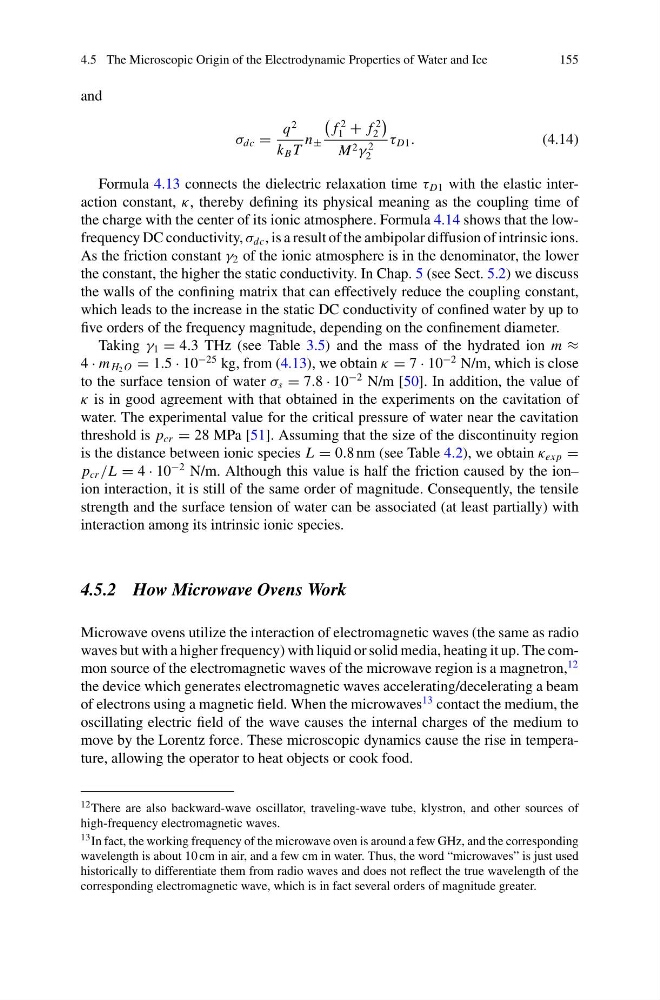
σ dc =
q
2
k B T
n ±
f
2
1 + f
2
2
M 2 γ
2
2
τ D1 .
(4.14)
Formula 4.13 connects the dielectric relaxation time τ D1 with the elastic interaction constant, κ, thereby defining its physical meaning as the coupling time of
the charge with the center of its ionic atmosphere. Formula 4.14 shows that the lowfrequency DC conductivity, σ dc , is a result of the ambipolar diffusion of intrinsic ions.
As the friction constant γ 2 of the ionic atmosphere is in the denominator, the lower
the constant, the higher the static conductivity. In Chap. 5 (see Sect. 5.2) we discuss
the walls of the confining matrix that can effectively reduce the coupling constant,
which leads to the increase in the static DC conductivity of confined water by up to
five orders of the frequency magnitude, depending on the confinement diameter.
Taking γ 1 = 4.3 THz (see Table 3.5) and the mass of the hydrated ion m ≈
4 · m H 2 O = 1.5 · 10
−25 kg, from (4.13), we obtain κ = 7 · 10
−2 N/m, which is close
to the surface tension of water σ s = 7.8 · 10
−2 N/m [50]. In addition, the value of
κ is in good agreement with that obtained in the experiments on the cavitation of
water. The experimental value for the critical pressure of water near the cavitation
threshold is p cr = 28 MPa [51]. Assuming that the size of the discontinuity region
is the distance between ionic species L = 0.8 nm (see Table 4.2), we obtain κ ex p =
p cr /L = 4 · 10
−2 N/m. Although this value is half the friction caused by the ion–
ion interaction, it is still of the same order of magnitude. Consequently, the tensile
strength and the surface tension of water can be associated (at least partially) with
interaction among its intrinsic ionic species.
4.5.2 How Microwave Ovens Work
Microwave ovens utilize the interaction of electromagnetic waves (the same as radio
waves but with a higher frequency) with liquid or solid media, heating it up. The common source of the electromagnetic waves of the microwave region is a magnetron,
12
the device which generates electromagnetic waves accelerating/decelerating a beam
of electrons using a magnetic field. When the microwaves
13 contact the medium, the
oscillating electric field of the wave causes the internal charges of the medium to
move by the Lorentz force. These microscopic dynamics cause the rise in temperature, allowing the operator to heat objects or cook food.
12 There are also backward-wave oscillator, traveling-wave tube, klystron, and other sources of
high-frequency electromagnetic waves.
13 In fact, the working frequency of the microwave oven is around a few GHz, and the corresponding
wavelength is about 10 cm in air, and a few cm in water. Thus, the word “microwaves” is just used
historically to differentiate them from radio waves and does not reflect the true wavelength of the
corresponding electromagnetic wave, which is in fact several orders of magnitude greater.
155
and
σ dc =
q
2
k B T
n ±
f
2
1 + f
2
2
M 2 γ
2
2
τ D1 .
(4.14)
Formula 4.13 connects the dielectric relaxation time τ D1 with the elastic interaction constant, κ, thereby defining its physical meaning as the coupling time of
the charge with the center of its ionic atmosphere. Formula 4.14 shows that the lowfrequency DC conductivity, σ dc , is a result of the ambipolar diffusion of intrinsic ions.
As the friction constant γ 2 of the ionic atmosphere is in the denominator, the lower
the constant, the higher the static conductivity. In Chap. 5 (see Sect. 5.2) we discuss
the walls of the confining matrix that can effectively reduce the coupling constant,
which leads to the increase in the static DC conductivity of confined water by up to
five orders of the frequency magnitude, depending on the confinement diameter.
Taking γ 1 = 4.3 THz (see Table 3.5) and the mass of the hydrated ion m ≈
4 · m H 2 O = 1.5 · 10
−25 kg, from (4.13), we obtain κ = 7 · 10
−2 N/m, which is close
to the surface tension of water σ s = 7.8 · 10
−2 N/m [50]. In addition, the value of
κ is in good agreement with that obtained in the experiments on the cavitation of
water. The experimental value for the critical pressure of water near the cavitation
threshold is p cr = 28 MPa [51]. Assuming that the size of the discontinuity region
is the distance between ionic species L = 0.8 nm (see Table 4.2), we obtain κ ex p =
p cr /L = 4 · 10
−2 N/m. Although this value is half the friction caused by the ion–
ion interaction, it is still of the same order of magnitude. Consequently, the tensile
strength and the surface tension of water can be associated (at least partially) with
interaction among its intrinsic ionic species.
4.5.2 How Microwave Ovens Work
Microwave ovens utilize the interaction of electromagnetic waves (the same as radio
waves but with a higher frequency) with liquid or solid media, heating it up. The common source of the electromagnetic waves of the microwave region is a magnetron,
12
the device which generates electromagnetic waves accelerating/decelerating a beam
of electrons using a magnetic field. When the microwaves
13 contact the medium, the
oscillating electric field of the wave causes the internal charges of the medium to
move by the Lorentz force. These microscopic dynamics cause the rise in temperature, allowing the operator to heat objects or cook food.
12 There are also backward-wave oscillator, traveling-wave tube, klystron, and other sources of
high-frequency electromagnetic waves.
13 In fact, the working frequency of the microwave oven is around a few GHz, and the corresponding
wavelength is about 10 cm in air, and a few cm in water. Thus, the word “microwaves” is just used
historically to differentiate them from radio waves and does not reflect the true wavelength of the
corresponding electromagnetic wave, which is in fact several orders of magnitude greater.