

3.5 Protonic Transport as a Fundamental Mechanism of the Dielectric…
121
+
+
+
+
-
-
-
-
-
m
m
*
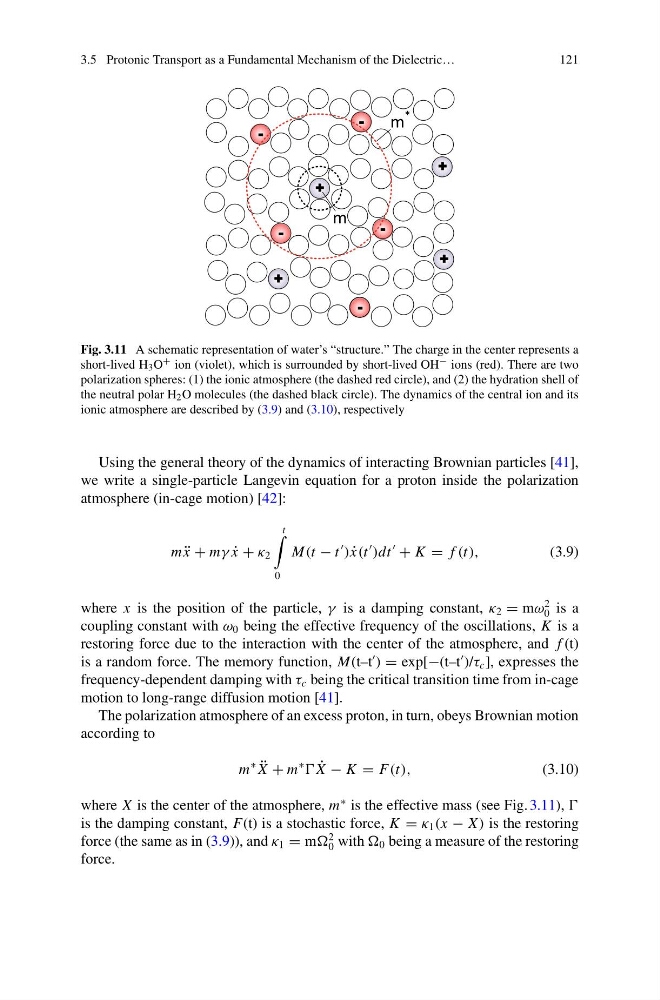
Fig. 3.11 A schematic representation of water’s “structure.” The charge in the center represents a
short-lived H 3 O + ion (violet), which is surrounded by short-lived OH − ions (red). There are two
polarization spheres: (1) the ionic atmosphere (the dashed red circle), and (2) the hydration shell of
the neutral polar H 2 O molecules (the dashed black circle). The dynamics of the central ion and its
ionic atmosphere are described by (3.9) and (3.10), respectively
Using the general theory of the dynamics of interacting Brownian particles [41],
we write a single-particle Langevin equation for a proton inside the polarization
atmosphere (in-cage motion) [42]:
m ¨
x + mγ ˙
x + κ 2
t
0
M(t − t
) ˙
x(t
)dt
+ K = f (t),
(3.9)
where x is the position of the particle, γ is a damping constant, κ 2 = mω
2
0 is a
coupling constant with ω 0 being the effective frequency of the oscillations, K is a
restoring force due to the interaction with the center of the atmosphere, and f (t)
is a random force. The memory function, M(t–t
) = exp[−(t–t
)/τ c ], expresses the
frequency-dependent damping with τ c being the critical transition time from in-cage
motion to long-range diffusion motion [41].
The polarization atmosphere of an excess proton, in turn, obeys Brownian motion
according to
m
∗ ¨
X + m
∗
˙
X − K = F(t),
(3.10)
where X is the center of the atmosphere, m
∗ is the effective mass (see Fig. 3.11),
is the damping constant, F(t) is a stochastic force, K = κ 1 (x − X ) is the restoring
force (the same as in (3.9)), and κ 1 = m
2
0 with 0 being a measure of the restoring
force.
121
+
+
+
+
-
-
-
-
-
m
m
*
Fig. 3.11 A schematic representation of water’s “structure.” The charge in the center represents a
short-lived H 3 O + ion (violet), which is surrounded by short-lived OH − ions (red). There are two
polarization spheres: (1) the ionic atmosphere (the dashed red circle), and (2) the hydration shell of
the neutral polar H 2 O molecules (the dashed black circle). The dynamics of the central ion and its
ionic atmosphere are described by (3.9) and (3.10), respectively
Using the general theory of the dynamics of interacting Brownian particles [41],
we write a single-particle Langevin equation for a proton inside the polarization
atmosphere (in-cage motion) [42]:
m ¨
x + mγ ˙
x + κ 2
t
0
M(t − t
) ˙
x(t
)dt
+ K = f (t),
(3.9)
where x is the position of the particle, γ is a damping constant, κ 2 = mω
2
0 is a
coupling constant with ω 0 being the effective frequency of the oscillations, K is a
restoring force due to the interaction with the center of the atmosphere, and f (t)
is a random force. The memory function, M(t–t
) = exp[−(t–t
)/τ c ], expresses the
frequency-dependent damping with τ c being the critical transition time from in-cage
motion to long-range diffusion motion [41].
The polarization atmosphere of an excess proton, in turn, obeys Brownian motion
according to
m
∗ ¨
X + m
∗
˙
X − K = F(t),
(3.10)
where X is the center of the atmosphere, m
∗ is the effective mass (see Fig. 3.11),
is the damping constant, F(t) is a stochastic force, K = κ 1 (x − X ) is the restoring
force (the same as in (3.9)), and κ 1 = m
2
0 with 0 being a measure of the restoring
force.