

114
3 The Interaction of Electromagnetic Waves with Ice
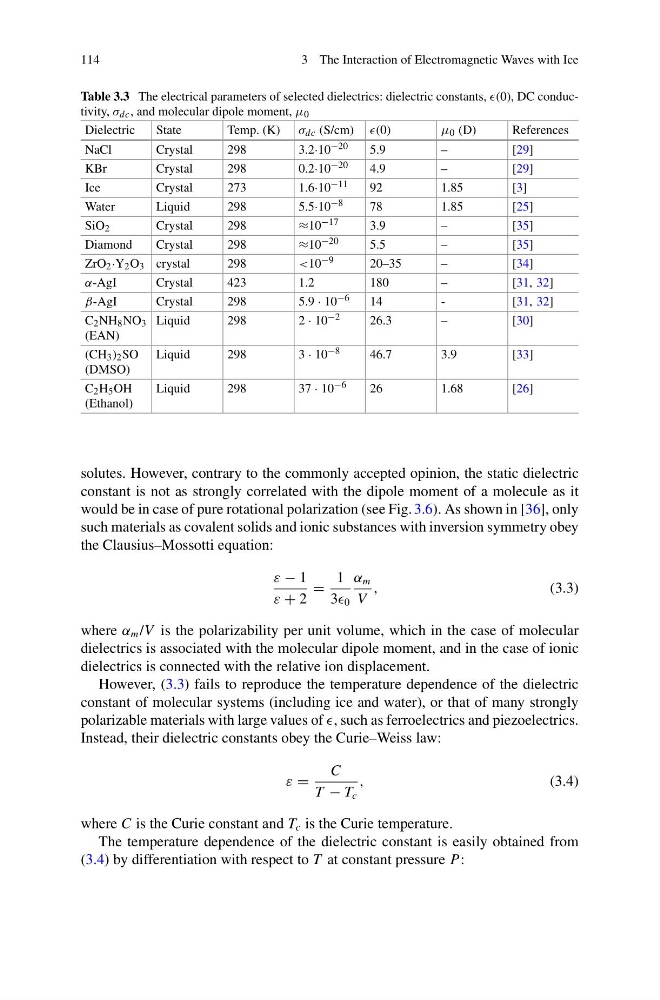
Table 3.3 The electrical parameters of selected dielectrics: dielectric constants, (0), DC conductivity, σ dc , and molecular dipole moment, μ 0
Dielectric
State
Temp. (K) σ dc (S/cm) (0)
μ 0 (D)
References
NaCl
Crystal
298
3.2·10 −20
5.9
–
[29]
KBr
Crystal
298
0.2·10 −20
4.9
–
[29]
Ice
Crystal
273
1.6·10 −11
92
1.85
[3]
Water
Liquid
298
5.5·10 −8
78
1.85
[25]
SiO 2
Crystal
298
≈10 −17
3.9
–
[35]
Diamond
Crystal
298
≈10 −20
5.5
–
[35]
ZrO 2 ·Y 2 O 3 crystal
298
<10 −9
20–35
–
[34]
α-AgI
Crystal
423
1.2
180
–
[31, 32]
β-AgI
Crystal
298
5.9 · 10 −6
14
-
[31, 32]
C 2 NH 8 NO 3
(EAN)
Liquid
298
2 · 10 −2
26.3
–
[30]
(CH 3 ) 2 SO
(DMSO)
Liquid
298
3 · 10 −8
46.7
3.9
[33]
C 2 H 5 OH
(Ethanol)
Liquid
298
37 · 10 −6
26
1.68
[26]
solutes. However, contrary to the commonly accepted opinion, the static dielectric
constant is not as strongly correlated with the dipole moment of a molecule as it
would be in case of pure rotational polarization (see Fig. 3.6). As shown in [36], only
such materials as covalent solids and ionic substances with inversion symmetry obey
the Clausius–Mossotti equation:
ε − 1
ε + 2
=
1
3 0
α m
V
,
(3.3)
where α m /V is the polarizability per unit volume, which in the case of molecular
dielectrics is associated with the molecular dipole moment, and in the case of ionic
dielectrics is connected with the relative ion displacement.
However, (3.3) fails to reproduce the temperature dependence of the dielectric
constant of molecular systems (including ice and water), or that of many strongly
polarizable materials with large values of , such as ferroelectrics and piezoelectrics.
Instead, their dielectric constants obey the Curie–Weiss law:
ε =
C
T − T c
,
(3.4)
where C is the Curie constant and T c is the Curie temperature.
The temperature dependence of the dielectric constant is easily obtained from
(3.4) by differentiation with respect to T at constant pressure P:
3 The Interaction of Electromagnetic Waves with Ice
Table 3.3 The electrical parameters of selected dielectrics: dielectric constants, (0), DC conductivity, σ dc , and molecular dipole moment, μ 0
Dielectric
State
Temp. (K) σ dc (S/cm) (0)
μ 0 (D)
References
NaCl
Crystal
298
3.2·10 −20
5.9
–
[29]
KBr
Crystal
298
0.2·10 −20
4.9
–
[29]
Ice
Crystal
273
1.6·10 −11
92
1.85
[3]
Water
Liquid
298
5.5·10 −8
78
1.85
[25]
SiO 2
Crystal
298
≈10 −17
3.9
–
[35]
Diamond
Crystal
298
≈10 −20
5.5
–
[35]
ZrO 2 ·Y 2 O 3 crystal
298
<10 −9
20–35
–
[34]
α-AgI
Crystal
423
1.2
180
–
[31, 32]
β-AgI
Crystal
298
5.9 · 10 −6
14
-
[31, 32]
C 2 NH 8 NO 3
(EAN)
Liquid
298
2 · 10 −2
26.3
–
[30]
(CH 3 ) 2 SO
(DMSO)
Liquid
298
3 · 10 −8
46.7
3.9
[33]
C 2 H 5 OH
(Ethanol)
Liquid
298
37 · 10 −6
26
1.68
[26]
solutes. However, contrary to the commonly accepted opinion, the static dielectric
constant is not as strongly correlated with the dipole moment of a molecule as it
would be in case of pure rotational polarization (see Fig. 3.6). As shown in [36], only
such materials as covalent solids and ionic substances with inversion symmetry obey
the Clausius–Mossotti equation:
ε − 1
ε + 2
=
1
3 0
α m
V
,
(3.3)
where α m /V is the polarizability per unit volume, which in the case of molecular
dielectrics is associated with the molecular dipole moment, and in the case of ionic
dielectrics is connected with the relative ion displacement.
However, (3.3) fails to reproduce the temperature dependence of the dielectric
constant of molecular systems (including ice and water), or that of many strongly
polarizable materials with large values of , such as ferroelectrics and piezoelectrics.
Instead, their dielectric constants obey the Curie–Weiss law:
ε =
C
T − T c
,
(3.4)
where C is the Curie constant and T c is the Curie temperature.
The temperature dependence of the dielectric constant is easily obtained from
(3.4) by differentiation with respect to T at constant pressure P: