

106
3 The Interaction of Electromagnetic Waves with Ice
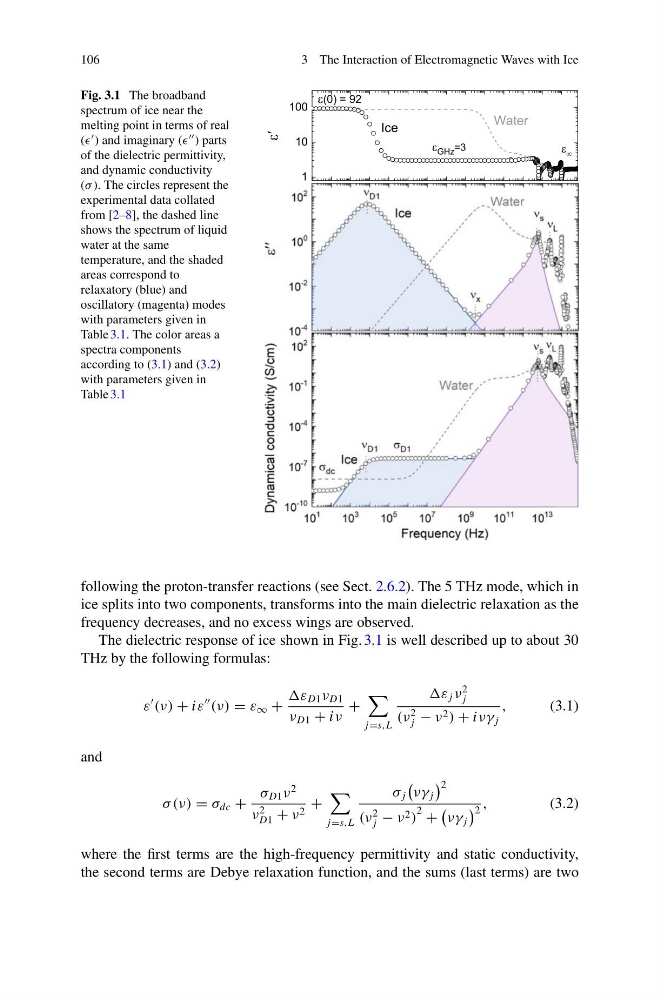
Fig. 3.1 The broadband
spectrum of ice near the
melting point in terms of real
( ) and imaginary ( ) parts
of the dielectric permittivity,
and dynamic conductivity
(σ ). The circles represent the
experimental data collated
from [2–8], the dashed line
shows the spectrum of liquid
water at the same
temperature, and the shaded
areas correspond to
relaxatory (blue) and
oscillatory (magenta) modes
with parameters given in
Table 3.1. The color areas a
spectra components
according to (3.1) and (3.2)
with parameters given in
Table 3.1
following the proton-transfer reactions (see Sect. 2.6.2). The 5 THz mode, which in
ice splits into two components, transforms into the main dielectric relaxation as the
frequency decreases, and no excess wings are observed.
The dielectric response of ice shown in Fig. 3.1 is well described up to about 30
THz by the following formulas:
ε
(ν) + iε
(ν) = ε ∞ +
D1 ν D1
ν D1 + iν
+
j=s,L
j ν
2
j
(ν
2
j − ν 2 ) + iνγ j
,
(3.1)
and
σ (ν) = σ dc +
σ D1 ν
2
ν
2
D1 + ν 2 +
j=s,L
σ j
νγ j
2
(ν
2
j − ν 2 )
2 +
νγ j
2 ,
(3.2)
where the first terms are the high-frequency permittivity and static conductivity,
the second terms are Debye relaxation function, and the sums (last terms) are two
3 The Interaction of Electromagnetic Waves with Ice
Fig. 3.1 The broadband
spectrum of ice near the
melting point in terms of real
( ) and imaginary ( ) parts
of the dielectric permittivity,
and dynamic conductivity
(σ ). The circles represent the
experimental data collated
from [2–8], the dashed line
shows the spectrum of liquid
water at the same
temperature, and the shaded
areas correspond to
relaxatory (blue) and
oscillatory (magenta) modes
with parameters given in
Table 3.1. The color areas a
spectra components
according to (3.1) and (3.2)
with parameters given in
Table 3.1
following the proton-transfer reactions (see Sect. 2.6.2). The 5 THz mode, which in
ice splits into two components, transforms into the main dielectric relaxation as the
frequency decreases, and no excess wings are observed.
The dielectric response of ice shown in Fig. 3.1 is well described up to about 30
THz by the following formulas:
ε
(ν) + iε
(ν) = ε ∞ +
D1 ν D1
ν D1 + iν
+
j=s,L
j ν
2
j
(ν
2
j − ν 2 ) + iνγ j
,
(3.1)
and
σ (ν) = σ dc +
σ D1 ν
2
ν
2
D1 + ν 2 +
j=s,L
σ j
νγ j
2
(ν
2
j − ν 2 )
2 +
νγ j
2 ,
(3.2)
where the first terms are the high-frequency permittivity and static conductivity,
the second terms are Debye relaxation function, and the sums (last terms) are two