

100
2 The Interaction of Electromagnetic Waves with Water
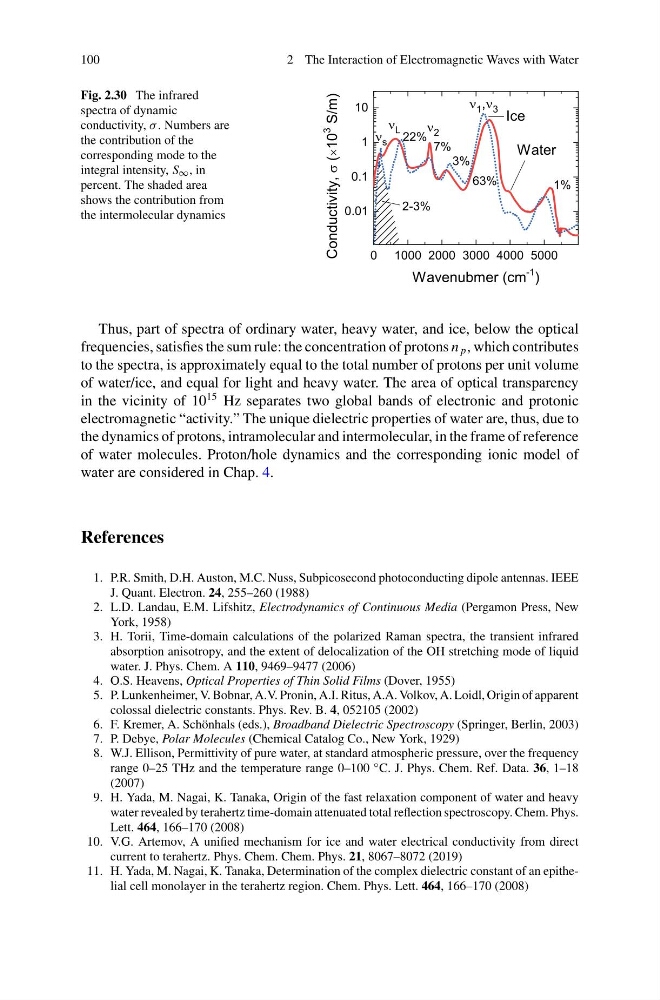
Fig. 2.30 The infrared
spectra of dynamic
conductivity, σ . Numbers are
the contribution of the
corresponding mode to the
integral intensity, S ∞ , in
percent. The shaded area
shows the contribution from
the intermolecular dynamics
Thus, part of spectra of ordinary water, heavy water, and ice, below the optical
frequencies, satisfies the sum rule: the concentration of protons n p , which contributes
to the spectra, is approximately equal to the total number of protons per unit volume
of water/ice, and equal for light and heavy water. The area of optical transparency
in the vicinity of 10
15 Hz separates two global bands of electronic and protonic
electromagnetic “activity.” The unique dielectric properties of water are, thus, due to
the dynamics of protons, intramolecular and intermolecular, in the frame of reference
of water molecules. Proton/hole dynamics and the corresponding ionic model of
water are considered in Chap. 4.
References
1. P.R. Smith, D.H. Auston, M.C. Nuss, Subpicosecond photoconducting dipole antennas. IEEE
J. Quant. Electron. 24, 255–260 (1988)
2. L.D. Landau, E.M. Lifshitz, Electrodynamics of Continuous Media (Pergamon Press, New
York, 1958)
3. H. Torii, Time-domain calculations of the polarized Raman spectra, the transient infrared
absorption anisotropy, and the extent of delocalization of the OH stretching mode of liquid
water. J. Phys. Chem. A 110, 9469–9477 (2006)
4. O.S. Heavens, Optical Properties of Thin Solid Films (Dover, 1955)
5. P. Lunkenheimer, V. Bobnar, A.V. Pronin, A.I. Ritus, A.A. Volkov, A. Loidl, Origin of apparent
colossal dielectric constants. Phys. Rev. B. 4, 052105 (2002)
6. F. Kremer, A. Schönhals (eds.), Broadband Dielectric Spectroscopy (Springer, Berlin, 2003)
7. P. Debye, Polar Molecules (Chemical Catalog Co., New York, 1929)
8. W.J. Ellison, Permittivity of pure water, at standard atmospheric pressure, over the frequency
range 0–25 THz and the temperature range 0–100 ◦ C. J. Phys. Chem. Ref. Data. 36, 1–18
(2007)
9. H. Yada, M. Nagai, K. Tanaka, Origin of the fast relaxation component of water and heavy
water revealed by terahertz time-domain attenuated total reflection spectroscopy. Chem. Phys.
Lett. 464, 166–170 (2008)
10. V.G. Artemov, A unified mechanism for ice and water electrical conductivity from direct
current to terahertz. Phys. Chem. Chem. Phys. 21, 8067–8072 (2019)
11. H. Yada, M. Nagai, K. Tanaka, Determination of the complex dielectric constant of an epithelial cell monolayer in the terahertz region. Chem. Phys. Lett. 464, 166–170 (2008)
2 The Interaction of Electromagnetic Waves with Water
Fig. 2.30 The infrared
spectra of dynamic
conductivity, σ . Numbers are
the contribution of the
corresponding mode to the
integral intensity, S ∞ , in
percent. The shaded area
shows the contribution from
the intermolecular dynamics
Thus, part of spectra of ordinary water, heavy water, and ice, below the optical
frequencies, satisfies the sum rule: the concentration of protons n p , which contributes
to the spectra, is approximately equal to the total number of protons per unit volume
of water/ice, and equal for light and heavy water. The area of optical transparency
in the vicinity of 10
15 Hz separates two global bands of electronic and protonic
electromagnetic “activity.” The unique dielectric properties of water are, thus, due to
the dynamics of protons, intramolecular and intermolecular, in the frame of reference
of water molecules. Proton/hole dynamics and the corresponding ionic model of
water are considered in Chap. 4.
References
1. P.R. Smith, D.H. Auston, M.C. Nuss, Subpicosecond photoconducting dipole antennas. IEEE
J. Quant. Electron. 24, 255–260 (1988)
2. L.D. Landau, E.M. Lifshitz, Electrodynamics of Continuous Media (Pergamon Press, New
York, 1958)
3. H. Torii, Time-domain calculations of the polarized Raman spectra, the transient infrared
absorption anisotropy, and the extent of delocalization of the OH stretching mode of liquid
water. J. Phys. Chem. A 110, 9469–9477 (2006)
4. O.S. Heavens, Optical Properties of Thin Solid Films (Dover, 1955)
5. P. Lunkenheimer, V. Bobnar, A.V. Pronin, A.I. Ritus, A.A. Volkov, A. Loidl, Origin of apparent
colossal dielectric constants. Phys. Rev. B. 4, 052105 (2002)
6. F. Kremer, A. Schönhals (eds.), Broadband Dielectric Spectroscopy (Springer, Berlin, 2003)
7. P. Debye, Polar Molecules (Chemical Catalog Co., New York, 1929)
8. W.J. Ellison, Permittivity of pure water, at standard atmospheric pressure, over the frequency
range 0–25 THz and the temperature range 0–100 ◦ C. J. Phys. Chem. Ref. Data. 36, 1–18
(2007)
9. H. Yada, M. Nagai, K. Tanaka, Origin of the fast relaxation component of water and heavy
water revealed by terahertz time-domain attenuated total reflection spectroscopy. Chem. Phys.
Lett. 464, 166–170 (2008)
10. V.G. Artemov, A unified mechanism for ice and water electrical conductivity from direct
current to terahertz. Phys. Chem. Chem. Phys. 21, 8067–8072 (2019)
11. H. Yada, M. Nagai, K. Tanaka, Determination of the complex dielectric constant of an epithelial cell monolayer in the terahertz region. Chem. Phys. Lett. 464, 166–170 (2008)