

2.8 The Conductivity Sum Rule
97
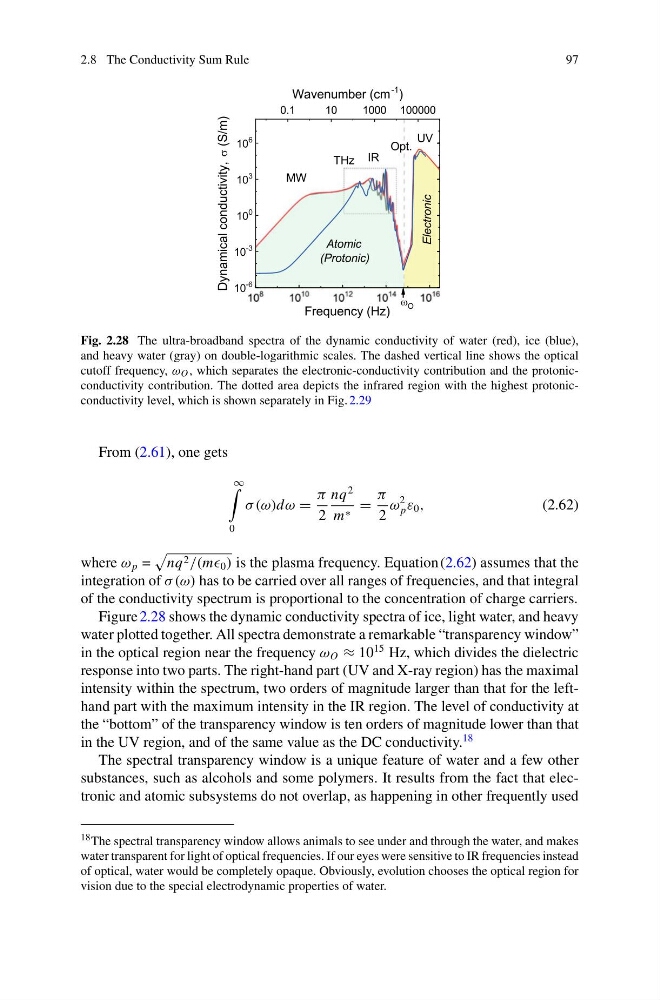
Fig. 2.28 The ultra-broadband spectra of the dynamic conductivity of water (red), ice (blue),
and heavy water (gray) on double-logarithmic scales. The dashed vertical line shows the optical
cutoff frequency, ω O , which separates the electronic-conductivity contribution and the protonicconductivity contribution. The dotted area depicts the infrared region with the highest protonicconductivity level, which is shown separately in Fig. 2.29
From (2.61), one gets
∞
0
σ (ω)dω =
π
2
nq
2
m ∗ =
π
2
ω
2
p ε 0 ,
(2.62)
where ω p =
nq 2 /(m 0 ) is the plasma frequency. Equation (2.62) assumes that the
integration of σ (ω) has to be carried over all ranges of frequencies, and that integral
of the conductivity spectrum is proportional to the concentration of charge carriers.
Figure 2.28 shows the dynamic conductivity spectra of ice, light water, and heavy
water plotted together. All spectra demonstrate a remarkable “transparency window”
in the optical region near the frequency ω O ≈ 10
15 Hz, which divides the dielectric
response into two parts. The right-hand part (UV and X-ray region) has the maximal
intensity within the spectrum, two orders of magnitude larger than that for the lefthand part with the maximum intensity in the IR region. The level of conductivity at
the “bottom” of the transparency window is ten orders of magnitude lower than that
in the UV region, and of the same value as the DC conductivity.
18
The spectral transparency window is a unique feature of water and a few other
substances, such as alcohols and some polymers. It results from the fact that electronic and atomic subsystems do not overlap, as happening in other frequently used
18 The spectral transparency window allows animals to see under and through the water, and makes
water transparent for light of optical frequencies. If our eyes were sensitive to IR frequencies instead
of optical, water would be completely opaque. Obviously, evolution chooses the optical region for
vision due to the special electrodynamic properties of water.
97
Fig. 2.28 The ultra-broadband spectra of the dynamic conductivity of water (red), ice (blue),
and heavy water (gray) on double-logarithmic scales. The dashed vertical line shows the optical
cutoff frequency, ω O , which separates the electronic-conductivity contribution and the protonicconductivity contribution. The dotted area depicts the infrared region with the highest protonicconductivity level, which is shown separately in Fig. 2.29
From (2.61), one gets
∞
0
σ (ω)dω =
π
2
nq
2
m ∗ =
π
2
ω
2
p ε 0 ,
(2.62)
where ω p =
nq 2 /(m 0 ) is the plasma frequency. Equation (2.62) assumes that the
integration of σ (ω) has to be carried over all ranges of frequencies, and that integral
of the conductivity spectrum is proportional to the concentration of charge carriers.
Figure 2.28 shows the dynamic conductivity spectra of ice, light water, and heavy
water plotted together. All spectra demonstrate a remarkable “transparency window”
in the optical region near the frequency ω O ≈ 10
15 Hz, which divides the dielectric
response into two parts. The right-hand part (UV and X-ray region) has the maximal
intensity within the spectrum, two orders of magnitude larger than that for the lefthand part with the maximum intensity in the IR region. The level of conductivity at
the “bottom” of the transparency window is ten orders of magnitude lower than that
in the UV region, and of the same value as the DC conductivity.
18
The spectral transparency window is a unique feature of water and a few other
substances, such as alcohols and some polymers. It results from the fact that electronic and atomic subsystems do not overlap, as happening in other frequently used
18 The spectral transparency window allows animals to see under and through the water, and makes
water transparent for light of optical frequencies. If our eyes were sensitive to IR frequencies instead
of optical, water would be completely opaque. Obviously, evolution chooses the optical region for
vision due to the special electrodynamic properties of water.