

2.6 The Terahertz Spectrum of Water
89
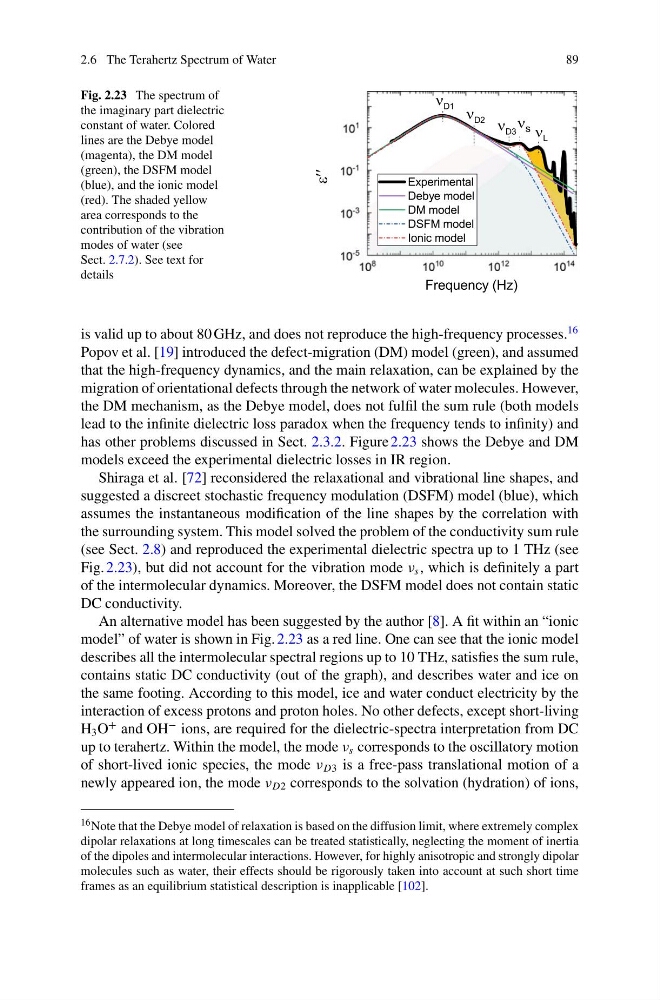
Fig. 2.23 The spectrum of
the imaginary part dielectric
constant of water. Colored
lines are the Debye model
(magenta), the DM model
(green), the DSFM model
(blue), and the ionic model
(red). The shaded yellow
area corresponds to the
contribution of the vibration
modes of water (see
Sect. 2.7.2). See text for
details
is valid up to about 80 GHz, and does not reproduce the high-frequency processes.
16
Popov et al. [19] introduced the defect-migration (DM) model (green), and assumed
that the high-frequency dynamics, and the main relaxation, can be explained by the
migration of orientational defects through the network of water molecules. However,
the DM mechanism, as the Debye model, does not fulfil the sum rule (both models
lead to the infinite dielectric loss paradox when the frequency tends to infinity) and
has other problems discussed in Sect. 2.3.2. Figure 2.23 shows the Debye and DM
models exceed the experimental dielectric losses in IR region.
Shiraga et al. [72] reconsidered the relaxational and vibrational line shapes, and
suggested a discreet stochastic frequency modulation (DSFM) model (blue), which
assumes the instantaneous modification of the line shapes by the correlation with
the surrounding system. This model solved the problem of the conductivity sum rule
(see Sect. 2.8) and reproduced the experimental dielectric spectra up to 1 THz (see
Fig. 2.23), but did not account for the vibration mode ν s , which is definitely a part
of the intermolecular dynamics. Moreover, the DSFM model does not contain static
DC conductivity.
An alternative model has been suggested by the author [8]. A fit within an “ionic
model” of water is shown in Fig. 2.23 as a red line. One can see that the ionic model
describes all the intermolecular spectral regions up to 10 THz, satisfies the sum rule,
contains static DC conductivity (out of the graph), and describes water and ice on
the same footing. According to this model, ice and water conduct electricity by the
interaction of excess protons and proton holes. No other defects, except short-living
H 3 O
+ and OH
− ions, are required for the dielectric-spectra interpretation from DC
up to terahertz. Within the model, the mode ν s corresponds to the oscillatory motion
of short-lived ionic species, the mode ν D3 is a free-pass translational motion of a
newly appeared ion, the mode ν D2 corresponds to the solvation (hydration) of ions,
16 Note that the Debye model of relaxation is based on the diffusion limit, where extremely complex
dipolar relaxations at long timescales can be treated statistically, neglecting the moment of inertia
of the dipoles and intermolecular interactions. However, for highly anisotropic and strongly dipolar
molecules such as water, their effects should be rigorously taken into account at such short time
frames as an equilibrium statistical description is inapplicable [102].
89
Fig. 2.23 The spectrum of
the imaginary part dielectric
constant of water. Colored
lines are the Debye model
(magenta), the DM model
(green), the DSFM model
(blue), and the ionic model
(red). The shaded yellow
area corresponds to the
contribution of the vibration
modes of water (see
Sect. 2.7.2). See text for
details
is valid up to about 80 GHz, and does not reproduce the high-frequency processes.
16
Popov et al. [19] introduced the defect-migration (DM) model (green), and assumed
that the high-frequency dynamics, and the main relaxation, can be explained by the
migration of orientational defects through the network of water molecules. However,
the DM mechanism, as the Debye model, does not fulfil the sum rule (both models
lead to the infinite dielectric loss paradox when the frequency tends to infinity) and
has other problems discussed in Sect. 2.3.2. Figure 2.23 shows the Debye and DM
models exceed the experimental dielectric losses in IR region.
Shiraga et al. [72] reconsidered the relaxational and vibrational line shapes, and
suggested a discreet stochastic frequency modulation (DSFM) model (blue), which
assumes the instantaneous modification of the line shapes by the correlation with
the surrounding system. This model solved the problem of the conductivity sum rule
(see Sect. 2.8) and reproduced the experimental dielectric spectra up to 1 THz (see
Fig. 2.23), but did not account for the vibration mode ν s , which is definitely a part
of the intermolecular dynamics. Moreover, the DSFM model does not contain static
DC conductivity.
An alternative model has been suggested by the author [8]. A fit within an “ionic
model” of water is shown in Fig. 2.23 as a red line. One can see that the ionic model
describes all the intermolecular spectral regions up to 10 THz, satisfies the sum rule,
contains static DC conductivity (out of the graph), and describes water and ice on
the same footing. According to this model, ice and water conduct electricity by the
interaction of excess protons and proton holes. No other defects, except short-living
H 3 O
+ and OH
− ions, are required for the dielectric-spectra interpretation from DC
up to terahertz. Within the model, the mode ν s corresponds to the oscillatory motion
of short-lived ionic species, the mode ν D3 is a free-pass translational motion of a
newly appeared ion, the mode ν D2 corresponds to the solvation (hydration) of ions,
16 Note that the Debye model of relaxation is based on the diffusion limit, where extremely complex
dipolar relaxations at long timescales can be treated statistically, neglecting the moment of inertia
of the dipoles and intermolecular interactions. However, for highly anisotropic and strongly dipolar
molecules such as water, their effects should be rigorously taken into account at such short time
frames as an equilibrium statistical description is inapplicable [102].