

2.6 The Terahertz Spectrum of Water
87
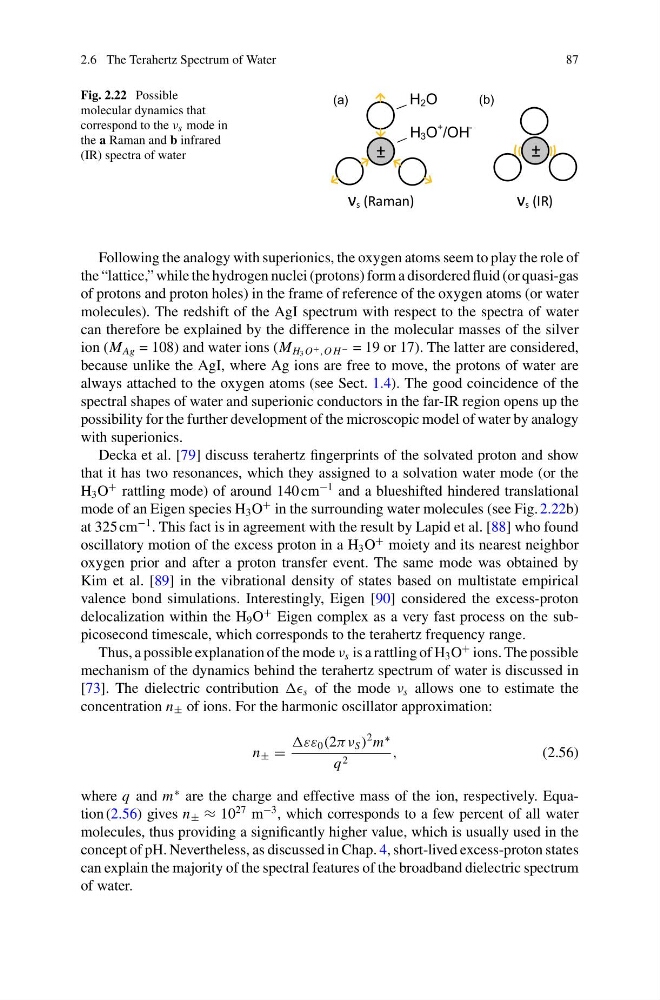
Fig. 2.22 Possible
molecular dynamics that
correspond to the ν s mode in
the a Raman and b infrared
(IR) spectra of water
±
±
(a)
(b)
H 3 O
+ /OH
-
ν s (Raman)
H 2 O
ν s (IR)
Following the analogy with superionics, the oxygen atoms seem to play the role of
the “lattice,” while the hydrogen nuclei (protons) form a disordered fluid (or quasi-gas
of protons and proton holes) in the frame of reference of the oxygen atoms (or water
molecules). The redshift of the AgI spectrum with respect to the spectra of water
can therefore be explained by the difference in the molecular masses of the silver
ion (M Ag = 108) and water ions (M H 3 O + ,O H − = 19 or 17). The latter are considered,
because unlike the AgI, where Ag ions are free to move, the protons of water are
always attached to the oxygen atoms (see Sect. 1.4). The good coincidence of the
spectral shapes of water and superionic conductors in the far-IR region opens up the
possibility for the further development of the microscopic model of water by analogy
with superionics.
Decka et al. [79] discuss terahertz fingerprints of the solvated proton and show
that it has two resonances, which they assigned to a solvation water mode (or the
H 3 O
+ rattling mode) of around 140 cm
−1 and a blueshifted hindered translational
mode of an Eigen species H 3 O
+ in the surrounding water molecules (see Fig. 2.22b)
at 325 cm
−1 . This fact is in agreement with the result by Lapid et al. [88] who found
oscillatory motion of the excess proton in a H 3 O
+ moiety and its nearest neighbor
oxygen prior and after a proton transfer event. The same mode was obtained by
Kim et al. [89] in the vibrational density of states based on multistate empirical
valence bond simulations. Interestingly, Eigen [90] considered the excess-proton
delocalization within the H 9 O
+ Eigen complex as a very fast process on the subpicosecond timescale, which corresponds to the terahertz frequency range.
Thus, a possible explanation of the mode ν s is a rattling of H 3 O
+ ions. The possible
mechanism of the dynamics behind the terahertz spectrum of water is discussed in
[73]. The dielectric contribution s of the mode ν s allows one to estimate the
concentration n ± of ions. For the harmonic oscillator approximation:
n ± =
εε 0 (2πν S )
2 m
∗
q 2
,
(2.56)
where q and m
∗ are the charge and effective mass of the ion, respectively. Equation (2.56) gives n ± ≈ 10
27 m
−3 , which corresponds to a few percent of all water
molecules, thus providing a significantly higher value, which is usually used in the
concept of pH. Nevertheless, as discussed in Chap. 4, short-lived excess-proton states
can explain the majority of the spectral features of the broadband dielectric spectrum
of water.
87
Fig. 2.22 Possible
molecular dynamics that
correspond to the ν s mode in
the a Raman and b infrared
(IR) spectra of water
±
±
(a)
(b)
H 3 O
+ /OH
-
ν s (Raman)
H 2 O
ν s (IR)
Following the analogy with superionics, the oxygen atoms seem to play the role of
the “lattice,” while the hydrogen nuclei (protons) form a disordered fluid (or quasi-gas
of protons and proton holes) in the frame of reference of the oxygen atoms (or water
molecules). The redshift of the AgI spectrum with respect to the spectra of water
can therefore be explained by the difference in the molecular masses of the silver
ion (M Ag = 108) and water ions (M H 3 O + ,O H − = 19 or 17). The latter are considered,
because unlike the AgI, where Ag ions are free to move, the protons of water are
always attached to the oxygen atoms (see Sect. 1.4). The good coincidence of the
spectral shapes of water and superionic conductors in the far-IR region opens up the
possibility for the further development of the microscopic model of water by analogy
with superionics.
Decka et al. [79] discuss terahertz fingerprints of the solvated proton and show
that it has two resonances, which they assigned to a solvation water mode (or the
H 3 O
+ rattling mode) of around 140 cm
−1 and a blueshifted hindered translational
mode of an Eigen species H 3 O
+ in the surrounding water molecules (see Fig. 2.22b)
at 325 cm
−1 . This fact is in agreement with the result by Lapid et al. [88] who found
oscillatory motion of the excess proton in a H 3 O
+ moiety and its nearest neighbor
oxygen prior and after a proton transfer event. The same mode was obtained by
Kim et al. [89] in the vibrational density of states based on multistate empirical
valence bond simulations. Interestingly, Eigen [90] considered the excess-proton
delocalization within the H 9 O
+ Eigen complex as a very fast process on the subpicosecond timescale, which corresponds to the terahertz frequency range.
Thus, a possible explanation of the mode ν s is a rattling of H 3 O
+ ions. The possible
mechanism of the dynamics behind the terahertz spectrum of water is discussed in
[73]. The dielectric contribution s of the mode ν s allows one to estimate the
concentration n ± of ions. For the harmonic oscillator approximation:
n ± =
εε 0 (2πν S )
2 m
∗
q 2
,
(2.56)
where q and m
∗ are the charge and effective mass of the ion, respectively. Equation (2.56) gives n ± ≈ 10
27 m
−3 , which corresponds to a few percent of all water
molecules, thus providing a significantly higher value, which is usually used in the
concept of pH. Nevertheless, as discussed in Chap. 4, short-lived excess-proton states
can explain the majority of the spectral features of the broadband dielectric spectrum
of water.