

67
Edge Detection and Segmentation of Images
(a)
(b)
(c)
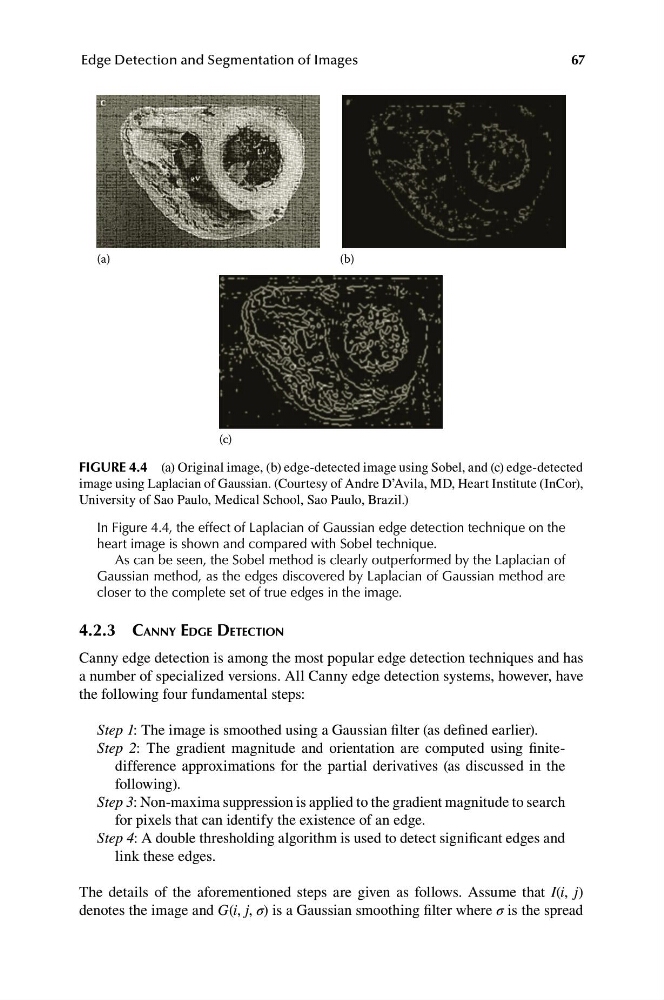
FIGURE 4.4 (a) Original image, (b) edge-detected image using Sobel, and (c) edge-detected
image using Laplacian of Gaussian. (Courtesy of Andre D’Avila, MD, Heart Institute (InCor),
University of Sao Paulo, Medical School, Sao Paulo, Brazil.)
In Figure 4.4, the effect of Laplacian of Gaussian edge detection technique on the
heart image is shown and compared with Sobel technique.
As can be seen, the Sobel method is clearly outperformed by the Laplacian of
Gaussian method, as the edges discovered by Laplacian of Gaussian method are
closer to the complete set of true edges in the image.
4.2.3 CANNY EDGE DETECTION
Canny edge detection is among the most popular edge detection techniques and has
a number of specialized versions. All Canny edge detection systems, however, have
the following four fundamental steps:
Step 1: The image is smoothed using a Gaussian filter (as defined earlier).
Step 2: The gradient magnitude and orientation are computed using finitedifference approximations for the partial derivatives (as discussed in the
following).
Step 3: Non-maxima suppression is applied to the gradient magnitude to search
for pixels that can identify the existence of an edge.
Step 4: A double thresholding algorithm is used to detect significant edges and
link these edges.
The details of the aforementioned steps are given as follows. Assume that I(i, j)
denotes the image and G(i, j, σ) is a Gaussian smoothing filter where σ is the spread
Edge Detection and Segmentation of Images
(a)
(b)
(c)
FIGURE 4.4 (a) Original image, (b) edge-detected image using Sobel, and (c) edge-detected
image using Laplacian of Gaussian. (Courtesy of Andre D’Avila, MD, Heart Institute (InCor),
University of Sao Paulo, Medical School, Sao Paulo, Brazil.)
In Figure 4.4, the effect of Laplacian of Gaussian edge detection technique on the
heart image is shown and compared with Sobel technique.
As can be seen, the Sobel method is clearly outperformed by the Laplacian of
Gaussian method, as the edges discovered by Laplacian of Gaussian method are
closer to the complete set of true edges in the image.
4.2.3 CANNY EDGE DETECTION
Canny edge detection is among the most popular edge detection techniques and has
a number of specialized versions. All Canny edge detection systems, however, have
the following four fundamental steps:
Step 1: The image is smoothed using a Gaussian filter (as defined earlier).
Step 2: The gradient magnitude and orientation are computed using finitedifference approximations for the partial derivatives (as discussed in the
following).
Step 3: Non-maxima suppression is applied to the gradient magnitude to search
for pixels that can identify the existence of an edge.
Step 4: A double thresholding algorithm is used to detect significant edges and
link these edges.
The details of the aforementioned steps are given as follows. Assume that I(i, j)
denotes the image and G(i, j, σ) is a Gaussian smoothing filter where σ is the spread