

Image Filtering, Enhancement, and Restoration
61
3.4.2.2 Butterworth High-Pass Filters
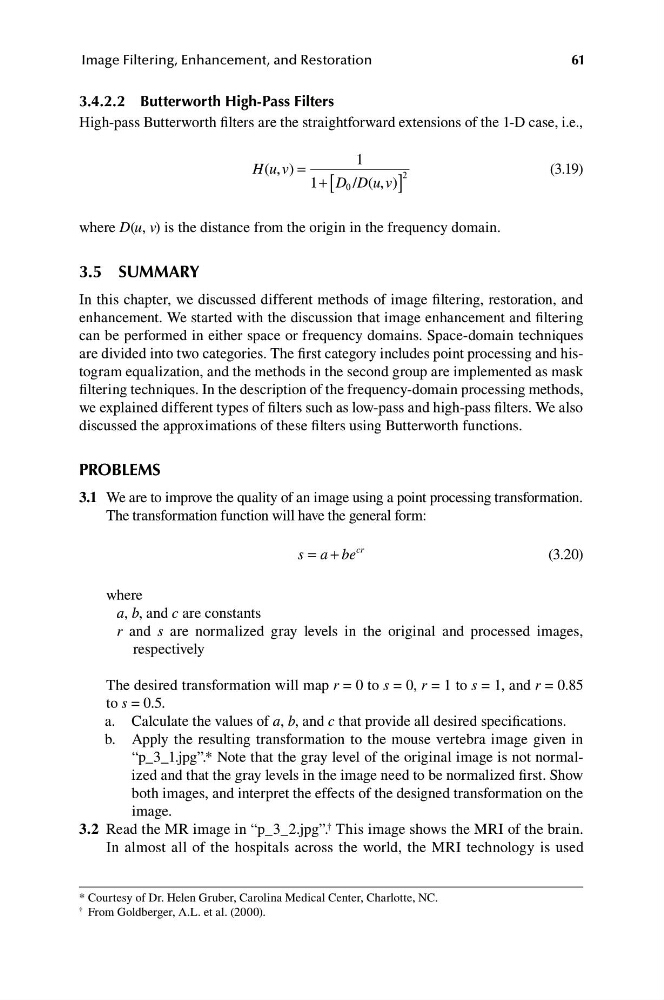
High-pass Butterworth filters are the straightforward extensions of the 1-D case, i.e.,
1
H u v =
(3.19)
( , )
2
1+ [ D D u v
/ ( , ) ]
0
where D(u, v) is the distance from the origin in the frequency domain.
3.5 SUMMARY
In this chapter, we discussed different methods of image filtering, restoration, and
enhancement. We started with the discussion that image enhancement and filtering
can be performed in either space or frequency domains. Space-domain techniques
are divided into two categories. The first category includes point processing and histogram equalization, and the methods in the second group are implemented as mask
filtering techniques. In the description of the frequency-domain processing methods,
we explained different types of filters such as low-pass and high-pass filters. We also
discussed the approximations of these filters using Butterworth functions.
PROBLEMS
3.1 We are to improve the quality of an image using a point processing transformation.
The transformation function will have the general form:
s a be
cr
(3.20)
= +
where
a, b, and c are constants
r and s are normalized gray levels in the original and processed images,
respectively
The desired transformation will map r = 0 to s = 0, r = 1 to s = 1, and r = 0.85
to s = 0.5.
a. Calculate the values of a, b, and c that provide all desired specifications.
b. A pply the resulting transformation to the mouse vertebra image given in
“p_3_1.jpg”.* Note that the gray level of the original image is not normalized and that the gray levels in the image need to be normalized first. Show
both images, and interpret the effects of the designed transformation on the
image.
3.2 R ead the MR image in “p_3_2.jpg”. † This image shows the MRI of the brain.
In almost all of the hospitals across the world, the MRI technology is used
* Courtesy of Dr. Helen Gruber, Carolina Medical Center, Charlotte, NC.
† From Goldberger, A.L. et al. (2000).
61
3.4.2.2 Butterworth High-Pass Filters
High-pass Butterworth filters are the straightforward extensions of the 1-D case, i.e.,
1
H u v =
(3.19)
( , )
2
1+ [ D D u v
/ ( , ) ]
0
where D(u, v) is the distance from the origin in the frequency domain.
3.5 SUMMARY
In this chapter, we discussed different methods of image filtering, restoration, and
enhancement. We started with the discussion that image enhancement and filtering
can be performed in either space or frequency domains. Space-domain techniques
are divided into two categories. The first category includes point processing and histogram equalization, and the methods in the second group are implemented as mask
filtering techniques. In the description of the frequency-domain processing methods,
we explained different types of filters such as low-pass and high-pass filters. We also
discussed the approximations of these filters using Butterworth functions.
PROBLEMS
3.1 We are to improve the quality of an image using a point processing transformation.
The transformation function will have the general form:
s a be
cr
(3.20)
= +
where
a, b, and c are constants
r and s are normalized gray levels in the original and processed images,
respectively
The desired transformation will map r = 0 to s = 0, r = 1 to s = 1, and r = 0.85
to s = 0.5.
a. Calculate the values of a, b, and c that provide all desired specifications.
b. A pply the resulting transformation to the mouse vertebra image given in
“p_3_1.jpg”.* Note that the gray level of the original image is not normalized and that the gray levels in the image need to be normalized first. Show
both images, and interpret the effects of the designed transformation on the
image.
3.2 R ead the MR image in “p_3_2.jpg”. † This image shows the MRI of the brain.
In almost all of the hospitals across the world, the MRI technology is used
* Courtesy of Dr. Helen Gruber, Carolina Medical Center, Charlotte, NC.
† From Goldberger, A.L. et al. (2000).