

52
Biomedical Signal and Image Processing
Example 3.7
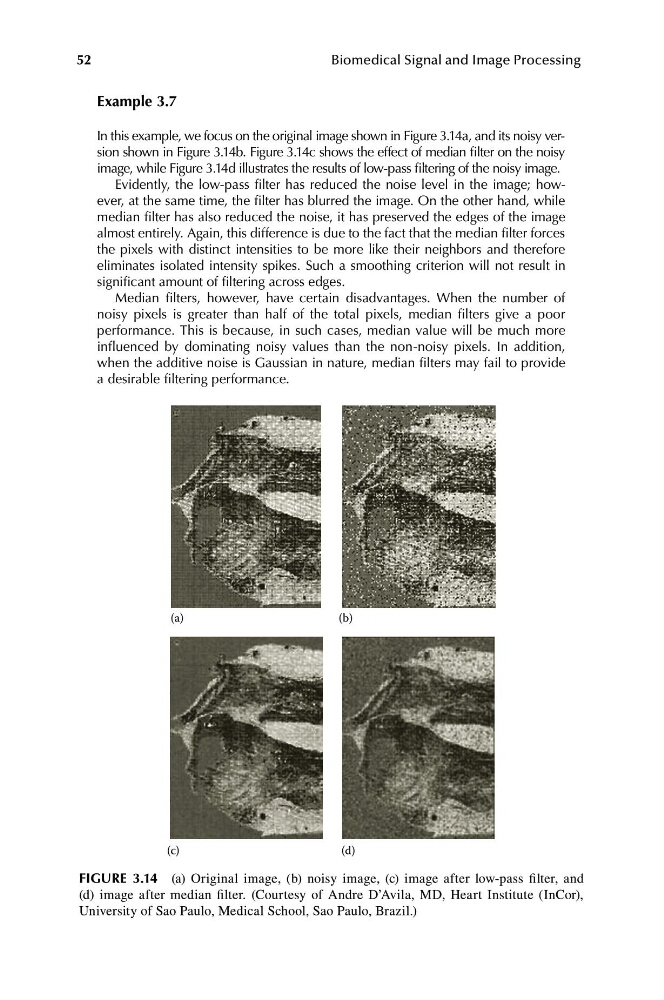
In this example, we focus on the original image shown in Figure 3.14a, and its noisy version shown in Figure 3.14b. Figure 3.14c shows the effect of median filter on the noisy
image, while Figure 3.14d illustrates the results of low-pass filtering of the noisy image.
Evidently, the low-pass filter has reduced the noise level in the image; however, at the same time, the filter has blurred the image. On the other hand, while
median filter has also reduced the noise, it has preserved the edges of the image
almost entirely. Again, this difference is due to the fact that the median filter forces
the pixels with distinct intensities to be more like their neighbors and therefore
eliminates isolated intensity spikes. Such a smoothing criterion will not result in
significant amount of filtering across edges.
Median filters, however, have certain disadvantages. When the number of
noisy pixels is greater than half of the total pixels, median filters give a poor
performance. This is because, in such cases, median value will be much more
influenced by dominating noisy values than the non-noisy pixels. In addition,
when the additive noise is Gaussian in nature, median filters may fail to provide
a desirable filtering performance.
(a)
(b)
(c)
(d)
FIGURE 3.14 (a) Original image, (b) noisy image, (c) image after low-pass filter, and
(d) image after median filter. (Courtesy of Andre D’Avila, MD, Heart Institute (InCor),
University of Sao Paulo, Medical School, Sao Paulo, Brazil.)
Biomedical Signal and Image Processing
Example 3.7
In this example, we focus on the original image shown in Figure 3.14a, and its noisy version shown in Figure 3.14b. Figure 3.14c shows the effect of median filter on the noisy
image, while Figure 3.14d illustrates the results of low-pass filtering of the noisy image.
Evidently, the low-pass filter has reduced the noise level in the image; however, at the same time, the filter has blurred the image. On the other hand, while
median filter has also reduced the noise, it has preserved the edges of the image
almost entirely. Again, this difference is due to the fact that the median filter forces
the pixels with distinct intensities to be more like their neighbors and therefore
eliminates isolated intensity spikes. Such a smoothing criterion will not result in
significant amount of filtering across edges.
Median filters, however, have certain disadvantages. When the number of
noisy pixels is greater than half of the total pixels, median filters give a poor
performance. This is because, in such cases, median value will be much more
influenced by dominating noisy values than the non-noisy pixels. In addition,
when the additive noise is Gaussian in nature, median filters may fail to provide
a desirable filtering performance.
(a)
(b)
(c)
(d)
FIGURE 3.14 (a) Original image, (b) noisy image, (c) image after low-pass filter, and
(d) image after median filter. (Courtesy of Andre D’Avila, MD, Heart Institute (InCor),
University of Sao Paulo, Medical School, Sao Paulo, Brazil.)