

ω(–1, –1)
ω(–1, 0)
ω(–1, 1)
ω(0, –1)
ω(0, 0)
ω(0, 1)
ω(1, –1)
ω(1, 0)
ω(1, 1)
48
Biomedical Signal and Image Processing
(a)
(b)
1600
1400
1200
1000
800
600
400
200
0
0
50
100
150
200
250
1600
1400
1200
1000
800
600
400
200
0
0
50
100
150
200
250
(c)
(d)
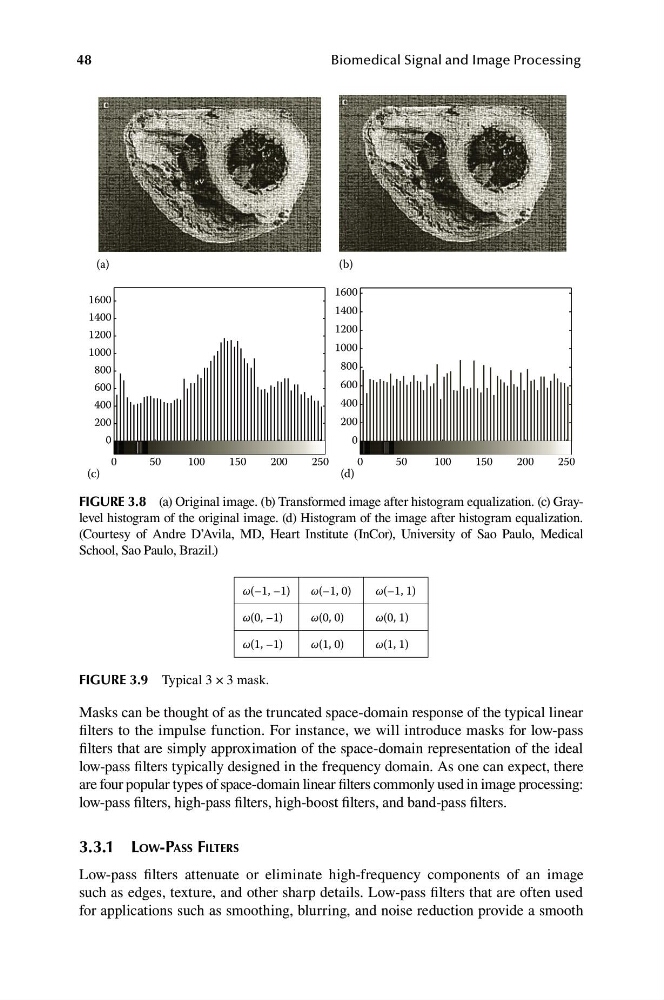
FIGURE 3.8 (a) Original image. (b) Transformed image after histogram equalization. (c) Graylevel histogram of the original image. (d) Histogram of the image after histogram equalization.
(Courtesy of Andre D’Avila, MD, Heart Institute (InCor), University of Sao Paulo, Medical
School, Sao Paulo, Brazil.)
FIGURE 3.9 Typical 3 × 3 mask.
Masks can be thought of as the truncated space-domain response of the typical linear
filters to the impulse function. For instance, we will introduce masks for low-pass
filters that are simply approximation of the space-domain representation of the ideal
low-pass filters typically designed in the frequency domain. As one can expect, there
are four popular types of space-domain linear filters commonly used in image processing:
low-pass filters, high-pass filters, high-boost filters, and band-pass filters.
3.3.1 LOW-PASS FILTERS
Low-pass filters attenuate or eliminate high-frequency components of an image
such as edges, texture, and other sharp details. Low-pass filters that are often used
for applications such as smoothing, blurring, and noise reduction provide a smooth
ω(–1, 0)
ω(–1, 1)
ω(0, –1)
ω(0, 0)
ω(0, 1)
ω(1, –1)
ω(1, 0)
ω(1, 1)
48
Biomedical Signal and Image Processing
(a)
(b)
1600
1400
1200
1000
800
600
400
200
0
0
50
100
150
200
250
1600
1400
1200
1000
800
600
400
200
0
0
50
100
150
200
250
(c)
(d)
FIGURE 3.8 (a) Original image. (b) Transformed image after histogram equalization. (c) Graylevel histogram of the original image. (d) Histogram of the image after histogram equalization.
(Courtesy of Andre D’Avila, MD, Heart Institute (InCor), University of Sao Paulo, Medical
School, Sao Paulo, Brazil.)
FIGURE 3.9 Typical 3 × 3 mask.
Masks can be thought of as the truncated space-domain response of the typical linear
filters to the impulse function. For instance, we will introduce masks for low-pass
filters that are simply approximation of the space-domain representation of the ideal
low-pass filters typically designed in the frequency domain. As one can expect, there
are four popular types of space-domain linear filters commonly used in image processing:
low-pass filters, high-pass filters, high-boost filters, and band-pass filters.
3.3.1 LOW-PASS FILTERS
Low-pass filters attenuate or eliminate high-frequency components of an image
such as edges, texture, and other sharp details. Low-pass filters that are often used
for applications such as smoothing, blurring, and noise reduction provide a smooth