

18
Biomedical Signal and Image Processing
t
δ Δ (t)
Δ/2
1/Δ
–Δ/2
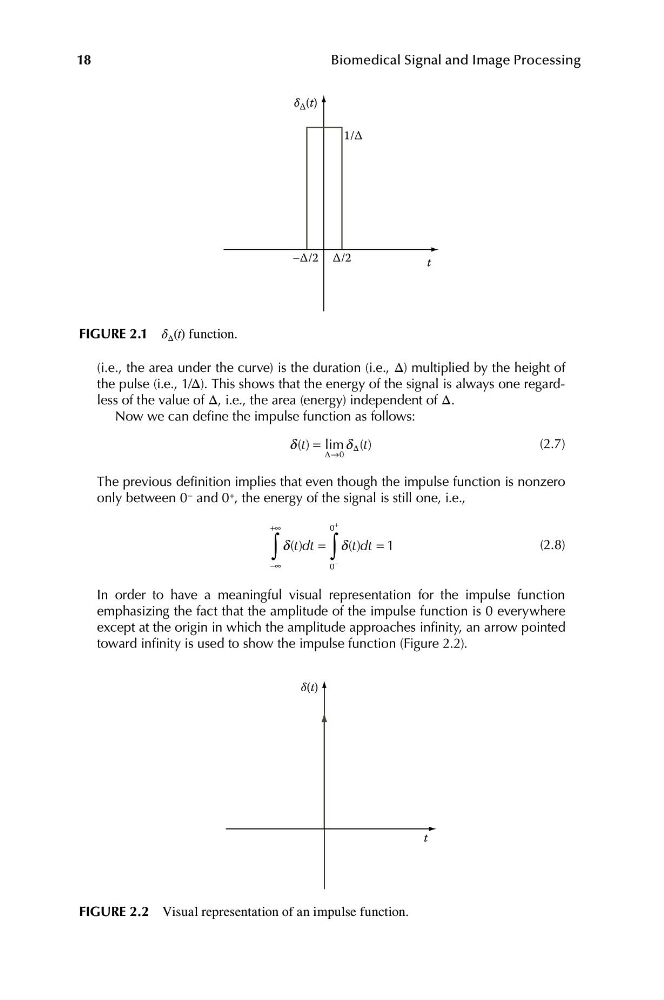
FIGURE 2.1 δ Δ (t) function.
(i.e., the area under the curve) is the duration (i.e., Δ) multiplied by the height of
the pulse (i.e., 1/Δ). This shows that the energy of the signal is always one regardless of the value of Δ, i.e., the area (energy) independent of Δ.
Now we can define the impulse function as follows:
d( )
t = lim d Δ ( )
t
(2.7)
Δ→0
The previous definition implies that even though the impulse function is nonzero
only between 0 − and 0 + , the energy of the signal is still one, i.e.,
+
+∞
0
d( )
t dt = d( )
t dt = 1
(2.8)
∫
∫
−
−∞
0
In order to have a meaningful visual representation for the impulse function
emphasizing the fact that the amplitude of the impulse function is 0 everywhere
except at the origin in which the amplitude approaches infinity, an arrow pointed
toward infinity is used to show the impulse function (Figure 2.2).
t
δ(t)
FIGURE 2.2 Visual representation of an impulse function.
Biomedical Signal and Image Processing
t
δ Δ (t)
Δ/2
1/Δ
–Δ/2
FIGURE 2.1 δ Δ (t) function.
(i.e., the area under the curve) is the duration (i.e., Δ) multiplied by the height of
the pulse (i.e., 1/Δ). This shows that the energy of the signal is always one regardless of the value of Δ, i.e., the area (energy) independent of Δ.
Now we can define the impulse function as follows:
d( )
t = lim d Δ ( )
t
(2.7)
Δ→0
The previous definition implies that even though the impulse function is nonzero
only between 0 − and 0 + , the energy of the signal is still one, i.e.,
+
+∞
0
d( )
t dt = d( )
t dt = 1
(2.8)
∫
∫
−
−∞
0
In order to have a meaningful visual representation for the impulse function
emphasizing the fact that the amplitude of the impulse function is 0 everywhere
except at the origin in which the amplitude approaches infinity, an arrow pointed
toward infinity is used to show the impulse function (Figure 2.2).
t
δ(t)
FIGURE 2.2 Visual representation of an impulse function.