

13
Signals and Biomedical Signal Processing
5/9
p(r)
3/9
0
1
2
r
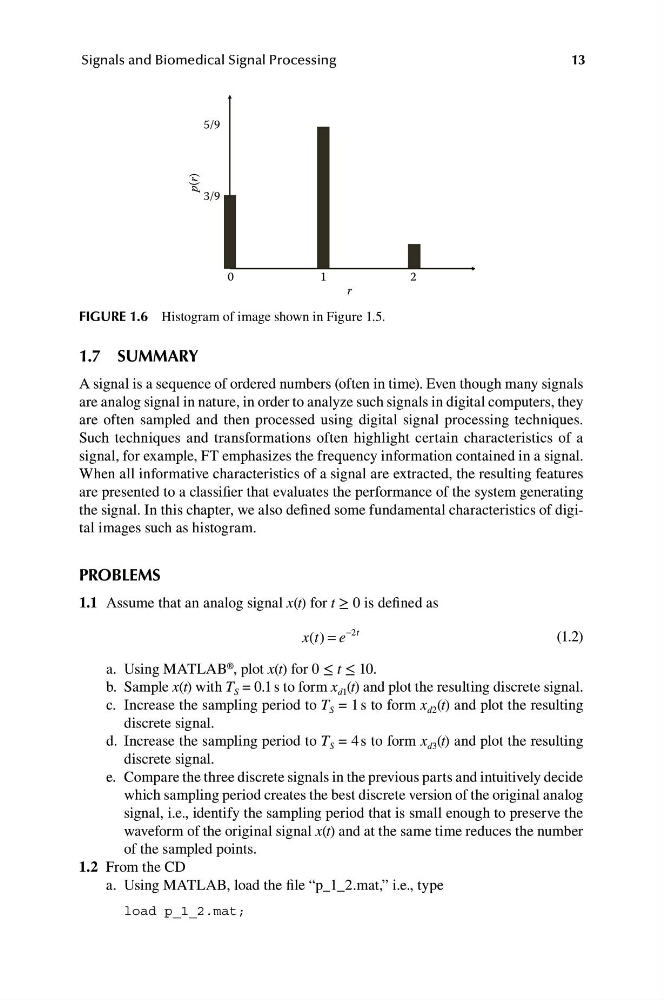
FIGURE 1.6 Histogram of image shown in Figure 1.5.
1.7 SUMMARY
A signal is a sequence of ordered numbers (often in time). Even though many signals
are analog signal in nature, in order to analyze such signals in digital computers, they
are often sampled and then processed using digital signal processing techniques.
Such techniques and transformations often highlight certain characteristics of a
signal, for example, FT emphasizes the frequency information contained in a signal.
When all informative characteristics of a signal are extracted, the resulting features
are presented to a classifier that evaluates the performance of the system generating
the signal. In this chapter, we also defined some fundamental characteristics of digital images such as histogram.
PROBLEMS
1.1 Assume that an analog signal x(t) for t ≥ 0 is defined as
x t
( ) = e
−2t
(1.2)
a. Using MATLAB ® , plot x(t) for 0 ≤ t ≤ 10.
b. Sample x(t) with T S = 0.1 s to form x d1 (t) and plot the resulting discrete signal.
c. I ncrease the sampling period to T S = 1 s to form x d2 (t) and plot the resulting
discrete signal.
d. Increase the sampling period to T S = 4 s to form x d3 (t) and plot the resulting
discrete signal.
e. Co mpare the three discrete signals in the previous parts and intuitively decide
which sampling period creates the best discrete version of the original analog
signal, i.e., identify the sampling period that is small enough to preserve the
waveform of the original signal x(t) and at the same time reduces the number
of the sampled points.
1.2 From the CD
a. Using MATLAB, load the file “p_1_2.mat,” i.e., type
load p_1_2.mat;
Signals and Biomedical Signal Processing
5/9
p(r)
3/9
0
1
2
r
FIGURE 1.6 Histogram of image shown in Figure 1.5.
1.7 SUMMARY
A signal is a sequence of ordered numbers (often in time). Even though many signals
are analog signal in nature, in order to analyze such signals in digital computers, they
are often sampled and then processed using digital signal processing techniques.
Such techniques and transformations often highlight certain characteristics of a
signal, for example, FT emphasizes the frequency information contained in a signal.
When all informative characteristics of a signal are extracted, the resulting features
are presented to a classifier that evaluates the performance of the system generating
the signal. In this chapter, we also defined some fundamental characteristics of digital images such as histogram.
PROBLEMS
1.1 Assume that an analog signal x(t) for t ≥ 0 is defined as
x t
( ) = e
−2t
(1.2)
a. Using MATLAB ® , plot x(t) for 0 ≤ t ≤ 10.
b. Sample x(t) with T S = 0.1 s to form x d1 (t) and plot the resulting discrete signal.
c. I ncrease the sampling period to T S = 1 s to form x d2 (t) and plot the resulting
discrete signal.
d. Increase the sampling period to T S = 4 s to form x d3 (t) and plot the resulting
discrete signal.
e. Co mpare the three discrete signals in the previous parts and intuitively decide
which sampling period creates the best discrete version of the original analog
signal, i.e., identify the sampling period that is small enough to preserve the
waveform of the original signal x(t) and at the same time reduces the number
of the sampled points.
1.2 From the CD
a. Using MATLAB, load the file “p_1_2.mat,” i.e., type
load p_1_2.mat;