

Epicardial temperature (°C)
1 cm
87.0
83.0
78.8
74.8
70.8
66.8
62.7
58.7
54.6
50.7
46.7
42.4
38.7
34.6
30.6
26.5
22.6
370
Biomedical Signal and Image Processing
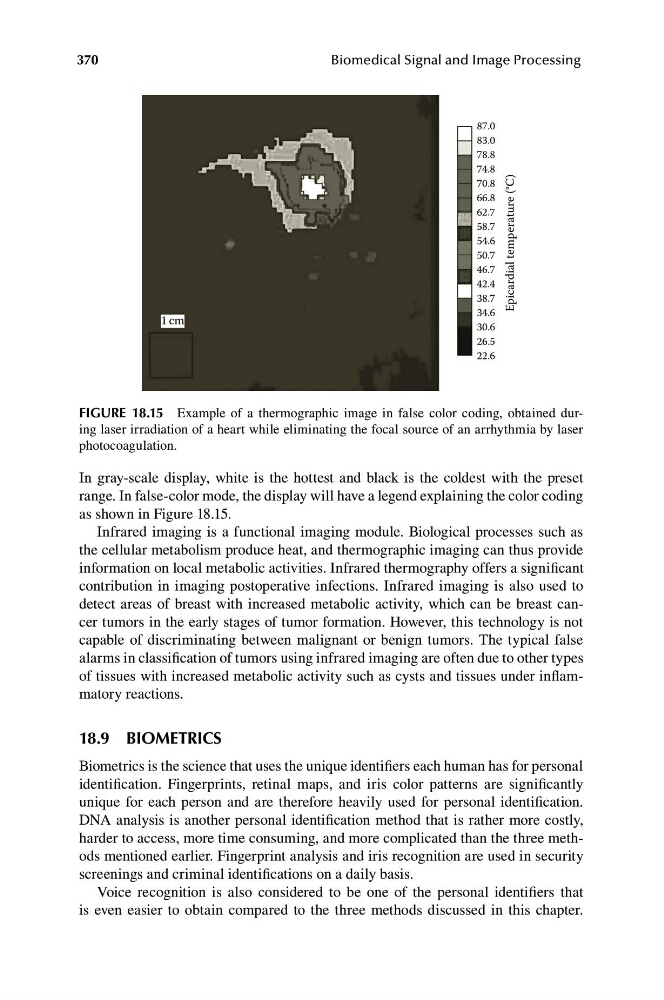
FIGURE 18.15 Example of a thermographic image in false color coding, obtained during laser irradiation of a heart while eliminating the focal source of an arrhythmia by laser
photocoagulation.
In gray-scale display, white is the hottest and black is the coldest with the preset
range. In false-color mode, the display will have a legend explaining the color coding
as shown in Figure 18.15.
Infrared imaging is a functional imaging module. Biological processes such as
the cellular metabolism produce heat, and thermographic imaging can thus provide
information on local metabolic activities. Infrared thermography offers a significant
contribution in imaging postoperative infections. Infrared imaging is also used to
detect areas of breast with increased metabolic activity, which can be breast cancer tumors in the early stages of tumor formation. However, this technology is not
capable of discriminating between malignant or benign tumors. The typical false
alarms in classification of tumors using infrared imaging are often due to other types
of tissues with increased metabolic activity such as cysts and tissues under inflammatory reactions.
18.9 BIOMETRICS
Biometrics is the science that uses the unique identifiers each human has for personal
identification. Fingerprints, retinal maps, and iris color patterns are significantly
unique for each person and are therefore heavily used for personal identification.
DNA analysis is another personal identification method that is rather more costly,
harder to access, more time consuming, and more complicated than the three methods mentioned earlier. Fingerprint analysis and iris recognition are used in security
screenings and criminal identifications on a daily basis.
Voice recognition is also considered to be one of the personal identifiers that
is even easier to obtain compared to the three methods discussed in this chapter.
1 cm
87.0
83.0
78.8
74.8
70.8
66.8
62.7
58.7
54.6
50.7
46.7
42.4
38.7
34.6
30.6
26.5
22.6
370
Biomedical Signal and Image Processing
FIGURE 18.15 Example of a thermographic image in false color coding, obtained during laser irradiation of a heart while eliminating the focal source of an arrhythmia by laser
photocoagulation.
In gray-scale display, white is the hottest and black is the coldest with the preset
range. In false-color mode, the display will have a legend explaining the color coding
as shown in Figure 18.15.
Infrared imaging is a functional imaging module. Biological processes such as
the cellular metabolism produce heat, and thermographic imaging can thus provide
information on local metabolic activities. Infrared thermography offers a significant
contribution in imaging postoperative infections. Infrared imaging is also used to
detect areas of breast with increased metabolic activity, which can be breast cancer tumors in the early stages of tumor formation. However, this technology is not
capable of discriminating between malignant or benign tumors. The typical false
alarms in classification of tumors using infrared imaging are often due to other types
of tissues with increased metabolic activity such as cysts and tissues under inflammatory reactions.
18.9 BIOMETRICS
Biometrics is the science that uses the unique identifiers each human has for personal
identification. Fingerprints, retinal maps, and iris color patterns are significantly
unique for each person and are therefore heavily used for personal identification.
DNA analysis is another personal identification method that is rather more costly,
harder to access, more time consuming, and more complicated than the three methods mentioned earlier. Fingerprint analysis and iris recognition are used in security
screenings and criminal identifications on a daily basis.
Voice recognition is also considered to be one of the personal identifiers that
is even easier to obtain compared to the three methods discussed in this chapter.