

259
Principles of Computed Tomography
While the principle idea of tomography is as simple and straightforward as what
we covered earlier, there are a number of practical considerations that need to be
addressed separately. The first issue is the fact that in practical systems, the projection
function is a discrete function. In order to see why this is true, let us explore a simplified version of the procedure under which a set of parallel scans are conducted.
In practical systems, a number of transmitters with certain physical dimensions are
arranged beside each other, along a straight or curved line. The same type of arrangement of receivers (detectors) is made for detectors on the other side of the tissue or
object. During scanning, each transmitter sends one scan that is received by the corresponding receiver (detector) on the other side of the object. This describes why
you have only a discrete number of scans; the projection function is calculated for a
number of points equal to the number of detectors. Obviously, one can make the transmitters and receivers smaller and smaller and, therefore, for the same scanning area,
increase the number of points at which the projection function is calculated but can
never reduce the size of the transducers ultimately small and form a continuous scan.
Now, knowing that the projection function is a discrete function, instead
of performing FT, one needs to perform DFT or fast Fourier transform (FFT). This
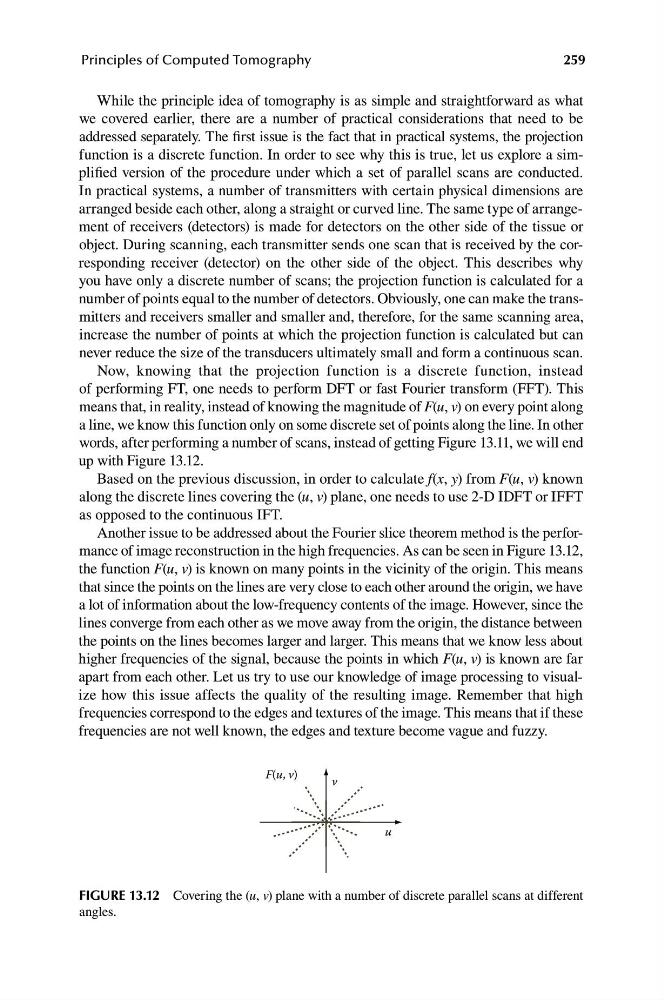
means that, in reality, instead of knowing the magnitude of F(u, v) on every point along
a line, we know this function only on some discrete set of points along the line. In other
words, after performing a number of scans, instead of getting Figure 13.11, we will end
up with Figure 13.12.
Based on the previous discussion, in order to calculate f(x, y) from F(u, v) known
along the discrete lines covering the (u, v) plane, one needs to use 2-D IDFT or IFFT
as opposed to the continuous IFT.
Another issue to be addressed about the Fourier slice theorem method is the performance of image reconstruction in the high frequencies. As can be seen in Figure 13.12,
the function F(u, v) is known on many points in the vicinity of the origin. This means
that since the points on the lines are very close to each other around the origin, we have
a lot of information about the low-frequency contents of the image. However, since the
lines converge from each other as we move away from the origin, the distance between
the points on the lines becomes larger and larger. This means that we know less about
higher frequencies of the signal, because the points in which F(u, v) is known are far
apart from each other. Let us try to use our knowledge of image processing to visualize how this issue affects the quality of the resulting image. Remember that high
frequencies correspond to the edges and textures of the image. This means that if these
frequencies are not well known, the edges and texture become vague and fuzzy.
F(u, v)
v
u
FIGURE 13.12 Covering the (u, v) plane with a number of discrete parallel scans at different
angles.
Principles of Computed Tomography
While the principle idea of tomography is as simple and straightforward as what
we covered earlier, there are a number of practical considerations that need to be
addressed separately. The first issue is the fact that in practical systems, the projection
function is a discrete function. In order to see why this is true, let us explore a simplified version of the procedure under which a set of parallel scans are conducted.
In practical systems, a number of transmitters with certain physical dimensions are
arranged beside each other, along a straight or curved line. The same type of arrangement of receivers (detectors) is made for detectors on the other side of the tissue or
object. During scanning, each transmitter sends one scan that is received by the corresponding receiver (detector) on the other side of the object. This describes why
you have only a discrete number of scans; the projection function is calculated for a
number of points equal to the number of detectors. Obviously, one can make the transmitters and receivers smaller and smaller and, therefore, for the same scanning area,
increase the number of points at which the projection function is calculated but can
never reduce the size of the transducers ultimately small and form a continuous scan.
Now, knowing that the projection function is a discrete function, instead
of performing FT, one needs to perform DFT or fast Fourier transform (FFT). This
means that, in reality, instead of knowing the magnitude of F(u, v) on every point along
a line, we know this function only on some discrete set of points along the line. In other
words, after performing a number of scans, instead of getting Figure 13.11, we will end
up with Figure 13.12.
Based on the previous discussion, in order to calculate f(x, y) from F(u, v) known
along the discrete lines covering the (u, v) plane, one needs to use 2-D IDFT or IFFT
as opposed to the continuous IFT.
Another issue to be addressed about the Fourier slice theorem method is the performance of image reconstruction in the high frequencies. As can be seen in Figure 13.12,
the function F(u, v) is known on many points in the vicinity of the origin. This means
that since the points on the lines are very close to each other around the origin, we have
a lot of information about the low-frequency contents of the image. However, since the
lines converge from each other as we move away from the origin, the distance between
the points on the lines becomes larger and larger. This means that we know less about
higher frequencies of the signal, because the points in which F(u, v) is known are far
apart from each other. Let us try to use our knowledge of image processing to visualize how this issue affects the quality of the resulting image. Remember that high
frequencies correspond to the edges and textures of the image. This means that if these
frequencies are not well known, the edges and texture become vague and fuzzy.
F(u, v)
v
u
FIGURE 13.12 Covering the (u, v) plane with a number of discrete parallel scans at different
angles.