

240
Biomedical Signal and Image Processing
the object with his or her eyes, the EOG is captured and analyzed. The lag between
the moves of the cursor and the electric activities captured by EOG provides the
metric needed for diagnostics.
Another major application of EOG is helping severely paralyzed patients. It is
estimated that number of patients in the United States whose spinal injuries have
paralyzed them from neck down is about 150,000. EOG provides these patients the
means to communicate with their caretakers and computers. In order to do so, a large
board is placed in front of the patient that is divided to an array of command.
For instance, a place on the board is marked as “copy” and another part as “paste.”
By analyzing the EOG, a computer identifies the gaze angle and based on that
identifies the command the patient is trying to execute. Similar systems have been
successfully used for navigation of aircrafts and boats.
60
40
40
50
60
EOG (right eye) μV
20
0
–20
–40
–60
–80
0
1 0
2 0
3 0
Time (s)
(a)
80
60
40
50
60
EOG (left eye) μV
(b)
40
20
0
–20
–40
–60
0
1 0
2 0
3 0
Time (s)
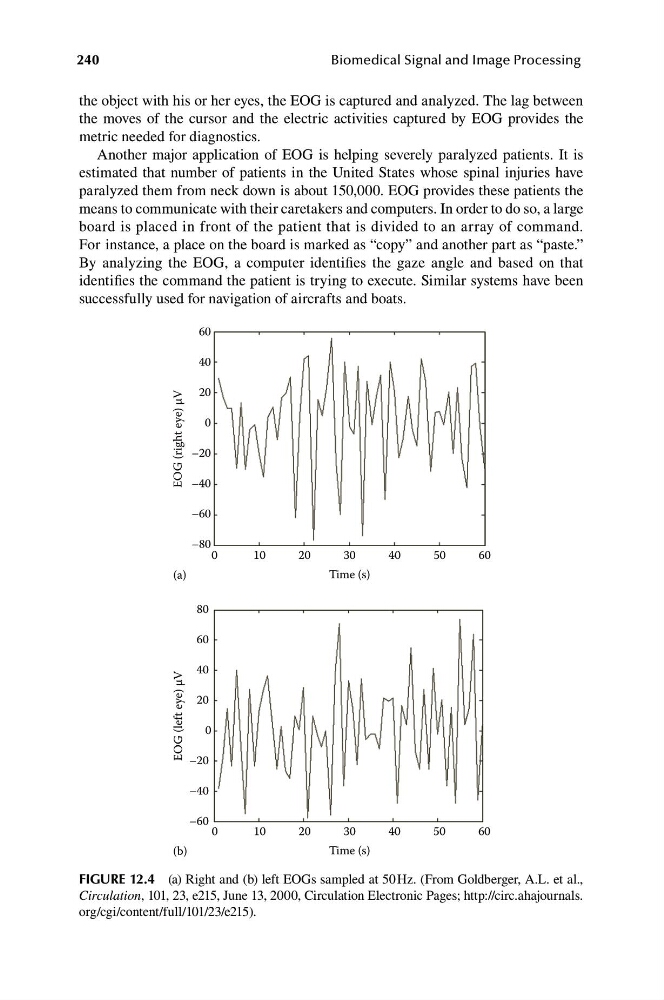
FIGURE 12.4 (a) Right and (b) left EOGs sampled at 50 Hz. (From Goldberger, A.L. et al.,
Circulation, 101, 23, e215, June 13, 2000, Circulation Electronic Pages; http://circ.ahajournals.
org/cgi/content/full/101/23/e215).
Biomedical Signal and Image Processing
the object with his or her eyes, the EOG is captured and analyzed. The lag between
the moves of the cursor and the electric activities captured by EOG provides the
metric needed for diagnostics.
Another major application of EOG is helping severely paralyzed patients. It is
estimated that number of patients in the United States whose spinal injuries have
paralyzed them from neck down is about 150,000. EOG provides these patients the
means to communicate with their caretakers and computers. In order to do so, a large
board is placed in front of the patient that is divided to an array of command.
For instance, a place on the board is marked as “copy” and another part as “paste.”
By analyzing the EOG, a computer identifies the gaze angle and based on that
identifies the command the patient is trying to execute. Similar systems have been
successfully used for navigation of aircrafts and boats.
60
40
40
50
60
EOG (right eye) μV
20
0
–20
–40
–60
–80
0
1 0
2 0
3 0
Time (s)
(a)
80
60
40
50
60
EOG (left eye) μV
(b)
40
20
0
–20
–40
–60
0
1 0
2 0
3 0
Time (s)
FIGURE 12.4 (a) Right and (b) left EOGs sampled at 50 Hz. (From Goldberger, A.L. et al.,
Circulation, 101, 23, e215, June 13, 2000, Circulation Electronic Pages; http://circ.ahajournals.
org/cgi/content/full/101/23/e215).