

219
Electromyogram
Z-disk
Nucleus
Motor neuron
Nerve axon
Propagation of
action potential
Vesicles containing
acetylcholine
Muscle fiber
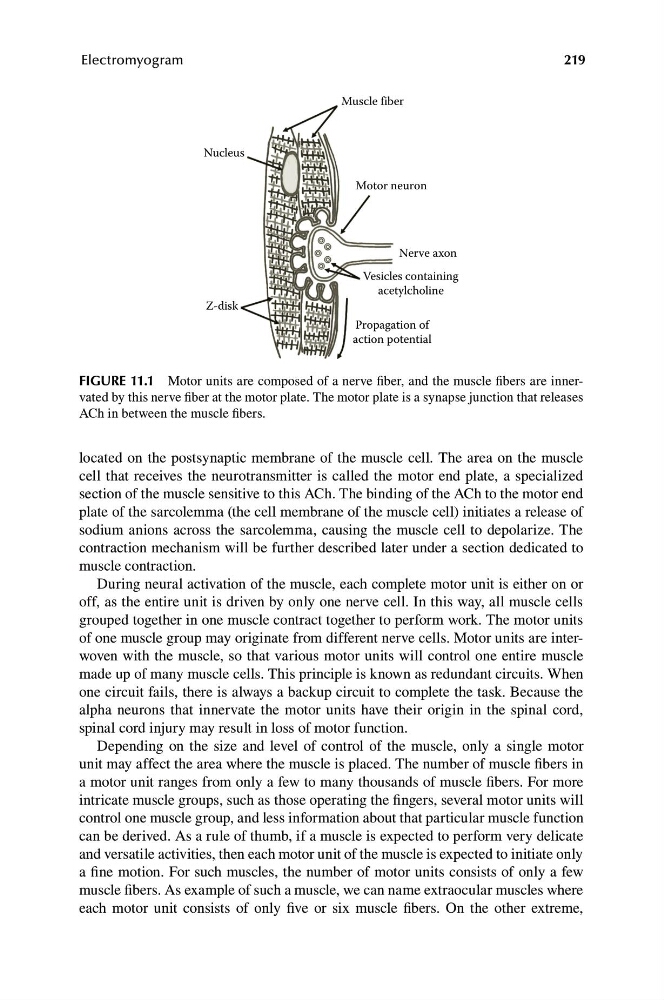
FIGURE 11.1 Motor units are composed of a nerve fiber, and the muscle fibers are innervated by this nerve fiber at the motor plate. The motor plate is a synapse junction that releases
ACh in between the muscle fibers.
located on the postsynaptic membrane of the muscle cell. The area on the muscle
cell that receives the neurotransmitter is called the motor end plate, a specialized
section of the muscle sensitive to this ACh. The binding of the ACh to the motor end
plate of the sarcolemma (the cell membrane of the muscle cell) initiates a release of
sodium anions across the sarcolemma, causing the muscle cell to depolarize. The
contraction mechanism will be further described later under a section dedicated to
muscle contraction.
During neural activation of the muscle, each complete motor unit is either on or
off, as the entire unit is driven by only one nerve cell. In this way, all muscle cells
grouped together in one muscle contract together to perform work. The motor units
of one muscle group may originate from different nerve cells. Motor units are interwoven with the muscle, so that various motor units will control one entire muscle
made up of many muscle cells. This principle is known as redundant circuits. When
one circuit fails, there is always a backup circuit to complete the task. Because the
alpha neurons that innervate the motor units have their origin in the spinal cord,
spinal cord injury may result in loss of motor function.
Depending on the size and level of control of the muscle, only a single motor
unit may affect the area where the muscle is placed. The number of muscle fibers in
a motor unit ranges from only a few to many thousands of muscle fibers. For more
intricate muscle groups, such as those operating the fingers, several motor units will
control one muscle group, and less information about that particular muscle function
can be derived. As a rule of thumb, if a muscle is expected to perform very delicate
and versatile activities, then each motor unit of the muscle is expected to initiate only
a fine motion. For such muscles, the number of motor units consists of only a few
muscle fibers. As example of such a muscle, we can name extraocular muscles where
each motor unit consists of only five or six muscle fibers. On the other extreme,
Electromyogram
Z-disk
Nucleus
Motor neuron
Nerve axon
Propagation of
action potential
Vesicles containing
acetylcholine
Muscle fiber
FIGURE 11.1 Motor units are composed of a nerve fiber, and the muscle fibers are innervated by this nerve fiber at the motor plate. The motor plate is a synapse junction that releases
ACh in between the muscle fibers.
located on the postsynaptic membrane of the muscle cell. The area on the muscle
cell that receives the neurotransmitter is called the motor end plate, a specialized
section of the muscle sensitive to this ACh. The binding of the ACh to the motor end
plate of the sarcolemma (the cell membrane of the muscle cell) initiates a release of
sodium anions across the sarcolemma, causing the muscle cell to depolarize. The
contraction mechanism will be further described later under a section dedicated to
muscle contraction.
During neural activation of the muscle, each complete motor unit is either on or
off, as the entire unit is driven by only one nerve cell. In this way, all muscle cells
grouped together in one muscle contract together to perform work. The motor units
of one muscle group may originate from different nerve cells. Motor units are interwoven with the muscle, so that various motor units will control one entire muscle
made up of many muscle cells. This principle is known as redundant circuits. When
one circuit fails, there is always a backup circuit to complete the task. Because the
alpha neurons that innervate the motor units have their origin in the spinal cord,
spinal cord injury may result in loss of motor function.
Depending on the size and level of control of the muscle, only a single motor
unit may affect the area where the muscle is placed. The number of muscle fibers in
a motor unit ranges from only a few to many thousands of muscle fibers. For more
intricate muscle groups, such as those operating the fingers, several motor units will
control one muscle group, and less information about that particular muscle function
can be derived. As a rule of thumb, if a muscle is expected to perform very delicate
and versatile activities, then each motor unit of the muscle is expected to initiate only
a fine motion. For such muscles, the number of motor units consists of only a few
muscle fibers. As example of such a muscle, we can name extraocular muscles where
each motor unit consists of only five or six muscle fibers. On the other extreme,