

207
Electroencephalogram
a minor event may sometimes be induced by mechanical stimulus such as tapping
on the arm. The frequency of epileptic EEG signals usually displays depolarization
spikes at 3 Hz intervals.
Epileptic events are characterized in various forms. One method of identifying
different stages of epilepsy is the discrimination between the duration of the epileptic events and the intervals between the events. The nomenclature for this designation uses the terms “petit mal” and “grand mal” from French, meaning “small bad”
and “severe bad” episodes, respectively. The petit mal frequently occurs in children
and is fairly brief in duration, but it may occur very frequently. During the several
seconds or minutes of the petit mal attack, the patient will endure minor spasms,
mostly in the face, jaw, and hands. There are not too many consequences involved
with a petit mal attack. The other classification is grand mall, which results in violent
convulsions and the patient will lose consciousness.
Another classification method for the types of epilepsy distinguishes general and
partial seizures, nonepileptic seizures, and the most severe: status epilepticus. The
general seizures are subdivided in severity as absence, atonic, tonic–clonic, and myoclonic. The absence corresponds mostly to the petit mal of the previous system of
classifications and the tonic–clonic is equivalent to the grand mal seizure. Partial seizures are subdivided in simple and complex. The nonepileptic seizures will change
the patient’s behavior for a brief period of time and resemble the symptoms of the
standard minor stages of general epileptic seizures. One main characteristic of nonepileptic seizures is that they are not generated by electric disturbances in the cortex.
The status epilepticus involves sustained epileptic attacks associated with nonstop
seizures and convulsions. The status epilepticus can result in death when no immediate medical attention is provided. Patients may have only one type of epilepsy or a
combination of several classified stages at different times.
The characteristic feature of an epileptic assault is an abrupt onset with perfectly
synchronized action potentials across all 20 electrodes. Therefore, the amplitude
of high-frequency epileptic EEG is much higher than the normal delta wave. The
mechanism driving an epileptic assault is still not completely understood. The EEG
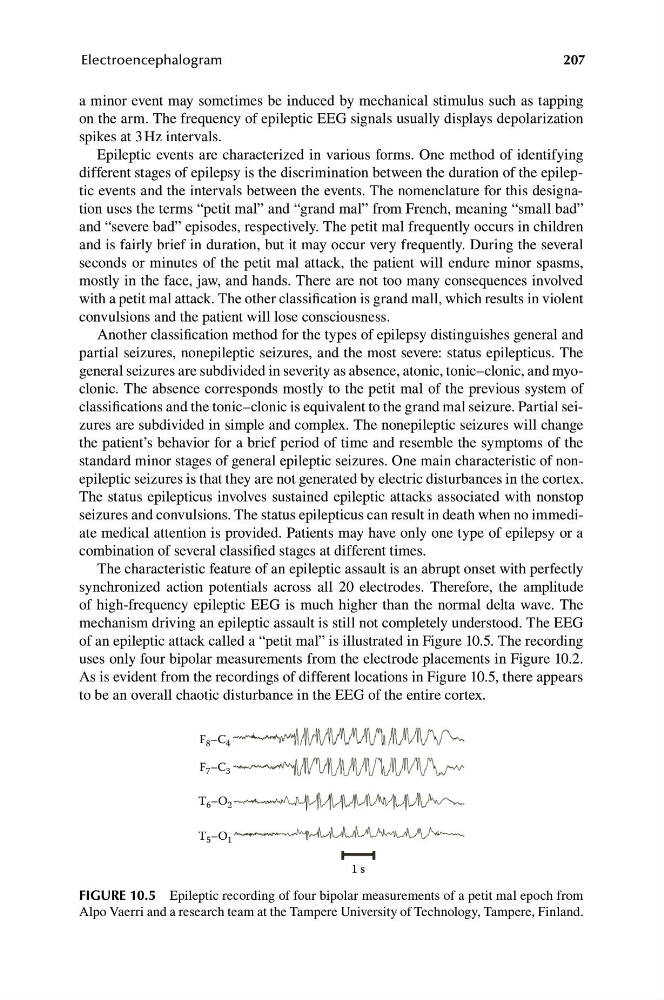
of an epileptic attack called a “petit mal” is illustrated in Figure 10.5. The recording
uses only four bipolar measurements from the electrode placements in Figure 10.2.
As is evident from the recordings of different locations in Figure 10.5, there appears
to be an overall chaotic disturbance in the EEG of the entire cortex.
F 8 –C 4
F 7 –C 3
T 6 –O 2
T 5 –O 1
1 s
FIGURE 10.5 Epileptic recording of four bipolar measurements of a petit mal epoch from
Alpo Vaerri and a research team at the Tampere University of Technology, Tampere, Finland.
Electroencephalogram
a minor event may sometimes be induced by mechanical stimulus such as tapping
on the arm. The frequency of epileptic EEG signals usually displays depolarization
spikes at 3 Hz intervals.
Epileptic events are characterized in various forms. One method of identifying
different stages of epilepsy is the discrimination between the duration of the epileptic events and the intervals between the events. The nomenclature for this designation uses the terms “petit mal” and “grand mal” from French, meaning “small bad”
and “severe bad” episodes, respectively. The petit mal frequently occurs in children
and is fairly brief in duration, but it may occur very frequently. During the several
seconds or minutes of the petit mal attack, the patient will endure minor spasms,
mostly in the face, jaw, and hands. There are not too many consequences involved
with a petit mal attack. The other classification is grand mall, which results in violent
convulsions and the patient will lose consciousness.
Another classification method for the types of epilepsy distinguishes general and
partial seizures, nonepileptic seizures, and the most severe: status epilepticus. The
general seizures are subdivided in severity as absence, atonic, tonic–clonic, and myoclonic. The absence corresponds mostly to the petit mal of the previous system of
classifications and the tonic–clonic is equivalent to the grand mal seizure. Partial seizures are subdivided in simple and complex. The nonepileptic seizures will change
the patient’s behavior for a brief period of time and resemble the symptoms of the
standard minor stages of general epileptic seizures. One main characteristic of nonepileptic seizures is that they are not generated by electric disturbances in the cortex.
The status epilepticus involves sustained epileptic attacks associated with nonstop
seizures and convulsions. The status epilepticus can result in death when no immediate medical attention is provided. Patients may have only one type of epilepsy or a
combination of several classified stages at different times.
The characteristic feature of an epileptic assault is an abrupt onset with perfectly
synchronized action potentials across all 20 electrodes. Therefore, the amplitude
of high-frequency epileptic EEG is much higher than the normal delta wave. The
mechanism driving an epileptic assault is still not completely understood. The EEG
of an epileptic attack called a “petit mal” is illustrated in Figure 10.5. The recording
uses only four bipolar measurements from the electrode placements in Figure 10.2.
As is evident from the recordings of different locations in Figure 10.5, there appears
to be an overall chaotic disturbance in the EEG of the entire cortex.
F 8 –C 4
F 7 –C 3
T 6 –O 2
T 5 –O 1
1 s
FIGURE 10.5 Epileptic recording of four bipolar measurements of a petit mal epoch from
Alpo Vaerri and a research team at the Tampere University of Technology, Tampere, Finland.