

202
Biomedical Signal and Image Processing
episodes with no particular frequency spectrum are also observed in EEG. A newborn’s EEG generally has a frequency range between 0.5 and 2 Hz. The frequency
spectrum of a baby’s EEG increases rapidly by the second year when short episodes
of alpha waves can be distinguished. At the age of 14, the EEG is identical to that of
a grown adult.
Before discussing the significance of EEG, it is very insightful to explore the
physical rules governing the formation of major frequencies in the EEG spectrum.
The coherence and formation of the higher frequencies in EEG can be explained as
a wave interference phenomenon on purely physical grounds. When a depolarization
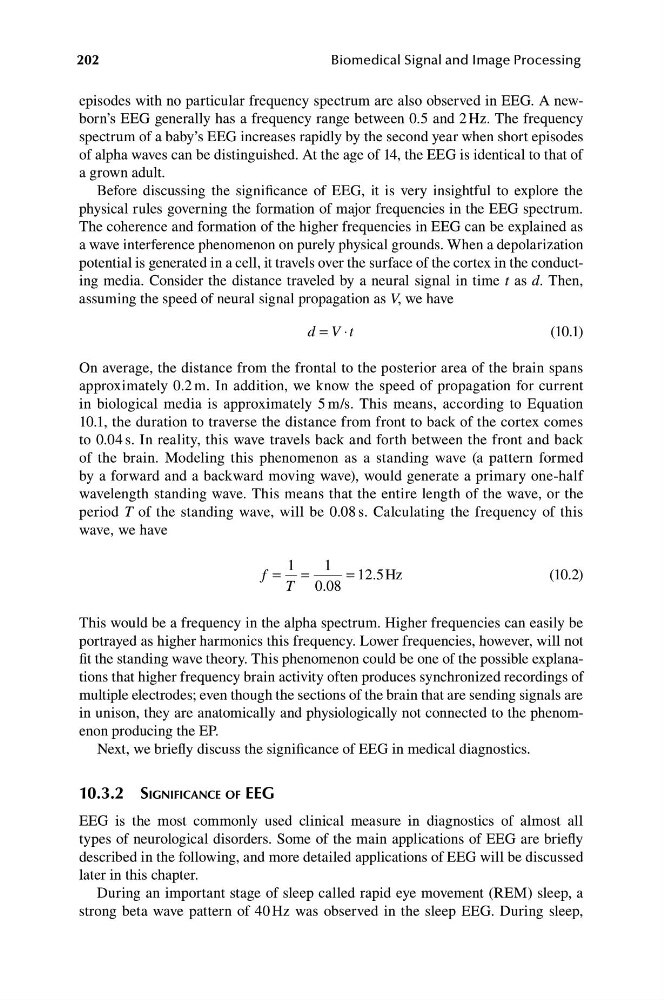
potential is generated in a cell, it travels over the surface of the cortex in the conducting media. Consider the distance traveled by a neural signal in time t as d. Then,
assuming the speed of neural signal propagation as V, we have
d V
= ⋅t
(10.1)
On average, the distance from the frontal to the posterior area of the brain spans
approximately 0.2 m. In addition, we know the speed of propagation for current
in biological media is approximately 5 m/s. This means, according to Equation
10.1, the duration to traverse the distance from front to back of the cortex comes
to 0.04 s. In reality, this wave travels back and forth between the front and back
of the brain. Modeling this phenomenon as a standing wave (a pattern formed
by a forward and a backward moving wave), would generate a primary one-half
wavelength standing wave. This means that the entire length of the wave, or the
period T of the standing wave, will be 0.08 s. Calculating the frequency of this
wave, we have
1
1
f = =
=12 5
(10.2)
. Hz
T 0 08
.
This would be a frequency in the alpha spectrum. Higher frequencies can easily be
portrayed as higher harmonics this frequency. Lower frequencies, however, will not
fit the standing wave theory. This phenomenon could be one of the possible explanations that higher frequency brain activity often produces synchronized recordings of
multiple electrodes; even though the sections of the brain that are sending signals are
in unison, they are anatomically and physiologically not connected to the phenomenon producing the EP.
Next, we briefly discuss the significance of EEG in medical diagnostics.
10.3.2 SIGNIFICANCE OF EEG
EEG is the most commonly used clinical measure in diagnostics of almost all
types of neurological disorders. Some of the main applications of EEG are briefly
described in the following, and more detailed applications of EEG will be discussed
later in this chapter.
During an important stage of sleep called rapid eye movement (REM) sleep, a
strong beta wave pattern of 40 Hz was observed in the sleep EEG. During sleep,
Biomedical Signal and Image Processing
episodes with no particular frequency spectrum are also observed in EEG. A newborn’s EEG generally has a frequency range between 0.5 and 2 Hz. The frequency
spectrum of a baby’s EEG increases rapidly by the second year when short episodes
of alpha waves can be distinguished. At the age of 14, the EEG is identical to that of
a grown adult.
Before discussing the significance of EEG, it is very insightful to explore the
physical rules governing the formation of major frequencies in the EEG spectrum.
The coherence and formation of the higher frequencies in EEG can be explained as
a wave interference phenomenon on purely physical grounds. When a depolarization
potential is generated in a cell, it travels over the surface of the cortex in the conducting media. Consider the distance traveled by a neural signal in time t as d. Then,
assuming the speed of neural signal propagation as V, we have
d V
= ⋅t
(10.1)
On average, the distance from the frontal to the posterior area of the brain spans
approximately 0.2 m. In addition, we know the speed of propagation for current
in biological media is approximately 5 m/s. This means, according to Equation
10.1, the duration to traverse the distance from front to back of the cortex comes
to 0.04 s. In reality, this wave travels back and forth between the front and back
of the brain. Modeling this phenomenon as a standing wave (a pattern formed
by a forward and a backward moving wave), would generate a primary one-half
wavelength standing wave. This means that the entire length of the wave, or the
period T of the standing wave, will be 0.08 s. Calculating the frequency of this
wave, we have
1
1
f = =
=12 5
(10.2)
. Hz
T 0 08
.
This would be a frequency in the alpha spectrum. Higher frequencies can easily be
portrayed as higher harmonics this frequency. Lower frequencies, however, will not
fit the standing wave theory. This phenomenon could be one of the possible explanations that higher frequency brain activity often produces synchronized recordings of
multiple electrodes; even though the sections of the brain that are sending signals are
in unison, they are anatomically and physiologically not connected to the phenomenon producing the EP.
Next, we briefly discuss the significance of EEG in medical diagnostics.
10.3.2 SIGNIFICANCE OF EEG
EEG is the most commonly used clinical measure in diagnostics of almost all
types of neurological disorders. Some of the main applications of EEG are briefly
described in the following, and more detailed applications of EEG will be discussed
later in this chapter.
During an important stage of sleep called rapid eye movement (REM) sleep, a
strong beta wave pattern of 40 Hz was observed in the sleep EEG. During sleep,