

190
Biomedical Signal and Image Processing
I
aV R
V1
V4
II
aV L
V2
V5
III
aV F
V3
V6
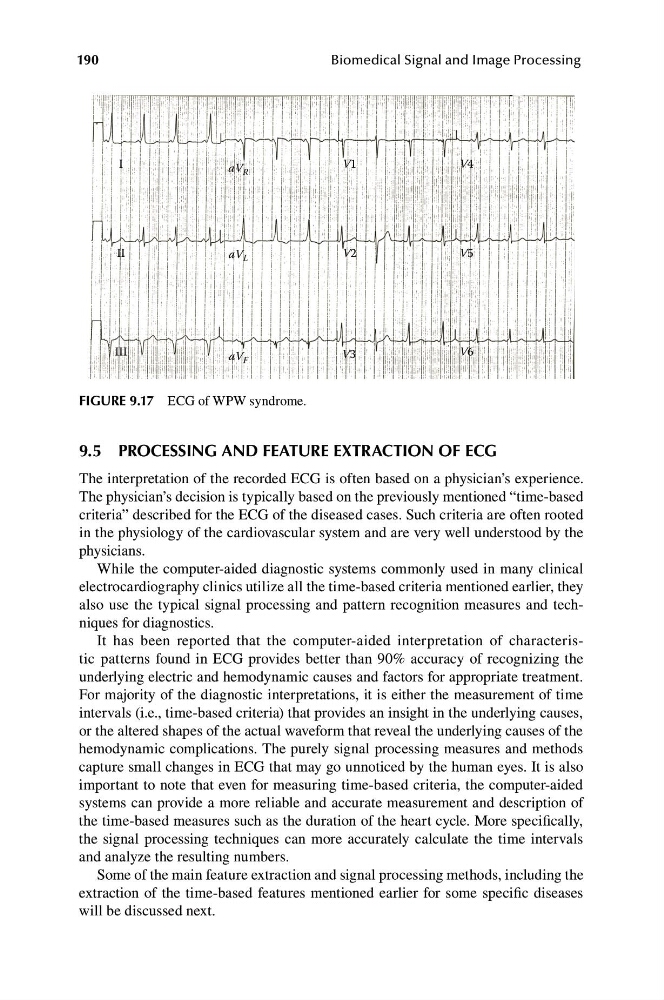
FIGURE 9.17 ECG of WPW syndrome.
9.5 PROCESSING AND FEATURE EXTRACTION OF ECG
The interpretation of the recorded ECG is often based on a physician’s experience.
The physician’s decision is typically based on the previously mentioned “time-based
criteria” described for the ECG of the diseased cases. Such criteria are often rooted
in the physiology of the cardiovascular system and are very well understood by the
physicians.
While the computer-aided diagnostic systems commonly used in many clinical
electrocardiography clinics utilize all the time-based criteria mentioned earlier, they
also use the typical signal processing and pattern recognition measures and techniques for diagnostics.
It has been reported that the computer-aided interpretation of characteristic patterns found in ECG provides better than 90% accuracy of recognizing the
underlying electric and hemodynamic causes and factors for appropriate treatment.
For majority of the diagnostic interpretations, it is either the measurement of time
intervals (i.e., time-based criteria) that provides an insight in the underlying causes,
or the altered shapes of the actual waveform that reveal the underlying causes of the
hemodynamic complications. The purely signal processing measures and methods
capture small changes in ECG that may go unnoticed by the human eyes. It is also
important to note that even for measuring time-based criteria, the computer-aided
systems can provide a more reliable and accurate measurement and description of
the time-based measures such as the duration of the heart cycle. More specifically,
the signal processing techniques can more accurately calculate the time intervals
and analyze the resulting numbers.
Some of the main feature extraction and signal processing methods, including the
extraction of the time-based features mentioned earlier for some specific diseases
will be discussed next.
Biomedical Signal and Image Processing
I
aV R
V1
V4
II
aV L
V2
V5
III
aV F
V3
V6
FIGURE 9.17 ECG of WPW syndrome.
9.5 PROCESSING AND FEATURE EXTRACTION OF ECG
The interpretation of the recorded ECG is often based on a physician’s experience.
The physician’s decision is typically based on the previously mentioned “time-based
criteria” described for the ECG of the diseased cases. Such criteria are often rooted
in the physiology of the cardiovascular system and are very well understood by the
physicians.
While the computer-aided diagnostic systems commonly used in many clinical
electrocardiography clinics utilize all the time-based criteria mentioned earlier, they
also use the typical signal processing and pattern recognition measures and techniques for diagnostics.
It has been reported that the computer-aided interpretation of characteristic patterns found in ECG provides better than 90% accuracy of recognizing the
underlying electric and hemodynamic causes and factors for appropriate treatment.
For majority of the diagnostic interpretations, it is either the measurement of time
intervals (i.e., time-based criteria) that provides an insight in the underlying causes,
or the altered shapes of the actual waveform that reveal the underlying causes of the
hemodynamic complications. The purely signal processing measures and methods
capture small changes in ECG that may go unnoticed by the human eyes. It is also
important to note that even for measuring time-based criteria, the computer-aided
systems can provide a more reliable and accurate measurement and description of
the time-based measures such as the duration of the heart cycle. More specifically,
the signal processing techniques can more accurately calculate the time intervals
and analyze the resulting numbers.
Some of the main feature extraction and signal processing methods, including the
extraction of the time-based features mentioned earlier for some specific diseases
will be discussed next.