

183
Electrocardiogram
placement combined with augmented Einthoven electrode recording, giving a total
of nine recordings. One of the standard chart recordings are given by the augments
Einthoven recordings aV R , aV L , and aV F , combined with the Wilson recording V1
through V6.
9.4.2 VENTRICULAR ARRHYTHMIAS
In ventricular arrhythmias, ventricular activation does not originate in the A-V node.
Moreover, the arrhythmia does not proceed in the ventricles in a normal way. In a
normal heart in which the activation proceeds to the ventricles along the conduction
system, the inner walls of the ventricles are activated almost simultaneously, and
the activation front proceeds mainly radially toward the outer walls. As a result,
the QRS complex of a healthy heart is of relatively short duration. In ventricular
arrhythmias, however, since either the ventricular conduction system is broken or
the ventricular activation starts far from the A-V node, it takes a longer time for the
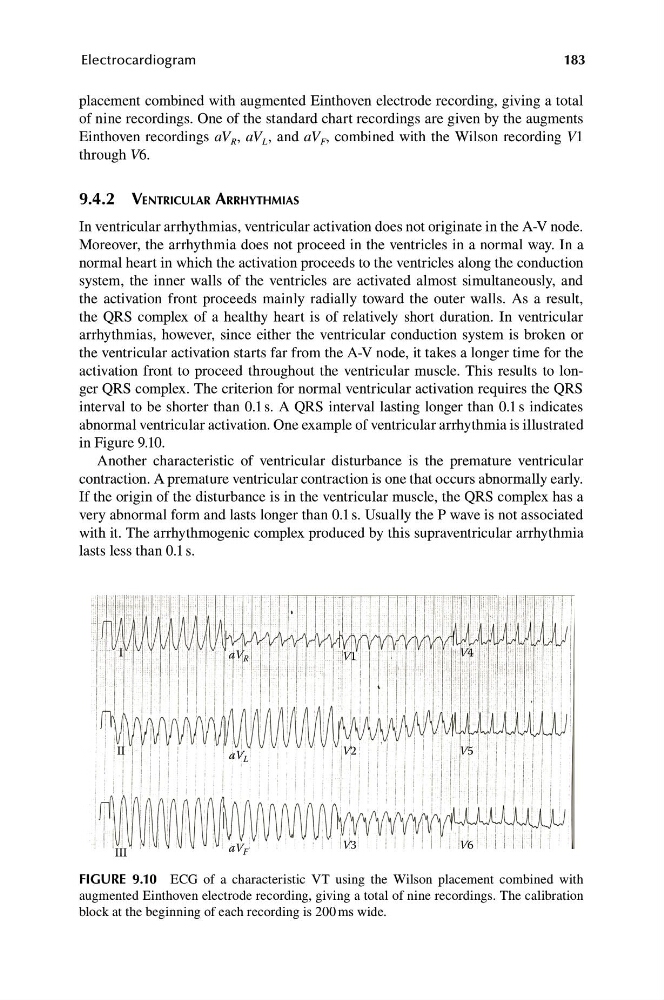
activation front to proceed throughout the ventricular muscle. This results to longer QRS complex. The criterion for normal ventricular activation requires the QRS
interval to be shorter than 0.1 s. A QRS interval lasting longer than 0.1 s indicates
abnormal ventricular activation. One example of ventricular arrhythmia is illustrated
in Figure 9.10.
Another characteristic of ventricular disturbance is the premature ventricular
contraction. A premature ventricular contraction is one that occurs abnormally early.
If the origin of the disturbance is in the ventricular muscle, the QRS complex has a
very abnormal form and lasts longer than 0.1 s. Usually the P wave is not associated
with it. The arrhythmogenic complex produced by this supraventricular arrhythmia
lasts less than 0.1 s.
I
V4
aV R
V1
II
V2
V5
aV L
V3
V6
aV F
III
FIGURE 9.10 ECG of a characteristic VT using the Wilson placement combined with
augmented Einthoven electrode recording, giving a total of nine recordings. The calibration
block at the beginning of each recording is 200 ms wide.
Electrocardiogram
placement combined with augmented Einthoven electrode recording, giving a total
of nine recordings. One of the standard chart recordings are given by the augments
Einthoven recordings aV R , aV L , and aV F , combined with the Wilson recording V1
through V6.
9.4.2 VENTRICULAR ARRHYTHMIAS
In ventricular arrhythmias, ventricular activation does not originate in the A-V node.
Moreover, the arrhythmia does not proceed in the ventricles in a normal way. In a
normal heart in which the activation proceeds to the ventricles along the conduction
system, the inner walls of the ventricles are activated almost simultaneously, and
the activation front proceeds mainly radially toward the outer walls. As a result,
the QRS complex of a healthy heart is of relatively short duration. In ventricular
arrhythmias, however, since either the ventricular conduction system is broken or
the ventricular activation starts far from the A-V node, it takes a longer time for the
activation front to proceed throughout the ventricular muscle. This results to longer QRS complex. The criterion for normal ventricular activation requires the QRS
interval to be shorter than 0.1 s. A QRS interval lasting longer than 0.1 s indicates
abnormal ventricular activation. One example of ventricular arrhythmia is illustrated
in Figure 9.10.
Another characteristic of ventricular disturbance is the premature ventricular
contraction. A premature ventricular contraction is one that occurs abnormally early.
If the origin of the disturbance is in the ventricular muscle, the QRS complex has a
very abnormal form and lasts longer than 0.1 s. Usually the P wave is not associated
with it. The arrhythmogenic complex produced by this supraventricular arrhythmia
lasts less than 0.1 s.
I
V4
aV R
V1
II
V2
V5
aV L
V3
V6
aV F
III
FIGURE 9.10 ECG of a characteristic VT using the Wilson placement combined with
augmented Einthoven electrode recording, giving a total of nine recordings. The calibration
block at the beginning of each recording is 200 ms wide.