

Other Signal and Image Processing Methods
103
measure of self-similarity of a signal. Informally speaking, assume we have printed
a signal on a piece of paper and have a number of magnifiers with different zoom
power. First, we look at the entire signal without a magnifier and observe the signal pattern. Then, we focus only on a portion of the signal and use a magnifier. In
biological and biomedical signal, we often notice that the observed pattern with the
magnifier has a high degree of similarity to the entire signal. If we continue focusing on smaller and smaller portions of the signal using magnifiers with higher and
higher zoom powers, we observe more or less similar patterns. This proves the “selfsimilarity” of the biomedical signals. Fractal dimension is a measure that quantitatively assesses the self-similarity of a signal. Knowing that almost all biomedical
signals are to some degree self-similar, evaluating the fractal dimension allows us to
distinguish between the healthy and diseased signals.
In the signal processing literature, several methods are introduced to estimate the
fractal dimension. Among all the fractal-based complexity measures, the Higuchi
algorithm is known to be one of the most accurate and efficient methods to estimate
self-similarity. Here, we briefly describe the estimation of fractal dimension using
Higuchi’s algorithm.
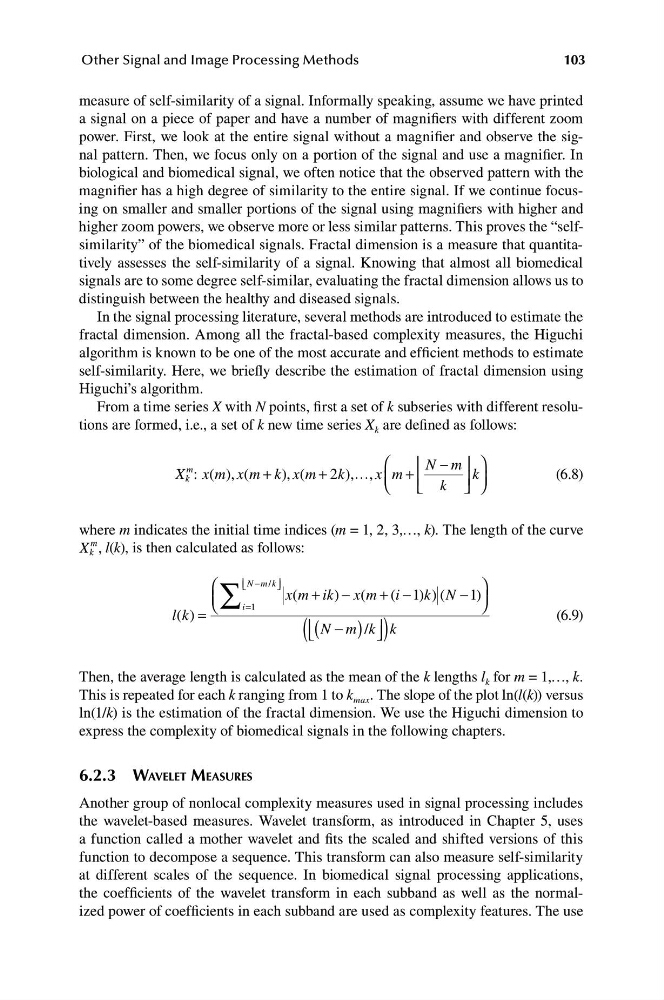
From a time series X with N points, first a set of k subseries with different resolutions are formed, i.e., a set of k new time series X k are defined as follows:
m
⎛
⎢ N m
− ⎥ ⎞
X x
k : ( m ), x( m+ k ), x( m + 2k),…, x
+
⎜ m ⎢
⎥ k
(6
k
⎟
.8)
⎝
⎣
⎦ ⎠
where m indicates the initial time indices (m = 1, 2, 3,…, k). The length of the curve
X
m
k , l(k), is then calculated as follows:
⎛
∑
⎣ ⎢N m
− / k ⎦ ⎥
⎞
⎜
x m
( + ik) − x m
( + ( i −1 )k) (N −1)
⎝
i=1
⎟ ⎠
l k
( ) =
( ⎢ (N m) / k⎥ ⎦ ⎦ )
(6.9)
−
⎣
k
Then, the average length is calculated as the mean of the k lengths l k for m = 1,…, k.
This is repeated for each k ranging from 1 to k max . The slope of the plot ln(l(k)) versus
ln(1/k) is the estimation of the fractal dimension. We use the Higuchi dimension to
express the complexity of biomedical signals in the following chapters.
6.2.3 WAVELET MEASURES
Another group of nonlocal complexity measures used in signal processing includes
the wavelet-based measures. Wavelet transform, as introduced in Chapter 5, uses
a function called a mother wavelet and fits the scaled and shifted versions of this
function to decompose a sequence. This transform can also measure self-similarity
at different scales of the sequence. In biomedical signal processing applications,
the coefficients of the wavelet transform in each subband as well as the normalized power of coefficients in each subband are used as complexity features. The use
103
measure of self-similarity of a signal. Informally speaking, assume we have printed
a signal on a piece of paper and have a number of magnifiers with different zoom
power. First, we look at the entire signal without a magnifier and observe the signal pattern. Then, we focus only on a portion of the signal and use a magnifier. In
biological and biomedical signal, we often notice that the observed pattern with the
magnifier has a high degree of similarity to the entire signal. If we continue focusing on smaller and smaller portions of the signal using magnifiers with higher and
higher zoom powers, we observe more or less similar patterns. This proves the “selfsimilarity” of the biomedical signals. Fractal dimension is a measure that quantitatively assesses the self-similarity of a signal. Knowing that almost all biomedical
signals are to some degree self-similar, evaluating the fractal dimension allows us to
distinguish between the healthy and diseased signals.
In the signal processing literature, several methods are introduced to estimate the
fractal dimension. Among all the fractal-based complexity measures, the Higuchi
algorithm is known to be one of the most accurate and efficient methods to estimate
self-similarity. Here, we briefly describe the estimation of fractal dimension using
Higuchi’s algorithm.
From a time series X with N points, first a set of k subseries with different resolutions are formed, i.e., a set of k new time series X k are defined as follows:
m
⎛
⎢ N m
− ⎥ ⎞
X x
k : ( m ), x( m+ k ), x( m + 2k),…, x
+
⎜ m ⎢
⎥ k
(6
k
⎟
.8)
⎝
⎣
⎦ ⎠
where m indicates the initial time indices (m = 1, 2, 3,…, k). The length of the curve
X
m
k , l(k), is then calculated as follows:
⎛
∑
⎣ ⎢N m
− / k ⎦ ⎥
⎞
⎜
x m
( + ik) − x m
( + ( i −1 )k) (N −1)
⎝
i=1
⎟ ⎠
l k
( ) =
( ⎢ (N m) / k⎥ ⎦ ⎦ )
(6.9)
−
⎣
k
Then, the average length is calculated as the mean of the k lengths l k for m = 1,…, k.
This is repeated for each k ranging from 1 to k max . The slope of the plot ln(l(k)) versus
ln(1/k) is the estimation of the fractal dimension. We use the Higuchi dimension to
express the complexity of biomedical signals in the following chapters.
6.2.3 WAVELET MEASURES
Another group of nonlocal complexity measures used in signal processing includes
the wavelet-based measures. Wavelet transform, as introduced in Chapter 5, uses
a function called a mother wavelet and fits the scaled and shifted versions of this
function to decompose a sequence. This transform can also measure self-similarity
at different scales of the sequence. In biomedical signal processing applications,
the coefficients of the wavelet transform in each subband as well as the normalized power of coefficients in each subband are used as complexity features. The use