

97
Wavelet Transform
Image selection
Decomposition at level 2
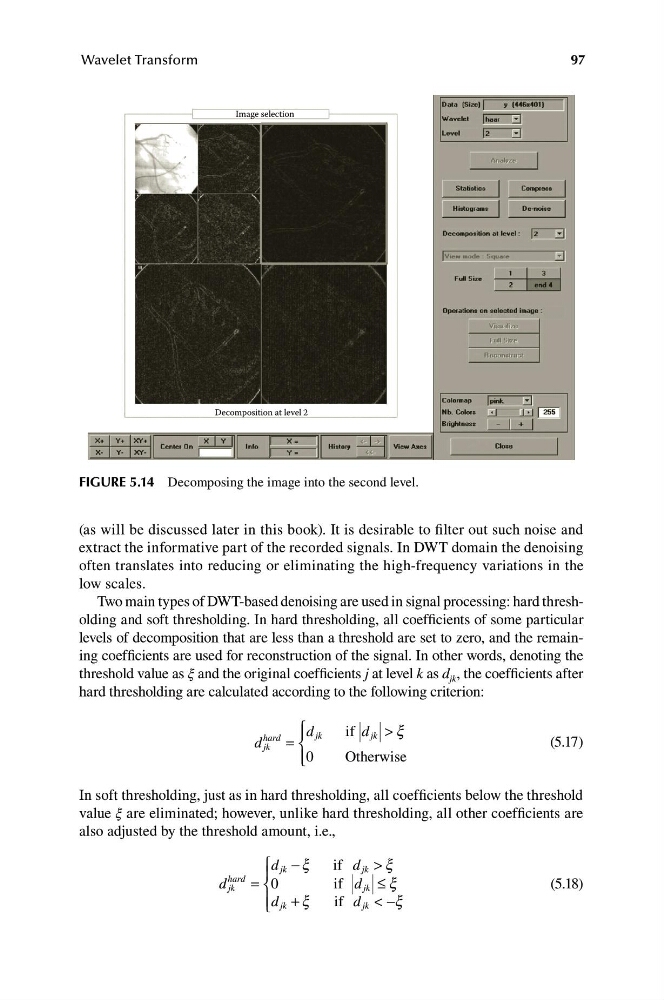
FIGURE 5.14 Decomposing the image into the second level.
(as will be discussed later in this book). It is desirable to filter out such noise and
extract the informative part of the recorded signals. In DWT domain the denoising
often translates into reducing or eliminating the high-frequency variations in the
low scales.
Two main types of DWT-based denoising are used in signal processing: hard thresholding and soft thresholding. In hard thresholding, all coefficients of some particular
levels of decomposition that are less than a threshold are set to zero, and the remaining coefficients are used for reconstruction of the signal. In other words, denoting the
threshold value as ξ and the original coefficients j at level k as d jk , the coefficients after
hard thresholding are calculated according to the following criterion:
hard
⎧ ⎪ d jk
if d jk > x
d jk = ⎨
(5.17)
⎪0
Otherwise
⎩
In soft thresholding, just as in hard thresholding, all coefficients below the threshold
value ξ are eliminated; however, unlike hard thresholding, all other coefficients are
also adjusted by the threshold amount, i.e.,
⎧d jk − x
if d jk > x
hard
⎪
d jk = ⎨ 0
if d jk ≤ x
(5.18)
⎪ ⎩ d jk + x
if d jk <− x
Wavelet Transform
Image selection
Decomposition at level 2
FIGURE 5.14 Decomposing the image into the second level.
(as will be discussed later in this book). It is desirable to filter out such noise and
extract the informative part of the recorded signals. In DWT domain the denoising
often translates into reducing or eliminating the high-frequency variations in the
low scales.
Two main types of DWT-based denoising are used in signal processing: hard thresholding and soft thresholding. In hard thresholding, all coefficients of some particular
levels of decomposition that are less than a threshold are set to zero, and the remaining coefficients are used for reconstruction of the signal. In other words, denoting the
threshold value as ξ and the original coefficients j at level k as d jk , the coefficients after
hard thresholding are calculated according to the following criterion:
hard
⎧ ⎪ d jk
if d jk > x
d jk = ⎨
(5.17)
⎪0
Otherwise
⎩
In soft thresholding, just as in hard thresholding, all coefficients below the threshold
value ξ are eliminated; however, unlike hard thresholding, all other coefficients are
also adjusted by the threshold amount, i.e.,
⎧d jk − x
if d jk > x
hard
⎪
d jk = ⎨ 0
if d jk ≤ x
(5.18)
⎪ ⎩ d jk + x
if d jk <− x