

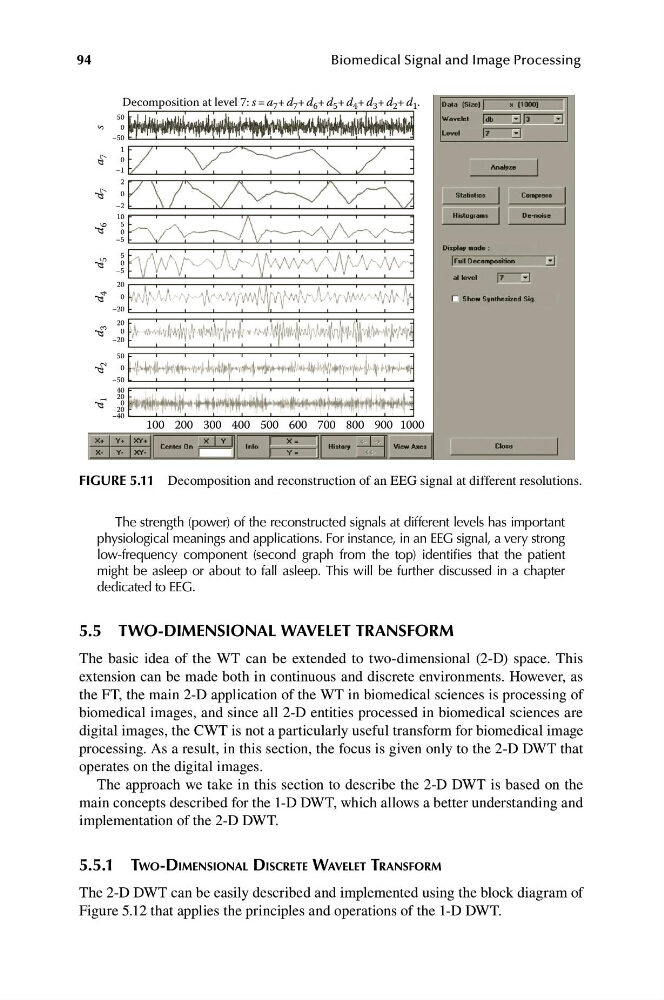
Decomposition at level 7: s = a 7 + d 7 + d 6 + d 5 + d 4 + d 3 + d 2 + d 1 .
d
1
d
2
d
3
d
4
d
5
d
6
d
7
a
7
s
50
0
–50
1
0
–1
2
0
–2
10
5
0
–5
5
0
–5
20
0
–20
20
0
–20
50
0
–50
40
20
0
–20
–40
100 200 300 400 500 600 700 800 900 1000
94
Biomedical Signal and Image Processing
FIGURE 5.11 Decomposition and reconstruction of an EEG signal at different resolutions.
The strength (power) of the reconstructed signals at different levels has important
physiological meanings and applications. For instance, in an EEG signal, a very strong
low-frequency component (second graph from the top) identifies that the patient
might be asleep or about to fall asleep. This will be further discussed in a chapter
dedicated to EEG.
5.5 TWO-DIMENSIONAL WAVELET TRANSFORM
The basic idea of the WT can be extended to two-dimensional (2-D) space. This
extension can be made both in continuous and discrete environments. However, as
the FT, the main 2-D application of the WT in biomedical sciences is processing of
biomedical images, and since all 2-D entities processed in biomedical sciences are
digital images, the CWT is not a particularly useful transform for biomedical image
processing. As a result, in this section, the focus is given only to the 2-D DWT that
operates on the digital images.
The approach we take in this section to describe the 2-D DWT is based on the
main concepts described for the 1-D DWT, which allows a better understanding and
implementation of the 2-D DWT.
5.5.1 TWO-DIMENSIONAL DISCRETE WAVELET TRANSFORM
The 2-D DWT can be easily described and implemented using the block diagram of
Figure 5.12 that applies the principles and operations of the 1-D DWT.
d
1
d
2
d
3
d
4
d
5
d
6
d
7
a
7
s
50
0
–50
1
0
–1
2
0
–2
10
5
0
–5
5
0
–5
20
0
–20
20
0
–20
50
0
–50
40
20
0
–20
–40
100 200 300 400 500 600 700 800 900 1000
94
Biomedical Signal and Image Processing
FIGURE 5.11 Decomposition and reconstruction of an EEG signal at different resolutions.
The strength (power) of the reconstructed signals at different levels has important
physiological meanings and applications. For instance, in an EEG signal, a very strong
low-frequency component (second graph from the top) identifies that the patient
might be asleep or about to fall asleep. This will be further discussed in a chapter
dedicated to EEG.
5.5 TWO-DIMENSIONAL WAVELET TRANSFORM
The basic idea of the WT can be extended to two-dimensional (2-D) space. This
extension can be made both in continuous and discrete environments. However, as
the FT, the main 2-D application of the WT in biomedical sciences is processing of
biomedical images, and since all 2-D entities processed in biomedical sciences are
digital images, the CWT is not a particularly useful transform for biomedical image
processing. As a result, in this section, the focus is given only to the 2-D DWT that
operates on the digital images.
The approach we take in this section to describe the 2-D DWT is based on the
main concepts described for the 1-D DWT, which allows a better understanding and
implementation of the 2-D DWT.
5.5.1 TWO-DIMENSIONAL DISCRETE WAVELET TRANSFORM
The 2-D DWT can be easily described and implemented using the block diagram of
Figure 5.12 that applies the principles and operations of the 1-D DWT.