

3.4 Cyclization of Dopamine Quinone Analogs
69
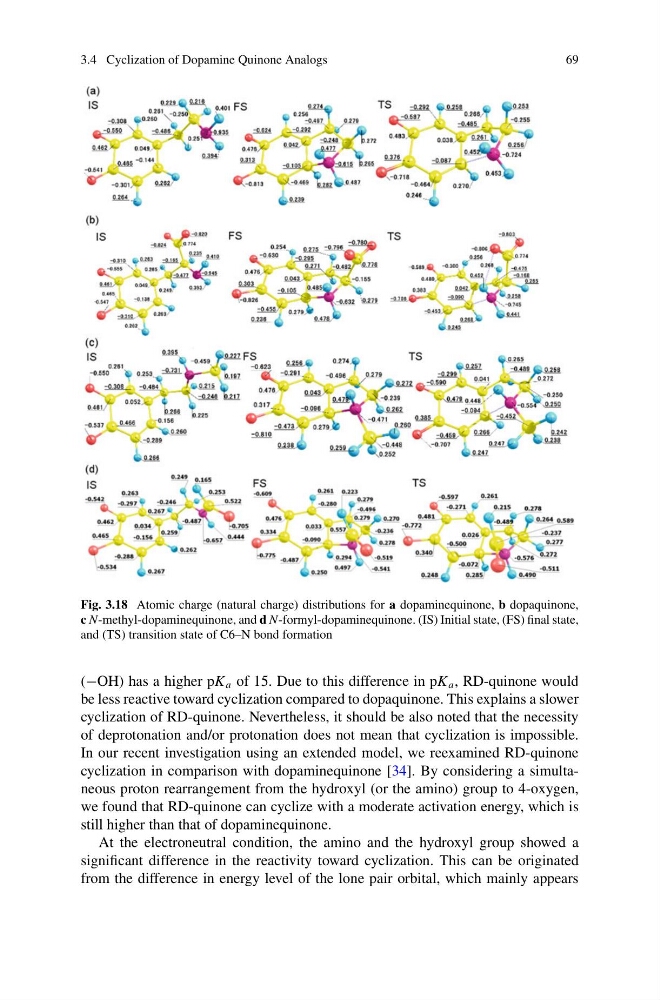
Fig. 3.18 Atomic charge (natural charge) distributions for a dopaminequinone, b dopaquinone,
c N-methyl-dopaminequinone, and d N-formyl-dopaminequinone. (IS) Initial state, (FS) final state,
and (TS) transition state of C6–N bond formation
(−OH) has a higher pK a of 15. Due to this difference in pK a , RD-quinone would
be less reactive toward cyclization compared to dopaquinone. This explains a slower
cyclization of RD-quinone. Nevertheless, it should be also noted that the necessity
of deprotonation and/or protonation does not mean that cyclization is impossible.
In our recent investigation using an extended model, we reexamined RD-quinone
cyclization in comparison with dopaminequinone [34]. By considering a simultaneous proton rearrangement from the hydroxyl (or the amino) group to 4-oxygen,
we found that RD-quinone can cyclize with a moderate activation energy, which is
still higher than that of dopaminequinone.
At the electroneutral condition, the amino and the hydroxyl group showed a
significant difference in the reactivity toward cyclization. This can be originated
from the difference in energy level of the lone pair orbital, which mainly appears
69
Fig. 3.18 Atomic charge (natural charge) distributions for a dopaminequinone, b dopaquinone,
c N-methyl-dopaminequinone, and d N-formyl-dopaminequinone. (IS) Initial state, (FS) final state,
and (TS) transition state of C6–N bond formation
(−OH) has a higher pK a of 15. Due to this difference in pK a , RD-quinone would
be less reactive toward cyclization compared to dopaquinone. This explains a slower
cyclization of RD-quinone. Nevertheless, it should be also noted that the necessity
of deprotonation and/or protonation does not mean that cyclization is impossible.
In our recent investigation using an extended model, we reexamined RD-quinone
cyclization in comparison with dopaminequinone [34]. By considering a simultaneous proton rearrangement from the hydroxyl (or the amino) group to 4-oxygen,
we found that RD-quinone can cyclize with a moderate activation energy, which is
still higher than that of dopaminequinone.
At the electroneutral condition, the amino and the hydroxyl group showed a
significant difference in the reactivity toward cyclization. This can be originated
from the difference in energy level of the lone pair orbital, which mainly appears