

68
3 Dopaquinone Conversion and Related Reactions
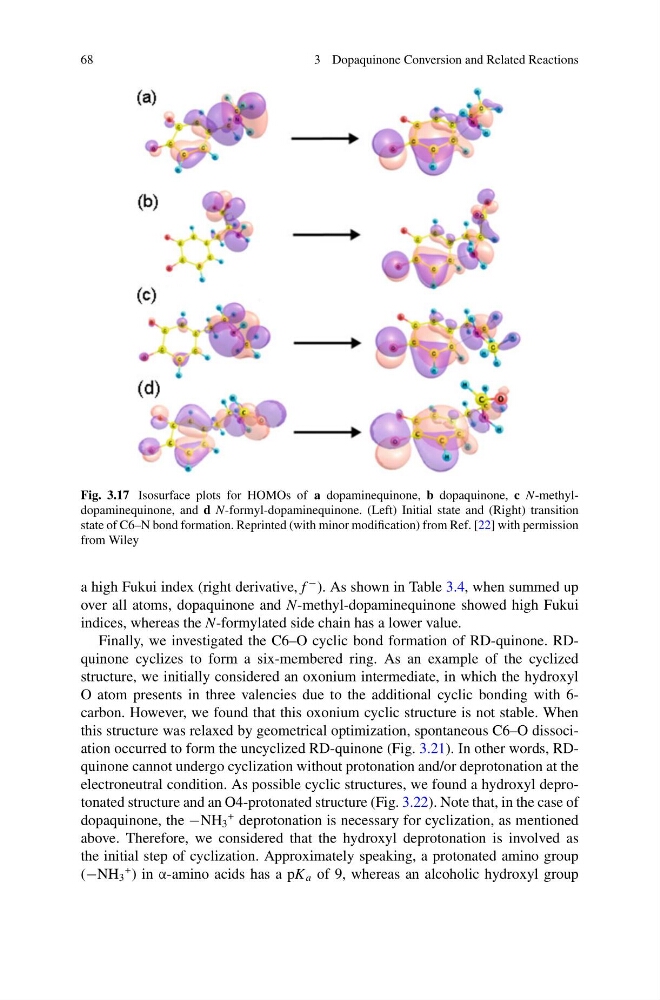
Fig. 3.17 Isosurface plots for HOMOs of a dopaminequinone, b dopaquinone, c N-methyldopaminequinone, and d N-formyl-dopaminequinone. (Left) Initial state and (Right) transition
state of C6–N bond formation. Reprinted (with minor modification) from Ref. [22] with permission
from Wiley
a high Fukui index (right derivative, f
− ). As shown in Table 3.4, when summed up
over all atoms, dopaquinone and N-methyl-dopaminequinone showed high Fukui
indices, whereas the N-formylated side chain has a lower value.
Finally, we investigated the C6–O cyclic bond formation of RD-quinone. RDquinone cyclizes to form a six-membered ring. As an example of the cyclized
structure, we initially considered an oxonium intermediate, in which the hydroxyl
O atom presents in three valencies due to the additional cyclic bonding with 6carbon. However, we found that this oxonium cyclic structure is not stable. When
this structure was relaxed by geometrical optimization, spontaneous C6–O dissociation occurred to form the uncyclized RD-quinone (Fig. 3.21). In other words, RDquinone cannot undergo cyclization without protonation and/or deprotonation at the
electroneutral condition. As possible cyclic structures, we found a hydroxyl deprotonated structure and an O4-protonated structure (Fig. 3.22). Note that, in the case of
dopaquinone, the −NH 3
+ deprotonation is necessary for cyclization, as mentioned
above. Therefore, we considered that the hydroxyl deprotonation is involved as
the initial step of cyclization. Approximately speaking, a protonated amino group
(−NH 3
+ ) in α-amino acids has a pK a of 9, whereas an alcoholic hydroxyl group
3 Dopaquinone Conversion and Related Reactions
Fig. 3.17 Isosurface plots for HOMOs of a dopaminequinone, b dopaquinone, c N-methyldopaminequinone, and d N-formyl-dopaminequinone. (Left) Initial state and (Right) transition
state of C6–N bond formation. Reprinted (with minor modification) from Ref. [22] with permission
from Wiley
a high Fukui index (right derivative, f
− ). As shown in Table 3.4, when summed up
over all atoms, dopaquinone and N-methyl-dopaminequinone showed high Fukui
indices, whereas the N-formylated side chain has a lower value.
Finally, we investigated the C6–O cyclic bond formation of RD-quinone. RDquinone cyclizes to form a six-membered ring. As an example of the cyclized
structure, we initially considered an oxonium intermediate, in which the hydroxyl
O atom presents in three valencies due to the additional cyclic bonding with 6carbon. However, we found that this oxonium cyclic structure is not stable. When
this structure was relaxed by geometrical optimization, spontaneous C6–O dissociation occurred to form the uncyclized RD-quinone (Fig. 3.21). In other words, RDquinone cannot undergo cyclization without protonation and/or deprotonation at the
electroneutral condition. As possible cyclic structures, we found a hydroxyl deprotonated structure and an O4-protonated structure (Fig. 3.22). Note that, in the case of
dopaquinone, the −NH 3
+ deprotonation is necessary for cyclization, as mentioned
above. Therefore, we considered that the hydroxyl deprotonation is involved as
the initial step of cyclization. Approximately speaking, a protonated amino group
(−NH 3
+ ) in α-amino acids has a pK a of 9, whereas an alcoholic hydroxyl group