

3.3 Competition Between Cyclization and Thiol Binding—Comparison …
59
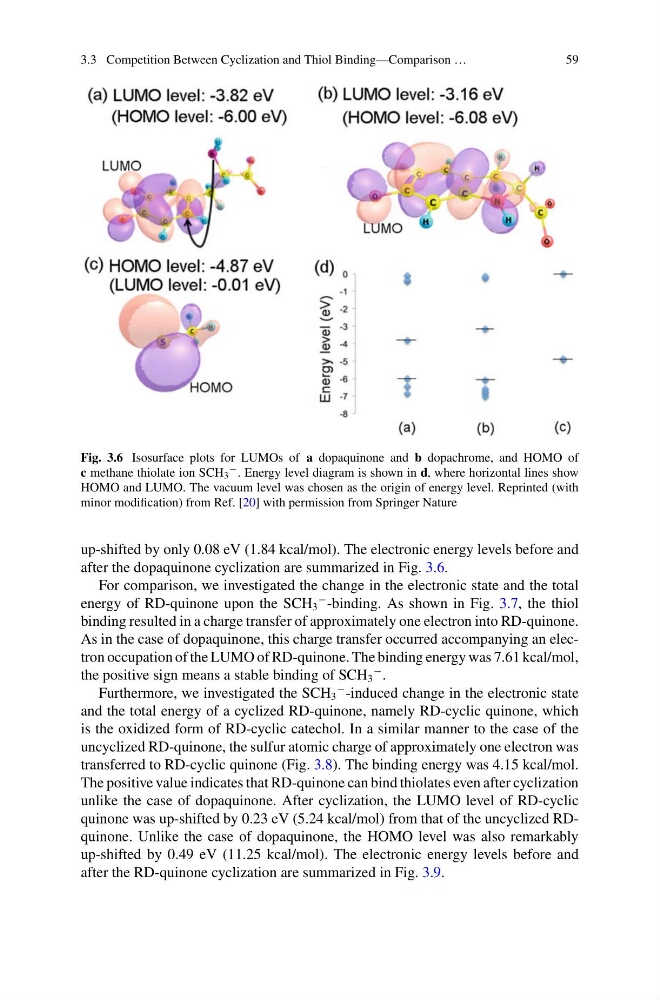
Fig. 3.6 Isosurface plots for LUMOs of a dopaquinone and b dopachrome, and HOMO of
c methane thiolate ion SCH 3
− . Energy level diagram is shown in d, where horizontal lines show
HOMO and LUMO. The vacuum level was chosen as the origin of energy level. Reprinted (with
minor modification) from Ref. [20] with permission from Springer Nature
up-shifted by only 0.08 eV (1.84 kcal/mol). The electronic energy levels before and
after the dopaquinone cyclization are summarized in Fig. 3.6.
For comparison, we investigated the change in the electronic state and the total
energy of RD-quinone upon the SCH 3
− -binding. As shown in Fig. 3.7, the thiol
binding resulted in a charge transfer of approximately one electron into RD-quinone.
As in the case of dopaquinone, this charge transfer occurred accompanying an electron occupation of the LUMO of RD-quinone. The binding energy was 7.61 kcal/mol,
the positive sign means a stable binding of SCH 3
− .
Furthermore, we investigated the SCH 3
− -induced change in the electronic state
and the total energy of a cyclized RD-quinone, namely RD-cyclic quinone, which
is the oxidized form of RD-cyclic catechol. In a similar manner to the case of the
uncyclized RD-quinone, the sulfur atomic charge of approximately one electron was
transferred to RD-cyclic quinone (Fig. 3.8). The binding energy was 4.15 kcal/mol.
The positive value indicates that RD-quinone can bind thiolates even after cyclization
unlike the case of dopaquinone. After cyclization, the LUMO level of RD-cyclic
quinone was up-shifted by 0.23 eV (5.24 kcal/mol) from that of the uncyclized RDquinone. Unlike the case of dopaquinone, the HOMO level was also remarkably
up-shifted by 0.49 eV (11.25 kcal/mol). The electronic energy levels before and
after the RD-quinone cyclization are summarized in Fig. 3.9.
59
Fig. 3.6 Isosurface plots for LUMOs of a dopaquinone and b dopachrome, and HOMO of
c methane thiolate ion SCH 3
− . Energy level diagram is shown in d, where horizontal lines show
HOMO and LUMO. The vacuum level was chosen as the origin of energy level. Reprinted (with
minor modification) from Ref. [20] with permission from Springer Nature
up-shifted by only 0.08 eV (1.84 kcal/mol). The electronic energy levels before and
after the dopaquinone cyclization are summarized in Fig. 3.6.
For comparison, we investigated the change in the electronic state and the total
energy of RD-quinone upon the SCH 3
− -binding. As shown in Fig. 3.7, the thiol
binding resulted in a charge transfer of approximately one electron into RD-quinone.
As in the case of dopaquinone, this charge transfer occurred accompanying an electron occupation of the LUMO of RD-quinone. The binding energy was 7.61 kcal/mol,
the positive sign means a stable binding of SCH 3
− .
Furthermore, we investigated the SCH 3
− -induced change in the electronic state
and the total energy of a cyclized RD-quinone, namely RD-cyclic quinone, which
is the oxidized form of RD-cyclic catechol. In a similar manner to the case of the
uncyclized RD-quinone, the sulfur atomic charge of approximately one electron was
transferred to RD-cyclic quinone (Fig. 3.8). The binding energy was 4.15 kcal/mol.
The positive value indicates that RD-quinone can bind thiolates even after cyclization
unlike the case of dopaquinone. After cyclization, the LUMO level of RD-cyclic
quinone was up-shifted by 0.23 eV (5.24 kcal/mol) from that of the uncyclized RDquinone. Unlike the case of dopaquinone, the HOMO level was also remarkably
up-shifted by 0.49 eV (11.25 kcal/mol). The electronic energy levels before and
after the RD-quinone cyclization are summarized in Fig. 3.9.