

2.4 Dopachrome Conversion Mechanism with Cu(II) Coordination
47
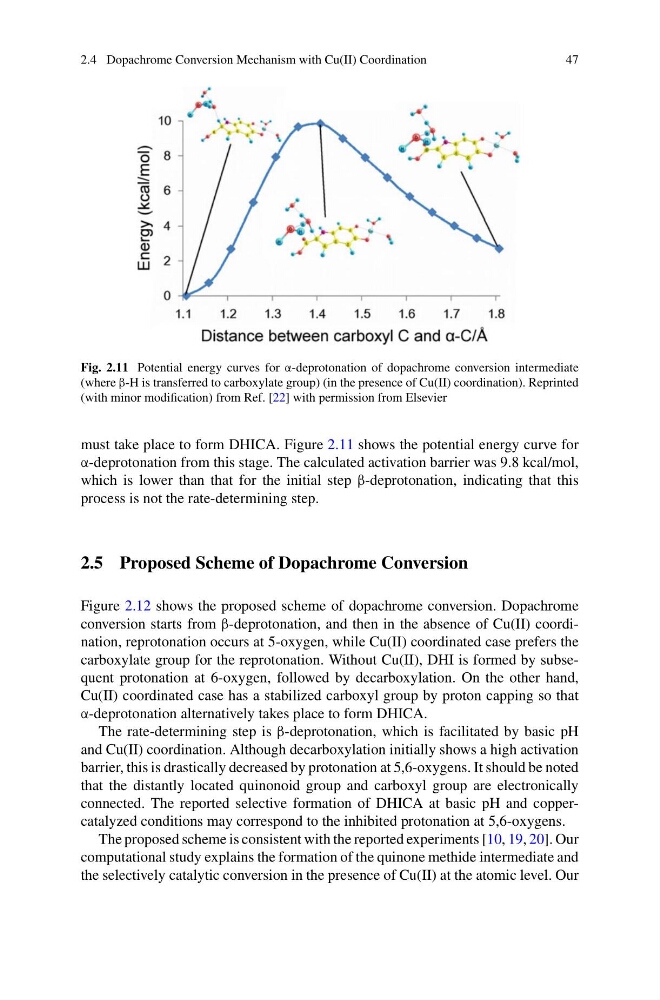
Fig. 2.11 Potential energy curves for α-deprotonation of dopachrome conversion intermediate
(where β-H is transferred to carboxylate group) (in the presence of Cu(II) coordination). Reprinted
(with minor modification) from Ref. [22] with permission from Elsevier
must take place to form DHICA. Figure 2.11 shows the potential energy curve for
α-deprotonation from this stage. The calculated activation barrier was 9.8 kcal/mol,
which is lower than that for the initial step β-deprotonation, indicating that this
process is not the rate-determining step.
2.5 Proposed Scheme of Dopachrome Conversion
Figure 2.12 shows the proposed scheme of dopachrome conversion. Dopachrome
conversion starts from β-deprotonation, and then in the absence of Cu(II) coordination, reprotonation occurs at 5-oxygen, while Cu(II) coordinated case prefers the
carboxylate group for the reprotonation. Without Cu(II), DHI is formed by subsequent protonation at 6-oxygen, followed by decarboxylation. On the other hand,
Cu(II) coordinated case has a stabilized carboxyl group by proton capping so that
α-deprotonation alternatively takes place to form DHICA.
The rate-determining step is β-deprotonation, which is facilitated by basic pH
and Cu(II) coordination. Although decarboxylation initially shows a high activation
barrier, this is drastically decreased by protonation at 5,6-oxygens. It should be noted
that the distantly located quinonoid group and carboxyl group are electronically
connected. The reported selective formation of DHICA at basic pH and coppercatalyzed conditions may correspond to the inhibited protonation at 5,6-oxygens.
The proposed scheme is consistent with the reported experiments [10, 19, 20]. Our
computational study explains the formation of the quinone methide intermediate and
the selectively catalytic conversion in the presence of Cu(II) at the atomic level. Our
47
Fig. 2.11 Potential energy curves for α-deprotonation of dopachrome conversion intermediate
(where β-H is transferred to carboxylate group) (in the presence of Cu(II) coordination). Reprinted
(with minor modification) from Ref. [22] with permission from Elsevier
must take place to form DHICA. Figure 2.11 shows the potential energy curve for
α-deprotonation from this stage. The calculated activation barrier was 9.8 kcal/mol,
which is lower than that for the initial step β-deprotonation, indicating that this
process is not the rate-determining step.
2.5 Proposed Scheme of Dopachrome Conversion
Figure 2.12 shows the proposed scheme of dopachrome conversion. Dopachrome
conversion starts from β-deprotonation, and then in the absence of Cu(II) coordination, reprotonation occurs at 5-oxygen, while Cu(II) coordinated case prefers the
carboxylate group for the reprotonation. Without Cu(II), DHI is formed by subsequent protonation at 6-oxygen, followed by decarboxylation. On the other hand,
Cu(II) coordinated case has a stabilized carboxyl group by proton capping so that
α-deprotonation alternatively takes place to form DHICA.
The rate-determining step is β-deprotonation, which is facilitated by basic pH
and Cu(II) coordination. Although decarboxylation initially shows a high activation
barrier, this is drastically decreased by protonation at 5,6-oxygens. It should be noted
that the distantly located quinonoid group and carboxyl group are electronically
connected. The reported selective formation of DHICA at basic pH and coppercatalyzed conditions may correspond to the inhibited protonation at 5,6-oxygens.
The proposed scheme is consistent with the reported experiments [10, 19, 20]. Our
computational study explains the formation of the quinone methide intermediate and
the selectively catalytic conversion in the presence of Cu(II) at the atomic level. Our