

2.3 Dopachrome Conversion Mechanism Without Cu(II) Coordination
45
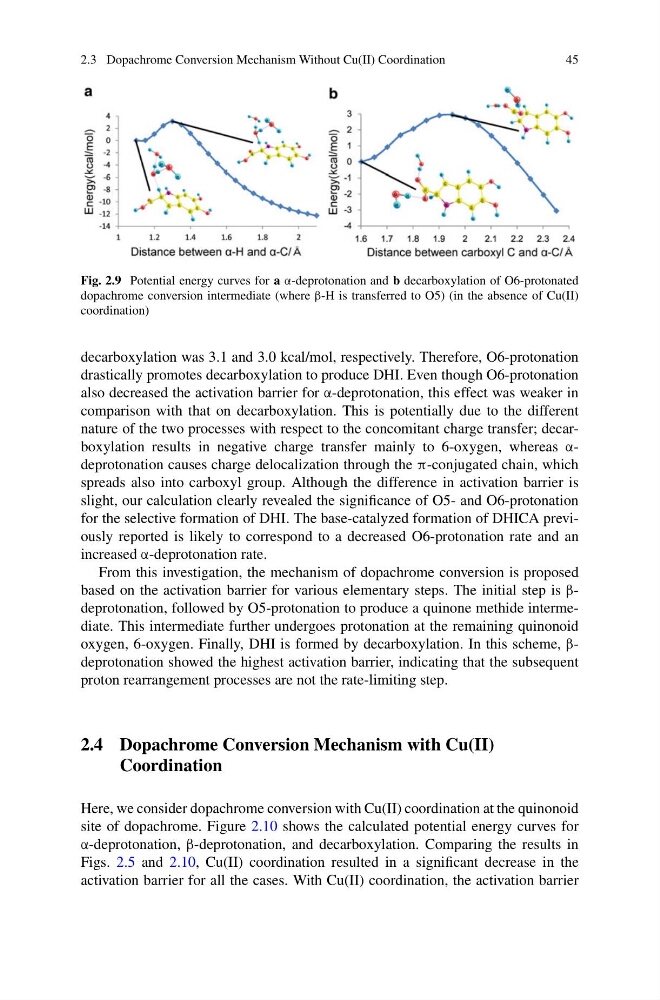
Fig. 2.9 Potential energy curves for a α-deprotonation and b decarboxylation of O6-protonated
dopachrome conversion intermediate (where β-H is transferred to O5) (in the absence of Cu(II)
coordination)
decarboxylation was 3.1 and 3.0 kcal/mol, respectively. Therefore, O6-protonation
drastically promotes decarboxylation to produce DHI. Even though O6-protonation
also decreased the activation barrier for α-deprotonation, this effect was weaker in
comparison with that on decarboxylation. This is potentially due to the different
nature of the two processes with respect to the concomitant charge transfer; decarboxylation results in negative charge transfer mainly to 6-oxygen, whereas αdeprotonation causes charge delocalization through the π-conjugated chain, which
spreads also into carboxyl group. Although the difference in activation barrier is
slight, our calculation clearly revealed the significance of O5- and O6-protonation
for the selective formation of DHI. The base-catalyzed formation of DHICA previously reported is likely to correspond to a decreased O6-protonation rate and an
increased α-deprotonation rate.
From this investigation, the mechanism of dopachrome conversion is proposed
based on the activation barrier for various elementary steps. The initial step is βdeprotonation, followed by O5-protonation to produce a quinone methide intermediate. This intermediate further undergoes protonation at the remaining quinonoid
oxygen, 6-oxygen. Finally, DHI is formed by decarboxylation. In this scheme, βdeprotonation showed the highest activation barrier, indicating that the subsequent
proton rearrangement processes are not the rate-limiting step.
2.4 Dopachrome Conversion Mechanism with Cu(II)
Coordination
Here, we consider dopachrome conversion with Cu(II) coordination at the quinonoid
site of dopachrome. Figure 2.10 shows the calculated potential energy curves for
α-deprotonation, β-deprotonation, and decarboxylation. Comparing the results in
Figs. 2.5 and 2.10, Cu(II) coordination resulted in a significant decrease in the
activation barrier for all the cases. With Cu(II) coordination, the activation barrier
45
Fig. 2.9 Potential energy curves for a α-deprotonation and b decarboxylation of O6-protonated
dopachrome conversion intermediate (where β-H is transferred to O5) (in the absence of Cu(II)
coordination)
decarboxylation was 3.1 and 3.0 kcal/mol, respectively. Therefore, O6-protonation
drastically promotes decarboxylation to produce DHI. Even though O6-protonation
also decreased the activation barrier for α-deprotonation, this effect was weaker in
comparison with that on decarboxylation. This is potentially due to the different
nature of the two processes with respect to the concomitant charge transfer; decarboxylation results in negative charge transfer mainly to 6-oxygen, whereas αdeprotonation causes charge delocalization through the π-conjugated chain, which
spreads also into carboxyl group. Although the difference in activation barrier is
slight, our calculation clearly revealed the significance of O5- and O6-protonation
for the selective formation of DHI. The base-catalyzed formation of DHICA previously reported is likely to correspond to a decreased O6-protonation rate and an
increased α-deprotonation rate.
From this investigation, the mechanism of dopachrome conversion is proposed
based on the activation barrier for various elementary steps. The initial step is βdeprotonation, followed by O5-protonation to produce a quinone methide intermediate. This intermediate further undergoes protonation at the remaining quinonoid
oxygen, 6-oxygen. Finally, DHI is formed by decarboxylation. In this scheme, βdeprotonation showed the highest activation barrier, indicating that the subsequent
proton rearrangement processes are not the rate-limiting step.
2.4 Dopachrome Conversion Mechanism with Cu(II)
Coordination
Here, we consider dopachrome conversion with Cu(II) coordination at the quinonoid
site of dopachrome. Figure 2.10 shows the calculated potential energy curves for
α-deprotonation, β-deprotonation, and decarboxylation. Comparing the results in
Figs. 2.5 and 2.10, Cu(II) coordination resulted in a significant decrease in the
activation barrier for all the cases. With Cu(II) coordination, the activation barrier