

2.3 Dopachrome Conversion Mechanism Without Cu(II) Coordination
43
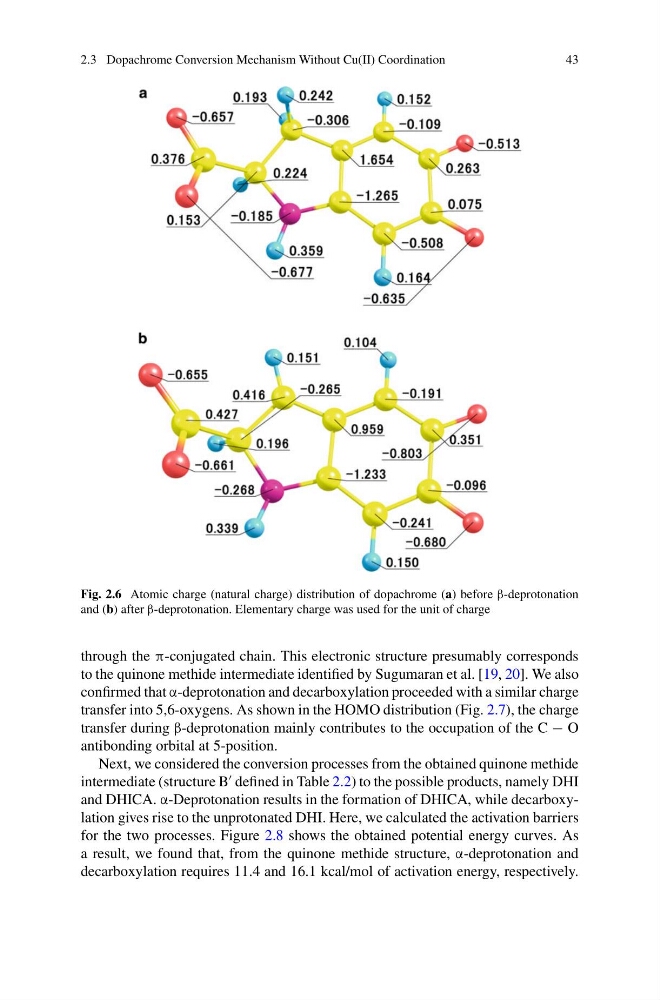
Fig. 2.6 Atomic charge (natural charge) distribution of dopachrome (a) before β-deprotonation
and (b) after β-deprotonation. Elementary charge was used for the unit of charge
through the π-conjugated chain. This electronic structure presumably corresponds
to the quinone methide intermediate identified by Sugumaran et al. [19, 20]. We also
confirmed that α-deprotonation and decarboxylation proceeded with a similar charge
transfer into 5,6-oxygens. As shown in the HOMO distribution (Fig. 2.7), the charge
transfer during β-deprotonation mainly contributes to the occupation of the C − O
antibonding orbital at 5-position.
Next, we considered the conversion processes from the obtained quinone methide
intermediate (structure B
defined in Table 2.2) to the possible products, namely DHI
and DHICA. α-Deprotonation results in the formation of DHICA, while decarboxylation gives rise to the unprotonated DHI. Here, we calculated the activation barriers
for the two processes. Figure 2.8 shows the obtained potential energy curves. As
a result, we found that, from the quinone methide structure, α-deprotonation and
decarboxylation requires 11.4 and 16.1 kcal/mol of activation energy, respectively.
43
Fig. 2.6 Atomic charge (natural charge) distribution of dopachrome (a) before β-deprotonation
and (b) after β-deprotonation. Elementary charge was used for the unit of charge
through the π-conjugated chain. This electronic structure presumably corresponds
to the quinone methide intermediate identified by Sugumaran et al. [19, 20]. We also
confirmed that α-deprotonation and decarboxylation proceeded with a similar charge
transfer into 5,6-oxygens. As shown in the HOMO distribution (Fig. 2.7), the charge
transfer during β-deprotonation mainly contributes to the occupation of the C − O
antibonding orbital at 5-position.
Next, we considered the conversion processes from the obtained quinone methide
intermediate (structure B
defined in Table 2.2) to the possible products, namely DHI
and DHICA. α-Deprotonation results in the formation of DHICA, while decarboxylation gives rise to the unprotonated DHI. Here, we calculated the activation barriers
for the two processes. Figure 2.8 shows the obtained potential energy curves. As
a result, we found that, from the quinone methide structure, α-deprotonation and
decarboxylation requires 11.4 and 16.1 kcal/mol of activation energy, respectively.