

1.3 Biosynthesis of Eumelanin—Formation of Dopaquinone and Dopachrome
7
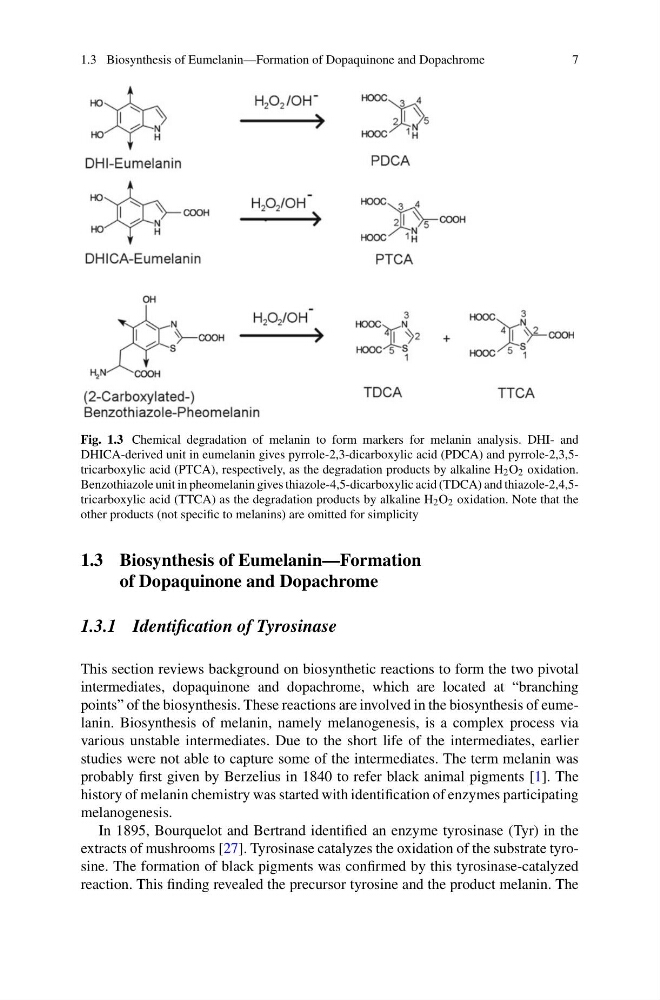
Fig. 1.3 Chemical degradation of melanin to form markers for melanin analysis. DHI- and
DHICA-derived unit in eumelanin gives pyrrole-2,3-dicarboxylic acid (PDCA) and pyrrole-2,3,5tricarboxylic acid (PTCA), respectively, as the degradation products by alkaline H 2 O 2 oxidation.
Benzothiazole unit in pheomelanin gives thiazole-4,5-dicarboxylic acid (TDCA) and thiazole-2,4,5tricarboxylic acid (TTCA) as the degradation products by alkaline H 2 O 2 oxidation. Note that the
other products (not specific to melanins) are omitted for simplicity
1.3 Biosynthesis of Eumelanin—Formation
of Dopaquinone and Dopachrome
1.3.1 Identification of Tyrosinase
This section reviews background on biosynthetic reactions to form the two pivotal
intermediates, dopaquinone and dopachrome, which are located at “branching
points” of the biosynthesis. These reactions are involved in the biosynthesis of eumelanin. Biosynthesis of melanin, namely melanogenesis, is a complex process via
various unstable intermediates. Due to the short life of the intermediates, earlier
studies were not able to capture some of the intermediates. The term melanin was
probably first given by Berzelius in 1840 to refer black animal pigments [1]. The
history of melanin chemistry was started with identification of enzymes participating
melanogenesis.
In 1895, Bourquelot and Bertrand identified an enzyme tyrosinase (Tyr) in the
extracts of mushrooms [27]. Tyrosinase catalyzes the oxidation of the substrate tyrosine. The formation of black pigments was confirmed by this tyrosinase-catalyzed
reaction. This finding revealed the precursor tyrosine and the product melanin. The
7
Fig. 1.3 Chemical degradation of melanin to form markers for melanin analysis. DHI- and
DHICA-derived unit in eumelanin gives pyrrole-2,3-dicarboxylic acid (PDCA) and pyrrole-2,3,5tricarboxylic acid (PTCA), respectively, as the degradation products by alkaline H 2 O 2 oxidation.
Benzothiazole unit in pheomelanin gives thiazole-4,5-dicarboxylic acid (TDCA) and thiazole-2,4,5tricarboxylic acid (TTCA) as the degradation products by alkaline H 2 O 2 oxidation. Note that the
other products (not specific to melanins) are omitted for simplicity
1.3 Biosynthesis of Eumelanin—Formation
of Dopaquinone and Dopachrome
1.3.1 Identification of Tyrosinase
This section reviews background on biosynthetic reactions to form the two pivotal
intermediates, dopaquinone and dopachrome, which are located at “branching
points” of the biosynthesis. These reactions are involved in the biosynthesis of eumelanin. Biosynthesis of melanin, namely melanogenesis, is a complex process via
various unstable intermediates. Due to the short life of the intermediates, earlier
studies were not able to capture some of the intermediates. The term melanin was
probably first given by Berzelius in 1840 to refer black animal pigments [1]. The
history of melanin chemistry was started with identification of enzymes participating
melanogenesis.
In 1895, Bourquelot and Bertrand identified an enzyme tyrosinase (Tyr) in the
extracts of mushrooms [27]. Tyrosinase catalyzes the oxidation of the substrate tyrosine. The formation of black pigments was confirmed by this tyrosinase-catalyzed
reaction. This finding revealed the precursor tyrosine and the product melanin. The