

1.2 Analysis Techniques for Melanin Chemistry
5
1.2 Analysis Techniques for Melanin Chemistry
The study on melanin has the very long history from the latter 19th century to the
present. In the earlier phase of study, it was not trivial how melanin should be defined.
The chemical structure and the composition of melanin depend on the synthetic condition. It is also difficult to completely analyze the chemical structure and the composition of melanin from conventional techniques [23]. The difficulty in analyzing
melanin samples lies in the strong carbon–carbon covalent bonds, which connect
the constituent monomer to each other, making the separation into monomers by
physicochemical technique such as the chromatography almost impossible. Besides,
the interpretation of the structure is difficult because such bondings could form not
only in a direction creating linear structures but also the branching structures. In
contrast, more loosely bonded linear structures are commonly found in many natural
macromolecules, such as the glycosidic bonds in saccharides, the peptide bonds in
proteins, and the phosphodiester bonds in nucleic acids. Furthermore, melanin is
poorly soluble in most of solvents, making its analysis much more difficult.
Up-to-date, there is a huge amount of science literatures with a term “melanin” as
a keyword. Thus, the interpretation of these must take the origin of the used melanin
into consideration; melanin depends on, the species if taken from a living tissue, the
synthetic methods if chemically synthesized in lab, and the passage or the culture
condition if formed in cultured cells, for instance. Therefore, it is advisable to learn
what is accessible by analysis techniques for melanin samples as a first step. This
section reviews widely used analysis methods in melanin chemistry.
The great effort on clarifying melanin biosynthesis revealed the building
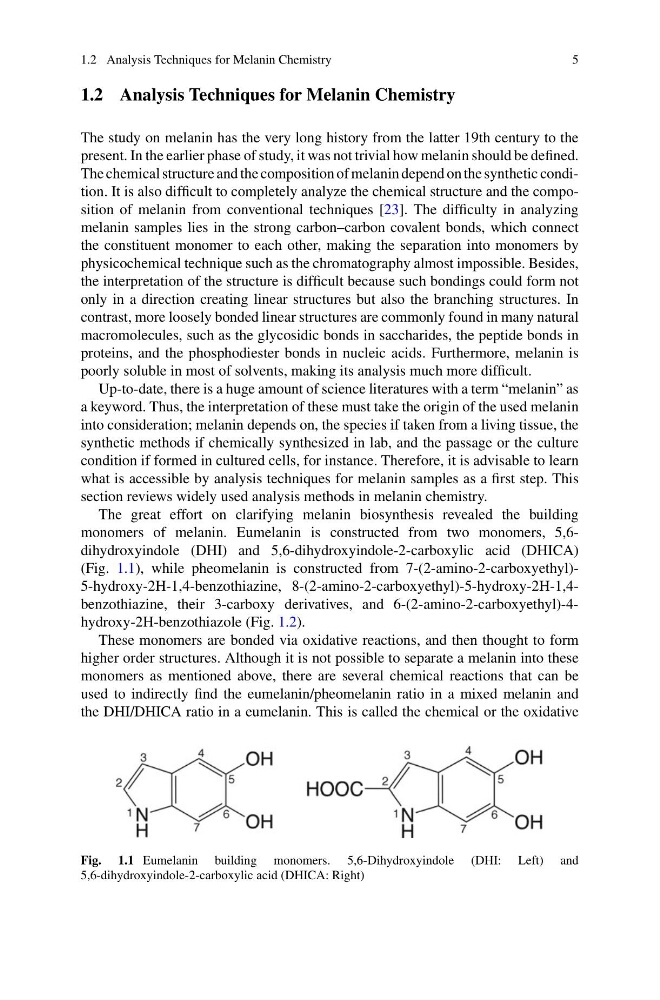
monomers of melanin. Eumelanin is constructed from two monomers, 5,6dihydroxyindole (DHI) and 5,6-dihydroxyindole-2-carboxylic acid (DHICA)
(Fig. 1.1), while pheomelanin is constructed from 7-(2-amino-2-carboxyethyl)5-hydroxy-2H-1,4-benzothiazine, 8-(2-amino-2-carboxyethyl)-5-hydroxy-2H-1,4benzothiazine, their 3-carboxy derivatives, and 6-(2-amino-2-carboxyethyl)-4hydroxy-2H-benzothiazole (Fig. 1.2).
These monomers are bonded via oxidative reactions, and then thought to form
higher order structures. Although it is not possible to separate a melanin into these
monomers as mentioned above, there are several chemical reactions that can be
used to indirectly find the eumelanin/pheomelanin ratio in a mixed melanin and
the DHI/DHICA ratio in a eumelanin. This is called the chemical or the oxidative
Fig. 1.1 Eumelanin building monomers. 5,6-Dihydroxyindole (DHI: Left) and
5,6-dihydroxyindole-2-carboxylic acid (DHICA: Right)
5
1.2 Analysis Techniques for Melanin Chemistry
The study on melanin has the very long history from the latter 19th century to the
present. In the earlier phase of study, it was not trivial how melanin should be defined.
The chemical structure and the composition of melanin depend on the synthetic condition. It is also difficult to completely analyze the chemical structure and the composition of melanin from conventional techniques [23]. The difficulty in analyzing
melanin samples lies in the strong carbon–carbon covalent bonds, which connect
the constituent monomer to each other, making the separation into monomers by
physicochemical technique such as the chromatography almost impossible. Besides,
the interpretation of the structure is difficult because such bondings could form not
only in a direction creating linear structures but also the branching structures. In
contrast, more loosely bonded linear structures are commonly found in many natural
macromolecules, such as the glycosidic bonds in saccharides, the peptide bonds in
proteins, and the phosphodiester bonds in nucleic acids. Furthermore, melanin is
poorly soluble in most of solvents, making its analysis much more difficult.
Up-to-date, there is a huge amount of science literatures with a term “melanin” as
a keyword. Thus, the interpretation of these must take the origin of the used melanin
into consideration; melanin depends on, the species if taken from a living tissue, the
synthetic methods if chemically synthesized in lab, and the passage or the culture
condition if formed in cultured cells, for instance. Therefore, it is advisable to learn
what is accessible by analysis techniques for melanin samples as a first step. This
section reviews widely used analysis methods in melanin chemistry.
The great effort on clarifying melanin biosynthesis revealed the building
monomers of melanin. Eumelanin is constructed from two monomers, 5,6dihydroxyindole (DHI) and 5,6-dihydroxyindole-2-carboxylic acid (DHICA)
(Fig. 1.1), while pheomelanin is constructed from 7-(2-amino-2-carboxyethyl)5-hydroxy-2H-1,4-benzothiazine, 8-(2-amino-2-carboxyethyl)-5-hydroxy-2H-1,4benzothiazine, their 3-carboxy derivatives, and 6-(2-amino-2-carboxyethyl)-4hydroxy-2H-benzothiazole (Fig. 1.2).
These monomers are bonded via oxidative reactions, and then thought to form
higher order structures. Although it is not possible to separate a melanin into these
monomers as mentioned above, there are several chemical reactions that can be
used to indirectly find the eumelanin/pheomelanin ratio in a mixed melanin and
the DHI/DHICA ratio in a eumelanin. This is called the chemical or the oxidative
Fig. 1.1 Eumelanin building monomers. 5,6-Dihydroxyindole (DHI: Left) and
5,6-dihydroxyindole-2-carboxylic acid (DHICA: Right)