

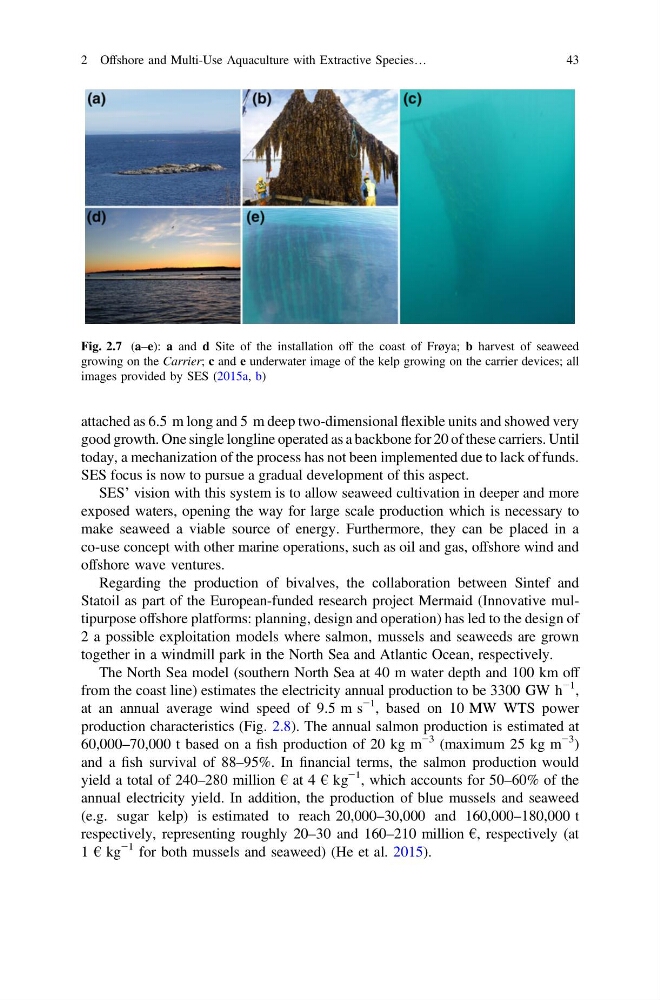
attached as 6.5 m long and 5 m deep two-dimensional flexible units and showed very
good growth. One single longline operated as a backbone for 20 of these carriers. Until
today, a mechanization of the process has not been implemented due to lack of funds.
SES focus is now to pursue a gradual development of this aspect.
SES’ vision with this system is to allow seaweed cultivation in deeper and more
exposed waters, opening the way for large scale production which is necessary to
make seaweed a viable source of energy. Furthermore, they can be placed in a
co-use concept with other marine operations, such as oil and gas, offshore wind and
offshore wave ventures.
Regarding the production of bivalves, the collaboration between Sintef and
Statoil as part of the European-funded research project Mermaid (Innovative multipurpose offshore platforms: planning, design and operation) has led to the design of
2 a possible exploitation models where salmon, mussels and seaweeds are grown
together in a windmill park in the North Sea and Atlantic Ocean, respectively.
The North Sea model (southern North Sea at 40 m water depth and 100 km off
from the coast line) estimates the electricity annual production to be 3300 GW h
−1 ,
at an annual average wind speed of 9.5 m s
−1 , based on 10 MW WTS power
production characteristics (Fig. 2.8). The annual salmon production is estimated at
60,000–70,000 t based on a fish production of 20 kg m
−3 (maximum 25 kg m
−3 )
and a fish survival of 88–95%. In financial terms, the salmon production would
yield a total of 240–280 million € at 4 € kg
−1 , which accounts for 50–60% of the
annual electricity yield. In addition, the production of blue mussels and seaweed
(e.g. sugar kelp) is estimated to reach 20,000–30,000 and 160,000–180,000 t
respectively, representing roughly 20–30 and 160–210 million €, respectively (at
1 € kg
−1 for both mussels and seaweed) (He et al. 2015).
Fig. 2.7 (a–e): a and d Site of the installation off the coast of Frøya; b harvest of seaweed
growing on the Carrier; c and e underwater image of the kelp growing on the carrier devices; all
images provided by SES (2015a, b)
2 Offshore and Multi-Use Aquaculture with Extractive Species…
43
good growth. One single longline operated as a backbone for 20 of these carriers. Until
today, a mechanization of the process has not been implemented due to lack of funds.
SES focus is now to pursue a gradual development of this aspect.
SES’ vision with this system is to allow seaweed cultivation in deeper and more
exposed waters, opening the way for large scale production which is necessary to
make seaweed a viable source of energy. Furthermore, they can be placed in a
co-use concept with other marine operations, such as oil and gas, offshore wind and
offshore wave ventures.
Regarding the production of bivalves, the collaboration between Sintef and
Statoil as part of the European-funded research project Mermaid (Innovative multipurpose offshore platforms: planning, design and operation) has led to the design of
2 a possible exploitation models where salmon, mussels and seaweeds are grown
together in a windmill park in the North Sea and Atlantic Ocean, respectively.
The North Sea model (southern North Sea at 40 m water depth and 100 km off
from the coast line) estimates the electricity annual production to be 3300 GW h
−1 ,
at an annual average wind speed of 9.5 m s
−1 , based on 10 MW WTS power
production characteristics (Fig. 2.8). The annual salmon production is estimated at
60,000–70,000 t based on a fish production of 20 kg m
−3 (maximum 25 kg m
−3 )
and a fish survival of 88–95%. In financial terms, the salmon production would
yield a total of 240–280 million € at 4 € kg
−1 , which accounts for 50–60% of the
annual electricity yield. In addition, the production of blue mussels and seaweed
(e.g. sugar kelp) is estimated to reach 20,000–30,000 and 160,000–180,000 t
respectively, representing roughly 20–30 and 160–210 million €, respectively (at
1 € kg
−1 for both mussels and seaweed) (He et al. 2015).
Fig. 2.7 (a–e): a and d Site of the installation off the coast of Frøya; b harvest of seaweed
growing on the Carrier; c and e underwater image of the kelp growing on the carrier devices; all
images provided by SES (2015a, b)
2 Offshore and Multi-Use Aquaculture with Extractive Species…
43