

Between 2005 and 2010, another subsidized project started independently in the
Belgian North Sea and was carried out by Stichting voor Duurzame
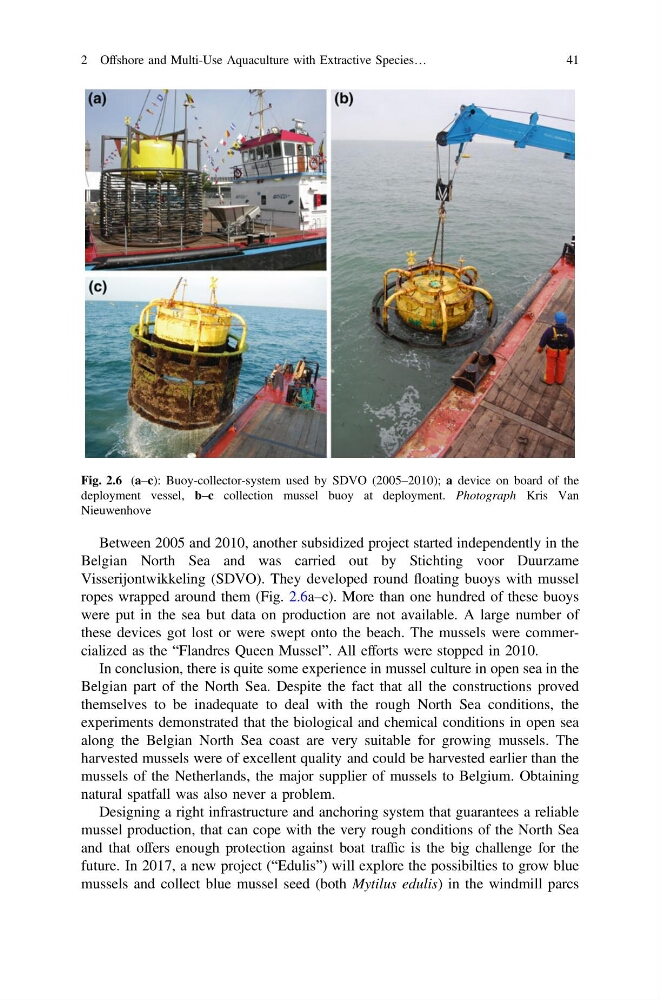
Visserijontwikkeling (SDVO). They developed round floating buoys with mussel
ropes wrapped around them (Fig. 2.6a–c). More than one hundred of these buoys
were put in the sea but data on production are not available. A large number of
these devices got lost or were swept onto the beach. The mussels were commercialized as the “Flandres Queen Mussel”. All efforts were stopped in 2010.
In conclusion, there is quite some experience in mussel culture in open sea in the
Belgian part of the North Sea. Despite the fact that all the constructions proved
themselves to be inadequate to deal with the rough North Sea conditions, the
experiments demonstrated that the biological and chemical conditions in open sea
along the Belgian North Sea coast are very suitable for growing mussels. The
harvested mussels were of excellent quality and could be harvested earlier than the
mussels of the Netherlands, the major supplier of mussels to Belgium. Obtaining
natural spatfall was also never a problem.
Designing a right infrastructure and anchoring system that guarantees a reliable
mussel production, that can cope with the very rough conditions of the North Sea
and that offers enough protection against boat traffic is the big challenge for the
future. In 2017, a new project (“Edulis”) will explore the possibilties to grow blue
mussels and collect blue mussel seed (both Mytilus edulis) in the windmill parcs
Fig. 2.6 (a–c): Buoy-collector-system used by SDVO (2005–2010); a device on board of the
deployment vessel, b–c collection mussel buoy at deployment. Photograph Kris Van
Nieuwenhove
2 Offshore and Multi-Use Aquaculture with Extractive Species…
41
Belgian North Sea and was carried out by Stichting voor Duurzame
Visserijontwikkeling (SDVO). They developed round floating buoys with mussel
ropes wrapped around them (Fig. 2.6a–c). More than one hundred of these buoys
were put in the sea but data on production are not available. A large number of
these devices got lost or were swept onto the beach. The mussels were commercialized as the “Flandres Queen Mussel”. All efforts were stopped in 2010.
In conclusion, there is quite some experience in mussel culture in open sea in the
Belgian part of the North Sea. Despite the fact that all the constructions proved
themselves to be inadequate to deal with the rough North Sea conditions, the
experiments demonstrated that the biological and chemical conditions in open sea
along the Belgian North Sea coast are very suitable for growing mussels. The
harvested mussels were of excellent quality and could be harvested earlier than the
mussels of the Netherlands, the major supplier of mussels to Belgium. Obtaining
natural spatfall was also never a problem.
Designing a right infrastructure and anchoring system that guarantees a reliable
mussel production, that can cope with the very rough conditions of the North Sea
and that offers enough protection against boat traffic is the big challenge for the
future. In 2017, a new project (“Edulis”) will explore the possibilties to grow blue
mussels and collect blue mussel seed (both Mytilus edulis) in the windmill parcs
Fig. 2.6 (a–c): Buoy-collector-system used by SDVO (2005–2010); a device on board of the
deployment vessel, b–c collection mussel buoy at deployment. Photograph Kris Van
Nieuwenhove
2 Offshore and Multi-Use Aquaculture with Extractive Species…
41