

from Ilvo. He developed a floating cage that contained several frames with mussel
ropes that could slide in and out of the cage. Results have not been communicated.
This system was further improved in 2009 by Reynaert and Versluys. It became a
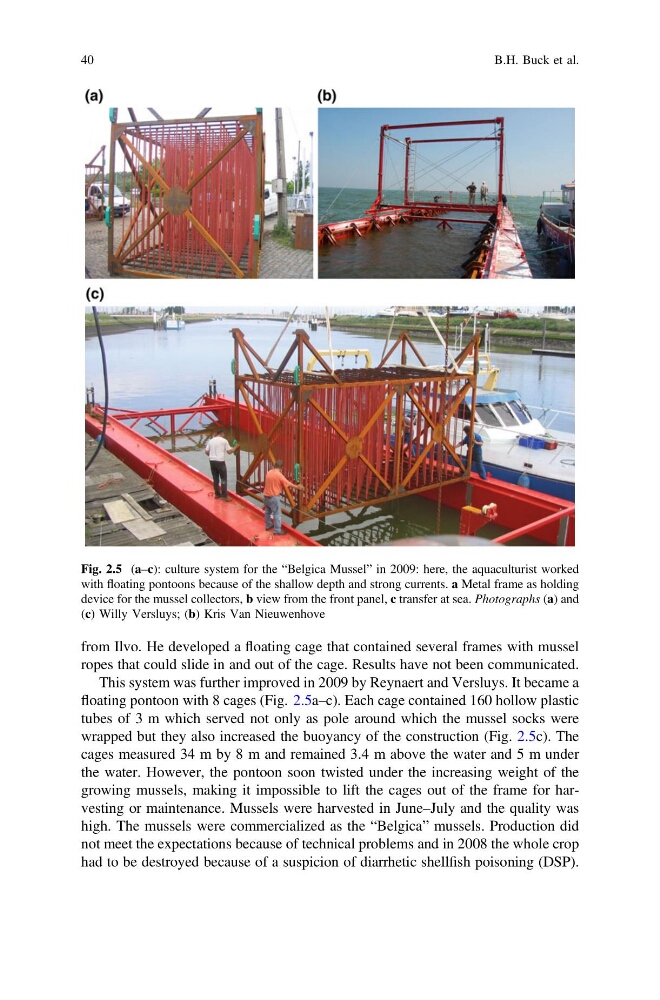
floating pontoon with 8 cages (Fig. 2.5a–c). Each cage contained 160 hollow plastic
tubes of 3 m which served not only as pole around which the mussel socks were
wrapped but they also increased the buoyancy of the construction (Fig. 2.5c). The
cages measured 34 m by 8 m and remained 3.4 m above the water and 5 m under
the water. However, the pontoon soon twisted under the increasing weight of the
growing mussels, making it impossible to lift the cages out of the frame for harvesting or maintenance. Mussels were harvested in June–July and the quality was
high. The mussels were commercialized as the “Belgica” mussels. Production did
not meet the expectations because of technical problems and in 2008 the whole crop
had to be destroyed because of a suspicion of diarrhetic shellfish poisoning (DSP).
Fig. 2.5 (a–c): culture system for the “Belgica Mussel” in 2009: here, the aquaculturist worked
with floating pontoons because of the shallow depth and strong currents. a Metal frame as holding
device for the mussel collectors, b view from the front panel, c transfer at sea. Photographs (a) and
(c) Willy Versluys; (b) Kris Van Nieuwenhove
40
B.H. Buck et al.
ropes that could slide in and out of the cage. Results have not been communicated.
This system was further improved in 2009 by Reynaert and Versluys. It became a
floating pontoon with 8 cages (Fig. 2.5a–c). Each cage contained 160 hollow plastic
tubes of 3 m which served not only as pole around which the mussel socks were
wrapped but they also increased the buoyancy of the construction (Fig. 2.5c). The
cages measured 34 m by 8 m and remained 3.4 m above the water and 5 m under
the water. However, the pontoon soon twisted under the increasing weight of the
growing mussels, making it impossible to lift the cages out of the frame for harvesting or maintenance. Mussels were harvested in June–July and the quality was
high. The mussels were commercialized as the “Belgica” mussels. Production did
not meet the expectations because of technical problems and in 2008 the whole crop
had to be destroyed because of a suspicion of diarrhetic shellfish poisoning (DSP).
Fig. 2.5 (a–c): culture system for the “Belgica Mussel” in 2009: here, the aquaculturist worked
with floating pontoons because of the shallow depth and strong currents. a Metal frame as holding
device for the mussel collectors, b view from the front panel, c transfer at sea. Photographs (a) and
(c) Willy Versluys; (b) Kris Van Nieuwenhove
40
B.H. Buck et al.