

13.2 The Gulf of Mexico
Location is arguably the most important factor for any offshore cage culture project.
Siting will dictate the expected sea conditions, type of cage system utilized, water
parameters, and all transportation and logistical planning. These factors, among
others, will ultimately determine the success or failure of a project. The GoM is
characterized by short period wind driven waves for much of the year combined
with tremendously powerful episodic tropical events during the June–November
hurricane season. Offshore platforms, while engineered to withstand tremendous
forces for decades, can be damaged or destroyed during hurricanes and tropical
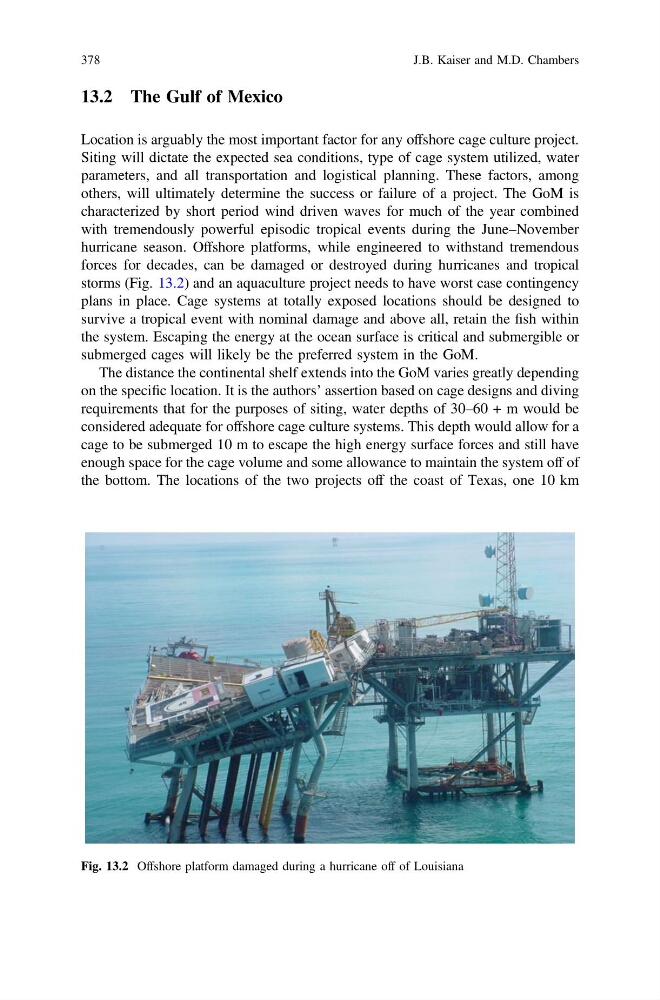
storms (Fig. 13.2) and an aquaculture project needs to have worst case contingency
plans in place. Cage systems at totally exposed locations should be designed to
survive a tropical event with nominal damage and above all, retain the fish within
the system. Escaping the energy at the ocean surface is critical and submergible or
submerged cages will likely be the preferred system in the GoM.
The distance the continental shelf extends into the GoM varies greatly depending
on the specific location. It is the authors’ assertion based on cage designs and diving
requirements that for the purposes of siting, water depths of 30–60 + m would be
considered adequate for offshore cage culture systems. This depth would allow for a
cage to be submerged 10 m to escape the high energy surface forces and still have
enough space for the cage volume and some allowance to maintain the system off of
the bottom. The locations of the two projects off the coast of Texas, one 10 km
Fig. 13.2 Offshore platform damaged during a hurricane off of Louisiana
378
J.B. Kaiser and M.D. Chambers
Location is arguably the most important factor for any offshore cage culture project.
Siting will dictate the expected sea conditions, type of cage system utilized, water
parameters, and all transportation and logistical planning. These factors, among
others, will ultimately determine the success or failure of a project. The GoM is
characterized by short period wind driven waves for much of the year combined
with tremendously powerful episodic tropical events during the June–November
hurricane season. Offshore platforms, while engineered to withstand tremendous
forces for decades, can be damaged or destroyed during hurricanes and tropical
storms (Fig. 13.2) and an aquaculture project needs to have worst case contingency
plans in place. Cage systems at totally exposed locations should be designed to
survive a tropical event with nominal damage and above all, retain the fish within
the system. Escaping the energy at the ocean surface is critical and submergible or
submerged cages will likely be the preferred system in the GoM.
The distance the continental shelf extends into the GoM varies greatly depending
on the specific location. It is the authors’ assertion based on cage designs and diving
requirements that for the purposes of siting, water depths of 30–60 + m would be
considered adequate for offshore cage culture systems. This depth would allow for a
cage to be submerged 10 m to escape the high energy surface forces and still have
enough space for the cage volume and some allowance to maintain the system off of
the bottom. The locations of the two projects off the coast of Texas, one 10 km
Fig. 13.2 Offshore platform damaged during a hurricane off of Louisiana
378
J.B. Kaiser and M.D. Chambers